Why 2030 Is a Real Inflection Point for Robotics
Robotics has spent years trapped between headline-grabbing demos and frustratingly slow commercial adoption. That gap is narrowing. By 2030, the companies that matter most will not simply be those with the most impressive machines, but those that can turn robots into dependable products: easy to deploy, cheap enough to scale, and useful enough to survive contact with messy real-world operations.
This is why the next wave of robotics winners will likely come from a blend of familiar industrial players, logistics automation specialists, and a smaller set of AI-native entrants trying to make robots more general-purpose. The market is no longer just about arm geometry or sensor stacks. It is about full systems: hardware, software, fleet management, uptime, service, and integration into labor-constrained workflows.
That matters because the addressable market is expanding in a very practical way. Warehouses need throughput. Factories need resilience. Hospitals need handling and delivery. Retail, construction, agriculture, and elder care all face labor shortages and operating-cost pressure. Robotics is becoming less of a moonshot and more of a default capital expenditure category. The companies best positioned for 2030 understand that shift.
The New Robotics Playbook: Reliability First, Autonomy Second
The public imagination often jumps straight to humanoids. In practice, the most valuable robotics businesses over the next five years will likely win by solving narrower problems extremely well. The reason is simple: a robot that reliably stacks pallets, moves totes, inspects welds, or sorts parcels can generate a faster return on investment than a general-purpose machine that looks futuristic but still struggles with edge cases.
That does not mean autonomy is secondary. It means autonomy must be commercially bounded. The winning model is a robot that can operate in constrained environments, recover from error, and improve with software updates without requiring a full redesign of the machine. The companies that master this stack will have an advantage over rivals that treat robots as one-off hardware products.
For investors, operators, and supply-chain planners, this distinction is critical. The companies to watch are not just the ones with the most advanced perception models; they are the ones with the best deployment economics, service networks, and manufacturing capacity.
ABB, FANUC, and Yaskawa: The Industrial Base Still Matters
When people talk about robotics, they often overlook the incumbents that already run factories around the world. ABB, FANUC, and Yaskawa remain central to the robotics story because they have something many startups still lack: decades of field data, global service infrastructure, and deep trust with manufacturers who cannot afford downtime.
These companies matter in 2030 because industrial robotics is moving from isolated automation toward more adaptive cells. Vision systems, better motion planning, and software-defined controls are making traditional robotic arms more flexible than they were a generation ago. That allows incumbents to sell not just metal and motors, but increasingly intelligent manufacturing systems.
Their challenge is strategic, not existential. They must modernize fast enough to integrate AI-driven perception, more modular software, and easier deployment tools while defending their core position in automotive, electronics, and general manufacturing. If they succeed, they will not just remain relevant; they will define the baseline for industrial automation at scale.
Amazon and the Logistics Robotics Model
Amazon is not a robotics company in the classic sense, but it is one of the most important robotics operators on the planet. Its fulfillment network has become a living laboratory for large-scale warehouse automation, where robots must work alongside people, conveyors, vision systems, and software orchestration layers that manage speed and error handling in real time.
Why does Amazon matter for 2030? Because logistics is where robotics proves its economics. The warehouse is the ideal proving ground: structured enough for automation, chaotic enough to require robust systems, and expensive enough that labor savings and throughput improvements can materially change margins. Amazon’s internal demand also creates a feedback loop that startups rarely enjoy: deploy, measure, iterate, expand.
What the market should watch is whether Amazon’s approach becomes a template for others. If robotics can be deployed as an integrated operations layer rather than a standalone machine purchase, that changes the entire sales model for the industry. It favors vendors that can sell outcomes, not just equipment.
Boston Dynamics: The Benchmark for Mobility
Boston Dynamics occupies a different role in the ecosystem. It is not the largest commercial robot maker, but it remains the most visible benchmark for mobility, balance, and manipulation in unstructured environments. Its machines are a reminder that robots are not only about repetitive industrial tasks; they can also move through spaces that are too irregular, too dynamic, or too dangerous for conventional automation.
The company matters because it sits at the intersection of engineering prestige and practical experimentation. Its systems help define what is physically possible, even when the commercial path is still forming. That influence extends beyond the company itself: competitors, customers, and researchers all calibrate their expectations against Boston Dynamics’ capabilities.
By 2030, the real question is whether that technical leadership translates into repeatable, revenue-generating deployments in inspection, security, logistics, or industrial support. If it does, Boston Dynamics could become one of the clearest examples of how advanced mobility turns into a business, not just a demo.
Figure, Agility, and the Humanoid Bet
The humanoid segment attracts outsized attention because it promises compatibility with a world built for human bodies. That is a powerful idea, but it is also an unforgiving business test. Humanoids need to do more than walk. They must manipulate objects, sustain long duty cycles, integrate with operational software, and do all of that at a cost that makes sense versus specialized machines or human labor.
Figure and Agility are among the companies trying to make that bet credible. Their relevance is not simply that they build humanoids; it is that they are trying to productize them for real work environments. The companies that survive this category will likely be the ones that narrow the first use cases aggressively, automate deployment, and make software the main source of performance improvement.
Humanoids are likely to be overhyped in the short run and underestimated in the long run. By 2030, they may not be ubiquitous, but a few companies could establish themselves as the standard-setters for general-purpose task robots in industrial and logistics settings. That would be enough to reshape the market.
Temi, Ubtech, and the Consumer-to-Commercial Bridge
Not every robotics company is aimed at heavy industry. Some of the most interesting competition comes from businesses trying to bridge consumer familiarity and commercial utility. Temi and Ubtech illustrate two different versions of that play: service-oriented robots that can navigate environments, interact with people, and provide a blend of mobility and human-facing functionality.
This category matters because adoption often depends on interface, not just intelligence. A robot that can communicate clearly, avoid confusion, and fit into customer-facing spaces can unlock use cases in hospitality, retail, healthcare, and public services. In these environments, reliability and social acceptability can matter as much as raw autonomy.
These companies also highlight a broader strategic truth: robotics does not always win by replacing labor head-on. Sometimes it wins by augmenting service staff, reducing repetitive movement, or providing a visible layer of automation that changes how a business feels to operate. That can be enough to justify deployment.
What to Watch: The Real Competitive Differentiators
By 2030, the robotics companies that matter most will be separated by a handful of operational realities.
- Deployment speed: Can the robot be installed, trained, and integrated without months of custom engineering?
- Uptime and service: Does the vendor have the support network to keep machines operating in the field?
- Software leverage: Can performance improve through updates, fleet learning, and data feedback loops?
- Manufacturing scale: Can the company build enough units with consistent quality and cost control?
- Clear ROI: Does the robot pay for itself in labor, throughput, safety, or accuracy?
These factors are why some well-known startups will fade while quieter operators with stronger execution become category leaders. Robotics is unforgiving. A beautiful prototype is easy to admire; a profitable fleet is much harder to build.
The Bottom Line

The robotics companies to watch in 2030 are not necessarily the ones making the loudest claims today. They are the ones building operationally useful systems for environments that can support scale. Industrial giants like ABB, FANUC, and Yaskawa still anchor the market. Amazon shows what large-scale deployment looks like. Boston Dynamics sets the mobility benchmark. Figure and Agility test the humanoid frontier. Temi and Ubtech point toward service robotics with a more human interface.
The common thread is not novelty. It is execution. In robotics, the winners will be those that turn physical complexity into repeatable operations. That is a hard business, but it is finally becoming a big one.
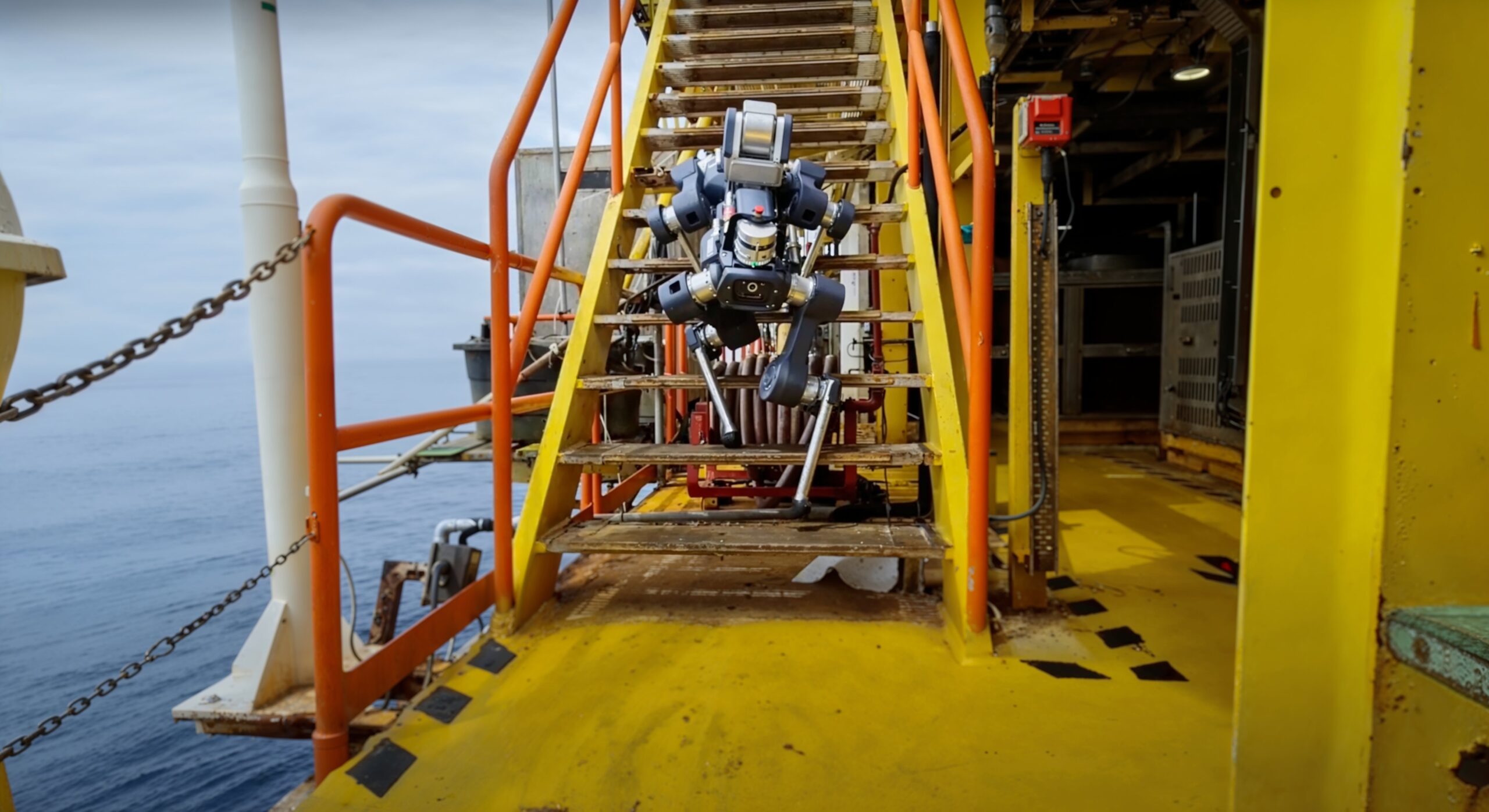
Image: AnymalX-robot-inspection-offshore.jpg | Own work | License: CC BY-SA 4.0 | Source: Wikimedia | https://commons.wikimedia.org/wiki/File:AnymalX-robot-inspection-offshore.jpg