Why robotics is entering a different phase
Robotics has spent decades as a field of promise with pockets of real commercial success. Industrial arms transformed automotive manufacturing. Warehouse automation changed fulfillment. Surgical robots found a durable niche. But the industry is now moving into a more competitive phase, driven by better sensors, stronger edge compute, cheaper motors, and AI systems that can generalize beyond one highly controlled task.
That shift matters because the robotics market is no longer just about whether a machine can move. It is about whether it can perceive uncertain environments, make safe decisions quickly, tolerate wear and variation, and deliver a return on investment in operations where labor is expensive or unreliable. The companies most likely to matter in 2030 are the ones that can close the gap between a polished demo and repeatable deployment.
That makes this a story about technical distinction and operating discipline. Some companies have the best autonomy stack. Others have the most practical product fit. A few have supply chain, manufacturing, or distribution advantages that are just as important as the robot itself.
What separates a serious robotics company from a good prototype
In 2030, the winners will not simply be the firms with the largest language model or the most eye-catching humanoid. Robotics is a systems business. It depends on sensing, planning, actuation, safety, power management, and field service, all integrated into hardware that must run for long periods in non-laboratory conditions.
The core technical constraints remain stubborn:
- Perception under uncertainty: cameras, lidar, force sensors, and tactile systems must work in changing light, clutter, dust, and motion.
- Dexterity and control: many valuable tasks still require precise manipulation, not just locomotion.
- Edge inference and latency: robots often need low-latency decisions without depending entirely on remote cloud systems.
- Safety and certification: industrial deployments must satisfy strict operational and insurance requirements.
- Unit economics: the machine has to justify its purchase, maintenance, and downtime costs against human labor or existing automation.
That is why some of the most interesting companies are not the ones that talk the loudest about general-purpose robotics. They are the ones solving a narrow but economically painful problem with enough technical depth to scale.
Boston Dynamics: still the reference point for mobility
Boston Dynamics remains one of the most strategically important robotics companies because it has long been the benchmark for dynamic motion. Its machines have shown what happens when control systems, mechanical design, and sensing are pushed hard enough to produce movement that looks almost biological. That matters because locomotion is not a solved problem; it is simply easier to impress with than to monetize.
The company’s real significance is not that it makes robots that can jump or dance. It is that it has accumulated a deep systems understanding of balance, motion planning, and hardware reliability. In a future where robots need to move through warehouses, factories, and mixed human environments, that expertise translates into a major advantage.
Boston Dynamics also matters because it sits at the intersection of research credibility and industrial deployment pressure. The company has moved from being a pure spectacle machine to one that must prove commercial value. That transition is exactly what determines whether mobility research becomes a category or remains an engineering showcase.
ABB, Fanuc, and KUKA: the incumbents that still set the pace
When people talk about robotics as if it is a brand-new industry, they often miss the installed base that already dominates factory automation. ABB, Fanuc, and KUKA are not startup stories, but they remain essential to understanding what is likely to be large at scale by 2030.
Their advantage is straightforward: they already know how to manufacture robots, support industrial customers, integrate with production lines, and survive the long sales cycles of capital equipment. In industrial robotics, software ambition matters, but uptime, service, and integration matter just as much. A factory buyer wants equipment that can run for years and be serviced without drama.
These companies are also positioned to benefit if AI makes robots easier to program. If natural-language interfaces, better simulation, and vision-based grasping reduce integration costs, the first beneficiaries may be the incumbents with the largest customer bases and the strongest service networks. The challenge for them is that their product lines were built for structured tasks. The next decade may reward companies that can extend from rigid automation into more adaptive systems.
Amazon Robotics: the warehouse as a proving ground
Amazon Robotics is one of the most consequential robotics platforms in the world because it operates inside a logistics system with enormous scale and relentless pressure for efficiency. That makes warehouses a powerful test environment for robotics: the tasks are economically valuable, the workflows are repetitive enough to automate, and the operational data is abundant.
Amazon’s strategic advantage is not just that it uses robots internally. It is that it can co-design robotics, software, and fulfillment architecture around the same business problem. Few companies can align product requirements, infrastructure, and deployment at that level. If a robot saves a few seconds per order across millions of packages, the economics become compelling quickly.
For the broader market, Amazon matters because its robotics work has shaped expectations around fleet management, autonomy in cluttered environments, and human-robot coordination. Even when the company is not selling robots broadly as a standalone product, its internal advances influence the state of the art in warehouse automation.
Figure AI and the humanoid bet
Figure AI belongs on any 2030 watch list because it is pursuing one of the most ambitious ideas in the field: a general-purpose humanoid robot designed to work in human-built environments. That is technically attractive because the world is already built for human bodies. If a robot can navigate stairs, open doors, handle tools, and operate in places not redesigned for automation, the addressable market expands dramatically.
The hard part is that humanoids combine every difficult subsystem in robotics at once. They need balance, manipulation, perception, battery management, and safe interaction with people. They also need a software stack capable of transferring learning from one task to another without catastrophic failure.
Figure matters not because humanoids are guaranteed to win, but because the company is one of the clearest expressions of the thesis that foundation-model-style learning can make robots more adaptable. If that thesis proves out, Figure could be part of a major category shift. If it does not, it will still help define the boundaries of what current hardware and AI can actually deliver.
Editorial note: the commercial timeline for humanoid deployment remains uncertain and should be verified against current company statements before publication or update.
Agility Robotics: a practical bet on labor substitution
Agility Robotics is strategically interesting because it has aimed at a narrower problem than many humanoid competitors: a robot that can work in logistics and material-handling environments where human-shaped form factors can help, but where the first jobs are still specific and operationally bounded. That focus is more likely to produce real deployments than a vague promise of general labor replacement.
The company’s significance lies in product discipline. Robotics businesses often fail when they overreach on autonomy before proving basic reliability in a commercial workflow. Agility’s challenge is to keep translating engineering progress into a machine that is maintainable, affordable, and practical enough for enterprise buyers.
By 2030, companies like Agility may matter more than the highest-profile generalists if they can prove a repeatable route from pilot to production. In robotics, the ability to ship and support matters as much as the underlying model architecture.
Covariant and the software-first robotics thesis
Covariant represents a different strategic model: robot intelligence as software that can be deployed across different pieces of hardware and different warehouse tasks. That matters because one of the key bottlenecks in robotics is not raw motion, but generalization. A system that can learn from data and adapt to new objects, bins, or package shapes can reduce the amount of hand-engineering required for each new site.
This is where AI and robotics intersect most clearly. Vision-language-action systems, simulation, and imitation learning are making it more plausible to train robots on broader task families rather than a single fixed routine. But the economics still depend on success rates, recovery behavior, and operational supervision. In the real world, a robot that fails gracefully is often more valuable than one that is occasionally brilliant and frequently brittle.
Covariant matters because it highlights a possible future in which the center of gravity moves from bespoke hardware to adaptable intelligence layers. If that future arrives, the winners may look less like classic robot manufacturers and more like infrastructure companies for machine behavior.
NVIDIA: not a robot maker, but a force multiplier
NVIDIA is not a robotics company in the traditional sense, but it is impossible to evaluate the sector without it. Robotics increasingly depends on simulation, onboard inference, sensor fusion, and accelerated training pipelines. NVIDIA’s GPU and platform stack has become a foundational layer for that work.
Why does this matter in a company watch list? Because robotics is becoming more software-defined, and software-defined robotics needs compute. If training pipelines get faster, simulation gets richer, and edge deployment gets more efficient, that changes the economics of development across the whole field. NVIDIA’s role is therefore strategic: it shapes what kinds of robots are feasible to build and how quickly companies can iterate.
For 2030, the practical point is simple. Robotics companies that can align with high-performance compute ecosystems will likely move faster than those trying to solve autonomy with thin tooling and limited simulation capacity.
The next battleground: deployment, not demos
The robotics companies worth watching into 2030 are the ones that solve deployment friction. That means robust maintenance schedules, better fleet software, easier integration with warehouse and factory systems, and business models that match customer risk tolerance. A robot that can operate 90 percent of the time but needs constant supervision may still fail commercially. A less glamorous machine that quietly works every shift can become a category leader.
This is also why the industry will likely remain segmented. Industrial arms, warehouse robots, humanoids, surgical systems, and mobile platforms each face different constraints and buyers. The idea that one robot form factor will dominate every use case is appealing, but the market is more likely to reward specialization first, followed by selective convergence where the economics are strongest.
By 2030, the companies that matter most will probably be those that combine three things: a technically credible autonomy stack, a product that fits a real labor bottleneck, and a route to scale through manufacturing or platform leverage. That is a harder standard than building a robot that looks impressive on stage. It is also the only standard that counts in the field.
Sources and further reading
- Company annual reports and investor materials from ABB, Fanuc, KUKA, Amazon, and NVIDIA
- Boston Dynamics product and technical publications
- Figure AI, Agility Robotics, and Covariant public announcements and product pages
- International Federation of Robotics reports on industrial robot adoption
- U.S. National Institute of Standards and Technology materials on robot safety and testing
- IEEE Robotics and Automation Society publications for current technical context
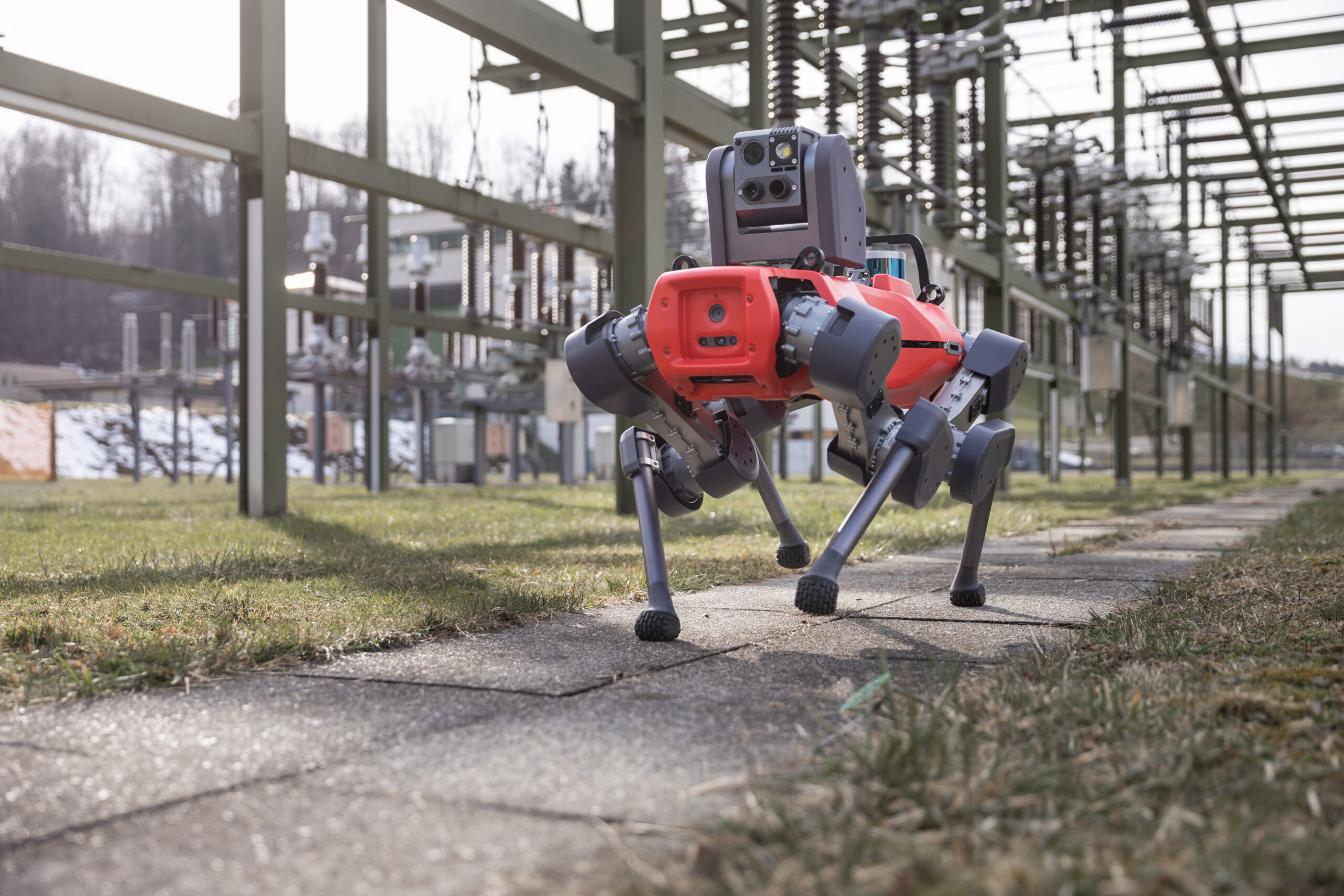
Image: Anymal-robot-inspection-power-grid.jpg | Own work | License: CC BY-SA 4.0 | Source: Wikimedia | https://commons.wikimedia.org/wiki/File:Anymal-robot-inspection-power-grid.jpg