Robotics has spent decades as a field of promising prototypes and frustratingly slow deployment. That is changing. The next five years are likely to reward companies that can do something much harder than build a compelling demo: they must ship machines that are robust enough to work in messy environments, cheap enough to deploy in volume, and smart enough to improve after they leave the lab.
That is why the most important robotics companies to watch in 2030 are not simply the ones with the most attention. They are the companies with a distinctive technical edge or strategic position in one of the few robotics markets that can scale: warehouse automation, industrial manipulation, autonomous mobile robots, service robotics, and the emerging humanoid category. The best businesses in this sector will not just sell hardware. They will own software, deployment workflows, fleet data, and sometimes the operational economics of the customer itself.
What separates a robotics leader from a robotics press release
In robotics, “great product” means something more demanding than in software. A robot must perceive the world, localize itself, plan motion, avoid failures, handle edge cases, and continue doing all of that after months of wear, dust, lighting changes, network dropouts, and human interference. Each of those problems has a cost attached.
For 2030, the winners will likely be companies that can reduce three bottlenecks at once:
Reliability: If a robot works 98% of the time in a demo but fails unpredictably in a distribution center, the economics collapse. Real deployment depends on uptime, maintainability, and simple serviceability.
Integration: Robots rarely replace an entire workflow. They slot into warehouse management systems, factory control systems, safety regimes, and labor processes. Companies that can integrate cleanly tend to scale faster.
Learning loops: The best robots improve from fleet data, remote telemetry, and increasingly from foundation-model-style training. But that only matters if the company can gather data at enough scale and convert it into better behavior in the field.
That framework helps explain why some highly visible robotics names may matter less than companies with a narrower but stronger business model.
Amazon Robotics: the quiet scale advantage
Amazon Robotics remains one of the most strategically important robotics operations in the world because it sits inside an enormous, unforgiving logistics network. Its advantage is not only that Amazon can deploy robots at scale; it is that the company can iterate on robot design, warehouse workflow, and software against one of the largest fulfillment systems ever built.
That matters because warehouse robotics is not primarily a “robot arm” story. It is a systems story. The value comes from moving goods faster, reducing labor intensity, and increasing throughput per square foot. Amazon’s internal use gives it something most robotics companies do not have: a direct feedback loop between machine performance and business economics.
For 2030, that could translate into leadership in several categories, from mobile fulfillment robots to manipulation systems around picking and sorting. The key question is not whether Amazon can build robots. It clearly can. The question is whether it can keep translating internal capability into a durable operational advantage without creating a standalone external market that rivals can commoditize.
ABB: industrial robotics with a systems integrator’s discipline
ABB has long been one of the most credible names in industrial automation, and that reputation is grounded in a hard reality: factories buy uptime, not novelty. Industrial robots must run for years in controlled but demanding settings, often alongside legacy equipment. That creates a business where reliability, software tooling, and channel relationships matter as much as mechanical performance.
ABB’s strategic strength is that it sits close to the industrial customer’s actual pain points: welding, painting, assembly, machine tending, and other repetitive tasks where labor is expensive, inconsistent, or unsafe. Its robots are not trying to be everything to everyone. They are part of a broader automation stack, which makes them easier to justify economically.
By 2030, the companies that matter most in industrial robotics will likely be those that can combine traditional arms with better vision, safer human-robot collaboration, and software that reduces programming friction. ABB’s challenge is to keep modernizing fast enough that its installed-base advantage does not become a legacy burden.
FANUC: the manufacturing benchmark that still matters
FANUC remains one of the most consequential robotics companies because it has built a reputation around manufacturing discipline, serviceability, and sheer installed base. In a sector where downtime is expensive and service teams are often part of the value proposition, FANUC’s long-standing presence in factories is a real moat.
The company’s importance in 2030 will depend on whether it can keep its position as factories add more software-defined automation. Industrial buyers increasingly want robots that can be reconfigured faster, monitored remotely, and integrated with AI-assisted quality control. The old model of fixed automation still matters, but the economics are shifting toward systems that can adapt to more product variation and shorter production runs.
FANUC is likely to remain relevant because it already understands what factory buyers value: predictable performance, support, and long lifecycle management. The competitive risk is that newer entrants may offer more flexible software layers on top of adequate hardware, shifting some of the value away from the robot arm itself.
Boston Dynamics: the technical prestige case for mobility
Boston Dynamics is often treated as the face of advanced robotics, and for good reason. Its machines have repeatedly pushed the state of the art in balance, locomotion, and dynamic motion. But by 2030, its importance will depend less on spectacle and more on whether its technical capabilities translate into economically useful products.
The company matters because mobile robots are fundamentally harder than fixed robots. Real environments are variable: stairs, thresholds, clutter, reflections, wet floors, uneven surfaces, and human unpredictability all complicate autonomy. Boston Dynamics has long specialized in the control systems and motion planning required to operate in such environments.
The strategic question is whether that technical edge can be paired with market fit. A robot that can move impressively is not automatically a robot that a customer can deploy profitably. Still, Boston Dynamics should remain on any 2030 watchlist because it represents a benchmark for what high-mobility robots can do when engineering depth is treated as the product.
Figure AI and the humanoid bet: high upside, high execution risk
No robotics category attracts more speculation than humanoids. Companies such as Figure AI have become symbols of a broader bet: if robots can be made to operate in human-built spaces using human-like form factors, they can slot into existing factories, warehouses, and service environments without requiring a full redesign of the world.
That thesis is attractive, but it is not free. Humanoids inherit all the difficulty of general-purpose robotics: perception, grasping, manipulation, balance, safety, battery life, thermal limits, and maintenance costs. They also carry an economic burden. A robot that resembles a person is only useful if it can do work that justifies its acquisition, support, and uptime profile.
What makes companies like Figure AI worth watching is not that humanoids are guaranteed to win. It is that they are testing whether foundation-model-like robot control, teleoperation data, and simulation can compress the historical gap between lab capability and field performance. If that works, the category could matter enormously. If not, it may remain a powerful prototype market for much longer than enthusiasts expect.
Agility Robotics: one of the clearest paths from demo to deployment
Agility Robotics stands out because it has been unusually focused on a specific use case: logistics and warehouse labor. Its humanoid-style robot Digit is often discussed in the context of general-purpose labor, but the real strategic value is narrower and more important: can a mobile biped do repetitive material handling in environments built for people?
That specificity matters. Many robotics companies fail because they start with a broad vision and no deployment wedge. Agility’s advantage is that it is trying to solve a constrained operational problem where there is enough labor pain to justify experimentation, but not so much complexity that the market becomes unmanageable.
If Agility succeeds, it could become a reference case for how humanoid robotics enters the real economy: not by replacing all workers, but by taking on bounded, physically repetitive tasks in settings where existing infrastructure is already human-centric.
Symbotic and GXO-linked automation: the economics-first model
Some of the most compelling robotics businesses are not the most famous. Companies such as Symbotic, which focuses on warehouse automation, are worth close attention because they frame robotics as an operating-system layer for logistics rather than a standalone gadget.
This model is powerful because it ties robotics directly to measurable financial outcomes: storage density, picking speed, labor efficiency, and throughput. In many warehouses, that is what makes automation investable. The customer is not buying “robots.” It is buying a redesigned economics engine.
The strategic question for this class of companies is whether they can keep their systems flexible enough to handle changing SKU mixes, seasonal demand, and layout constraints. If they can, they may become more durable than firms chasing general-purpose autonomy.
China’s robotics ecosystem: scale, speed, and policy support
Any serious 2030 watchlist has to account for China’s robotics ecosystem, even if individual company outcomes remain difficult to predict. China has structural advantages in manufacturing scale, supply chain density, and state support for automation in sectors where labor costs, export competitiveness, and industrial upgrading all matter.
The most important competitive angle here is not just domestic adoption. It is the ability of Chinese robotics firms to iterate quickly, source components efficiently, and compete on price in categories such as industrial arms, service robots, and warehouse systems. For some markets, that combination will be decisive.
Editorial caution is warranted here: company-specific leadership changes fast, and many claims about market share or product capability deserve verification against current filings and product documentation. But strategically, China remains one of the centers of gravity in global robotics because it couples demand with manufacturing depth.
The real 2030 test: can robots lower labor friction without creating new complexity?
The most important thing to understand about robotics in 2030 is that success will be judged less by autonomy in the abstract and more by operational fit. A robot is only valuable if it reduces labor friction, improves safety, or raises throughput enough to pay for itself after maintenance, integration, and downtime.
That is why the companies most worth watching are the ones that understand deployment, not just embodiment. Amazon Robotics benefits from internal scale. ABB and FANUC benefit from industrial trust and installed bases. Boston Dynamics matters because it sets the technical frontier for movement. Agility and Figure represent the bet that human-shaped machines can eventually become practical workers. Symbotic shows that robotics can succeed as systems engineering, not just mechanical engineering.
By 2030, the winners will likely look less like science projects and more like infrastructure companies: firms that make complex physical work more predictable. That may sound less glamorous than a viral robot demo, but it is where the real business is.
Sources and further reading
- Company annual reports and investor relations materials from ABB, FANUC, Amazon, and Symbotic
- Boston Dynamics product and technical documentation
- Agility Robotics public materials and deployment updates
- Figure AI public announcements and technical overviews, for editorial verification only
- Industrial automation and robotics market overviews from IFR (International Federation of Robotics)
- Factory automation and supply chain reports from major consultancies and industry trade publications, for comparison and fact-checking
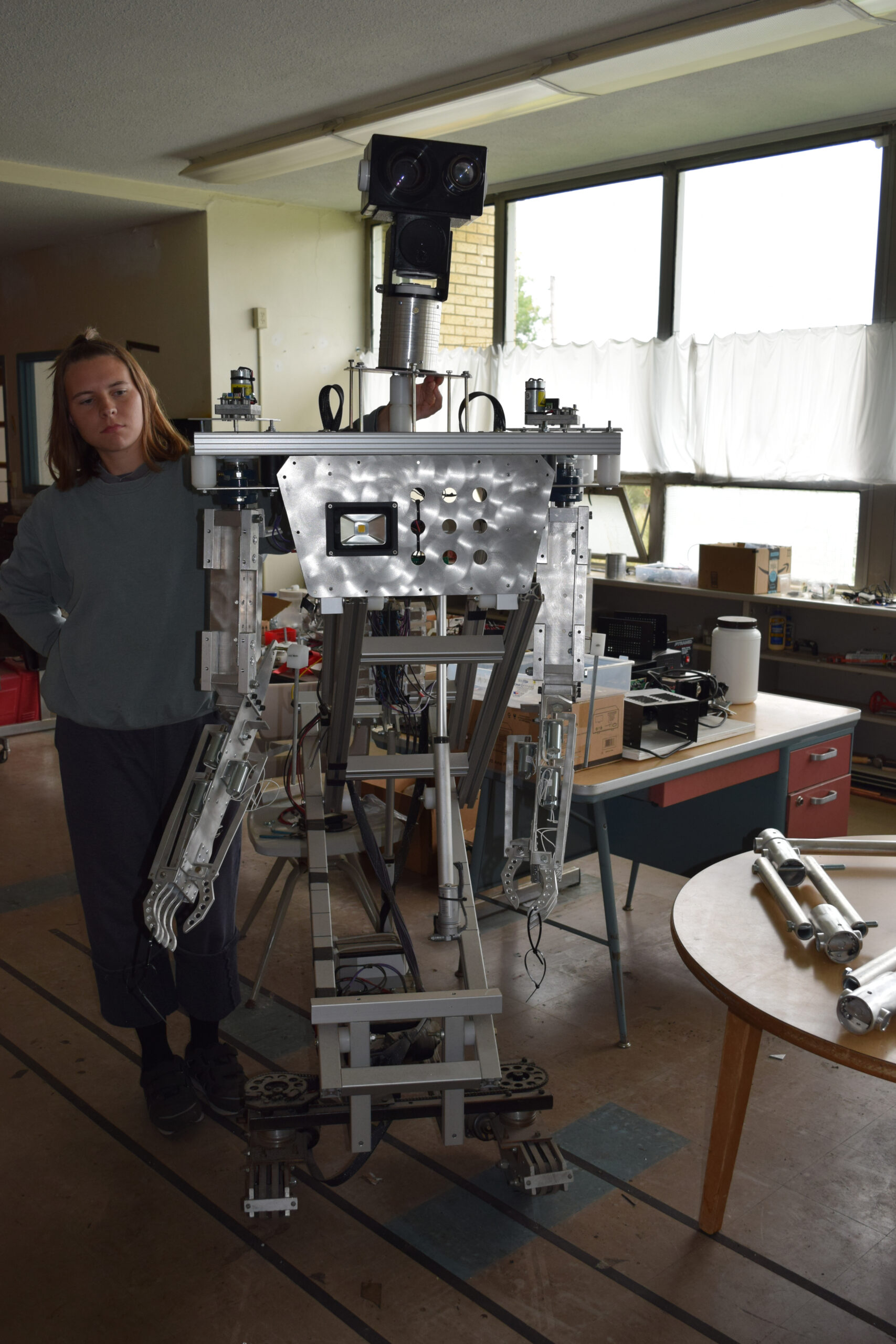
Image: A telepresence robot made from scrap.jpg | Own work | License: CC BY-SA 4.0 | Source: Wikimedia | https://commons.wikimedia.org/wiki/File:A_telepresence_robot_made_from_scrap.jpg