Artificial intelligence is entering education through the familiar front door of classroom software, but its impact reaches much farther than lesson plans and chatbots. The bigger shift is structural. AI is changing the operating model of education systems: who does the teaching, who verifies learning, how institutions allocate labor, and how governments regulate quality and equity.
That matters well beyond the tech sector. Schools and universities are major employers, public budget items, and social sorting mechanisms. When AI changes their workflows, it changes labor demand, public spending, and the distribution of opportunity. In that sense, AI in education is not simply an edtech story. It is a governance story, a workforce story, and eventually an economic competitiveness story.
The classroom use case is only the visible layer
The most visible AI applications in education are also the easiest to misunderstand. Students use large language models to brainstorm essays, summarize readings, generate practice questions, or explain homework step by step. Teachers use AI to draft quizzes, adapt reading levels, or produce parent communications. School districts experiment with chatbots for administrative support and early-warning systems that flag absenteeism or dropout risk.
These examples matter, but they are only the surface. AI is not just a new digital worksheet. It is software that can generate, classify, recommend, and personalize at scale. That makes it attractive in systems that are chronically short on human time. A teacher managing 25 to 35 students cannot manually tailor every assignment or give detailed feedback every day. A district office with limited staff cannot easily process every request, translation need, or routine document. AI promises to compress those bottlenecks.
The key phrase is “promises to.” In practice, AI systems inherit the constraints of the institutions that deploy them: uneven connectivity, outdated devices, fragmented procurement, weak training, and unclear accountability. A school district can buy the tool, but it still has to make it work in classrooms where teachers have different comfort levels, student needs vary widely, and policy rules around privacy and academic integrity remain unsettled.
The biggest change is labor, not content
Education is a labor-intensive sector. That is one reason AI has such outsized implications. If a system can automate some portion of lesson planning, grading, translation, scheduling, or student support, it does not merely save time; it changes the division of labor inside schools.
For teachers, the best-case scenario is that AI reduces administrative overhead and frees more time for instruction, mentoring, and human judgment. Drafting rubrics, generating quiz variations, summarizing parent updates, and scaffolding materials for different reading levels are all tasks where AI can plausibly assist. In a well-managed setting, that could make teachers more effective without replacing them.
But the labor story is not automatically benign. When a tool is capable of producing acceptable first drafts quickly, institutions often use it to raise throughput expectations rather than protect worker time. That pattern is familiar in other industries. If AI can generate more feedback, then administrators may expect more feedback. If AI can reduce translation friction, they may expect broader multilingual outreach without adding staff. Productivity gains can become workload creep.
There is also a question of role erosion. If vendors market AI tutors, automated grading, or always-on help desks as substitutes for human support, systems under budget pressure may be tempted to cut specialist roles rather than augment them. The same tension appears in higher education, where AI can support student services, writing help, and administrative functions, but could also be used to justify larger class sizes or fewer instructional staff. Whether AI becomes a force multiplier or a workforce substitute will depend less on the model itself than on policy choices, labor contracts, and funding conditions.
Assessment is becoming the central battleground
If AI changes how schools work, assessment is where the conflict becomes visible. The rise of generative AI has made it much easier for students to produce polished text, code, summaries, and presentations without demonstrating their own underlying understanding. That does not make learning impossible to measure, but it does make traditional take-home assignments less reliable as proof of skill.
Education systems are responding in several ways. Some are tightening restrictions on AI use. Others are redesigning assignments around in-class writing, oral defense, project-based learning, or process documentation. Many educators are doing both at once: allowing AI for some tasks while trying to preserve the integrity of final evaluation.
This is not a minor pedagogical adjustment. Assessment determines credentials, and credentials determine access to jobs, graduate school, and professional licensing. If AI makes written output cheaper, schools must decide what they are actually certifying. Is the credential meant to verify final output, domain knowledge, reasoning process, or the ability to use AI responsibly? Different answers imply different systems.
One practical consequence is that education may drift toward more authenticated and supervised forms of evaluation. That can mean more oral exams, more project checkpoints, more classroom-based work, and more emphasis on showing the steps behind the answer. Those changes can improve rigor, but they also require time and staff. In a resource-constrained system, the move away from cheap, scalable take-home assessment has a real cost.
AI could widen gaps before it narrows them
AI is often marketed as an equalizer: personalized tutoring for every student, instant feedback, adaptive pacing, and 24/7 support. That vision is not fanciful. Research and product pilots continue to suggest that AI can be useful for practice, explanation, and scaffolding when used carefully. But broad social effects usually depend on who gets access first, who gets trained to use the tools well, and who gets protected from their failure modes.
In education, the initial pattern is likely to be uneven. Students with better devices, stronger internet access, more digitally literate families, and more supportive schools will benefit earlier. So will institutions that can afford teacher training, paid enterprise tools, and legal review. Districts operating under financial stress are more likely to use free consumer-grade tools or adopt tools without deep integration. That creates a two-speed system.
There is also a language and disability dimension. AI can help translate materials, simplify texts, and support students with different learning needs. But if systems are not carefully validated, those same tools can introduce errors, flatten nuance, or produce outputs that fail specific accessibility requirements. For students who rely on the system most, “good enough” AI can become a hidden form of under-service.
The equity challenge is not unique to AI, but AI amplifies it because the technology’s advantages are strongest where institutions already have capacity. A school with strong leadership can pilot use cases, monitor outcomes, revise policy, and train staff. A school with weak infrastructure may only experience the confusion: inconsistent usage, unclear expectations, and more opportunities for cheating accusations without better learning.
Governance will decide whether AI is trusted or merely tolerated
Education systems are conservative for a reason. They are responsible for minors, public funds, and long-term human capital. That makes governance central to AI adoption. The key questions are not only “Does this tool work?” but “Who is accountable if it fails?” and “What data does it collect?”
Schools and universities are being pushed to answer questions about student privacy, data retention, model training, bias, and disclosure. If a vendor’s system processes student writing, behavioral signals, or learning profiles, institutions need to know where the data goes, whether it is used to train models, and what safeguards exist against misuse. In many jurisdictions, existing laws and procurement practices were not designed for generative AI. That leaves a gap between enthusiasm and enforceability.
Policy also has to address integrity. Students need clear rules about when AI use is allowed, when it must be disclosed, and what counts as unauthorized assistance. Vague policies tend to produce both over-enforcement and confusion. The more practical approach is to define use cases: brainstorming, editing, translation, practice, coding support, and final submission. That is more workable than pretending AI does not exist.
At the system level, education ministries and district leaders will likely need shared standards for procurement, transparency, and evaluation. Without them, every school becomes its own regulator. That is inefficient and uneven, and it favors vendors with the most polished sales pitch rather than the strongest educational evidence.
Universities, credentialing, and the labor market are linked
The education sector does not operate in isolation. It feeds the labor market, which is already adjusting to AI-assisted work. Employers increasingly want graduates who can use AI tools productively, but they also want people who can verify outputs, detect errors, and work with incomplete information. That creates a new baseline skill set: not just using AI, but supervising it.
Universities and vocational programs will have to decide whether AI literacy belongs in every curriculum or only in specialized technical tracks. The better answer is probably both. Basic familiarity with AI systems, their failure modes, and their ethical constraints is becoming as relevant as spreadsheet literacy once was. At the same time, not every field should treat AI the same way. A software engineer, a social worker, a nurse, a lawyer, and a history student will use these tools differently.
At the credential level, AI may also reduce the signaling value of some assignments while increasing the value of others. Employers may pay more attention to internships, live presentations, portfolios, practical exams, and project work that is harder to outsource to a model. Institutions that understand this shift can update curricula before graduates are penalized in the job market. Those that do not may produce credentials that look sound on paper but carry less confidence in practice.
The real question is not whether AI enters education, but on whose terms
AI will not simply “disrupt” education in the narrow startup sense. Education is too regulated, too labor-intensive, and too socially consequential for that. Instead, AI will gradually be absorbed into the machinery of schooling, with effects that differ across age groups, subjects, income levels, and institution types.
The most useful way to think about the transition is as a negotiation over control. Schools want efficiency, personalization, and support. Teachers want time, autonomy, and better tools. Students want help, but also fairness and legitimacy. Governments want higher performance without runaway costs. Vendors want distribution, data, and recurring revenue. AI sits at the center of those competing interests.
The outcome will depend on whether institutions treat AI as a blunt efficiency layer or as a reason to redesign how learning is organized. If they use it only to squeeze more output from an unchanged system, the likely result is more surveillance, more workload pressure, and more inequity. If they use it to rethink assessment, support, accessibility, and teacher capacity, AI could improve the quality of education without hollowing out its human core.
That distinction is the one that matters. The question is not whether AI can answer questions. It is whether education systems can use AI without surrendering the values that make schooling worth funding in the first place.
Sources and further reading
- UNESCO guidance on generative AI in education
- OECD analysis on AI, skills, and education systems
- U.S. Department of Education Office of Educational Technology reports on AI
- UK Department for Education guidance on generative AI in schools and colleges
- EdSurge, Education Week, and related policy coverage for implementation examples
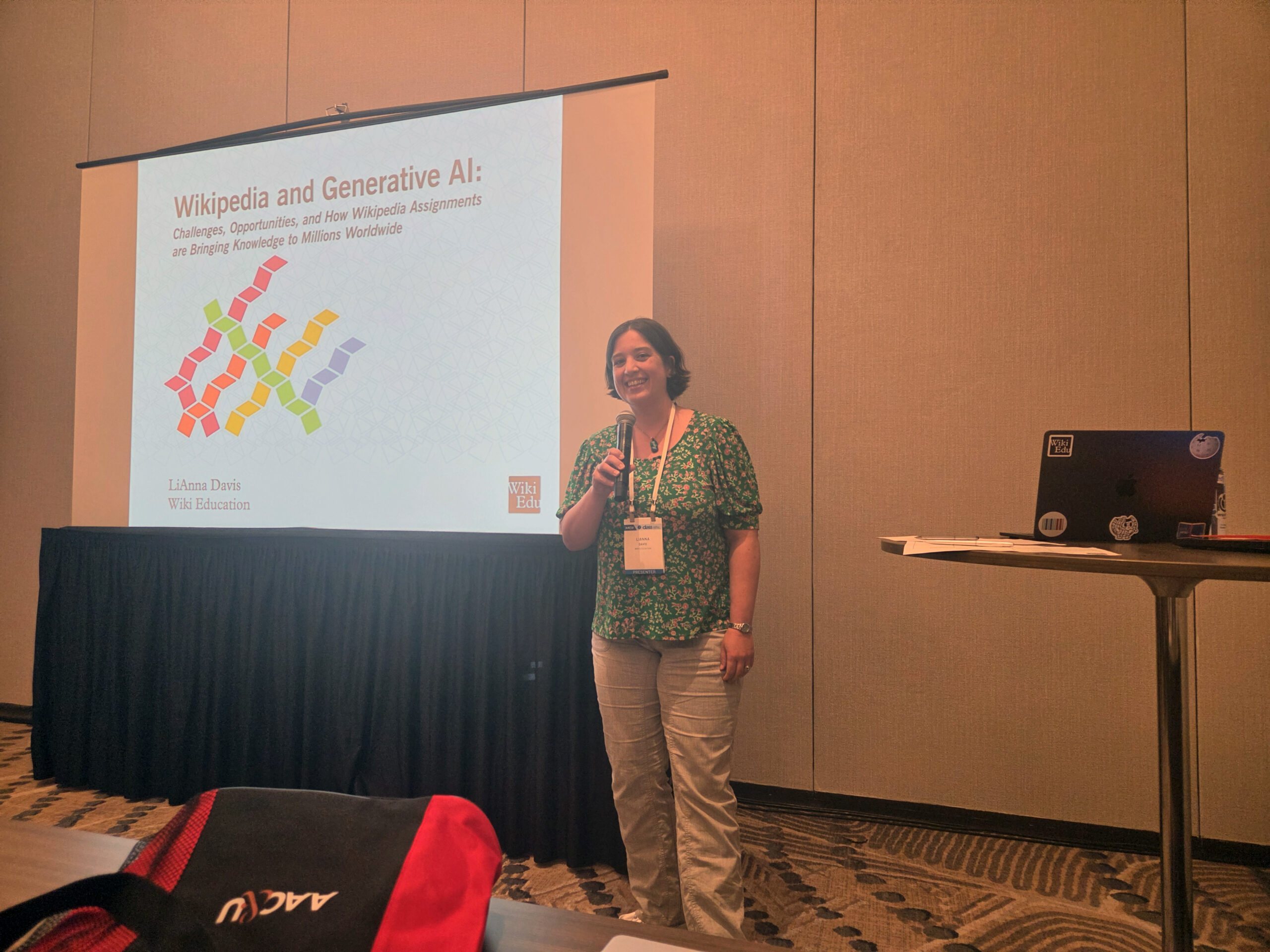
Image: AAC&U CLASS Conference Wikipedia & Generative AI talk.jpg | Own work | License: CC BY-SA 4.0 | Source: Wikimedia | https://commons.wikimedia.org/wiki/File:AAC%26U_CLASS_Conference_Wikipedia_%26_Generative_AI_talk.jpg