Google’s position in AI is easy to underestimate if you only look for the loudest product launch. The company does not compete the way a startup does, nor even exactly the way a software giant like Microsoft does. It is playing a broader game: building and controlling the stack that turns machine intelligence into a durable business.
That matters because the AI race is no longer just a contest over chatbots or model benchmarks. It is an industrial competition over compute, data centers, custom silicon, cloud distribution, and the software layers that determine who gets paid when AI is used in real workflows. Google’s strategy is a useful lens on the whole market because it shows where the real constraints are.
Google is competing on layers, not just models
The public conversation often collapses AI competition into a simple question: whose model is best? In practice, that is only one layer. A frontier model can be technically impressive and still lose if it is too expensive to run, hard to distribute, awkward to integrate into enterprise systems, or dependent on infrastructure someone else controls.
Google understands this better than most because it has spent years operating across the stack. It builds foundation models through Google DeepMind and the Gemini family. It sells access through Google Cloud. It controls a major consumer distribution layer through Search, Android, Chrome, YouTube, and Workspace. And it has its own silicon in Tensor Processing Units, or TPUs, which are designed to accelerate AI workloads more efficiently than general-purpose chips for certain tasks.
That combination is strategically powerful. It means Google can optimize model training and inference around hardware it influences, then route those capabilities into products that already reach billions of users and large enterprises. In AI, that kind of vertical integration is not a side detail. It is the business model.
TPUs are Google’s clearest advantage
If there is one element of Google’s AI strategy that captures the broader market shift, it is the company’s long-running bet on custom chips. TPUs are not as visible to consumers as GPUs, but they are central to how Google thinks about AI economics.
Most of the AI industry has been built around Nvidia GPUs, which remain the default accelerator for training and running large models. But the economics of AI do not stop at raw performance. They depend on supply, power use, software efficiency, and cost per inference. As AI systems move from occasional training runs to always-on deployment, the ability to serve models efficiently becomes a strategic advantage.
Google’s TPUs help explain why. They allow the company to tune hardware more closely to specific workloads, especially in its own internal and cloud environments. That can reduce dependence on outside chip supply and give Google more control over its cost structure. It also signals something larger about the market: the AI infrastructure stack is fragmenting. Not every company wants to rely only on general-purpose GPUs forever. The winners may be the firms that can mix GPUs, custom accelerators, networking gear, memory, and power systems into an optimized platform.
For readers watching the semiconductor industry, this is one of the most important takeaways. Google is not trying to replace Nvidia in every use case. It is proving that hyperscalers with enough scale will keep designing around the chip market rather than simply buying into it. That changes pricing power, procurement strategy, and long-term demand patterns across the data center supply chain.
Cloud is where AI turns into revenue
AI models may attract the headlines, but cloud platforms are where many companies hope to turn them into recurring revenue. Google Cloud sits at the center of that effort. It is both a sales channel for AI services and an infrastructure business that can monetize usage directly.
That matters because enterprise buyers do not purchase AI in the abstract. They buy workflows: code assistance, document automation, search, customer support, analytics, and internal knowledge tools. They want these capabilities embedded in the systems they already use, with security controls, auditability, data residency options, and cost predictability.
Google’s challenge is not simply to offer a capable model. It is to make Gemini, Vertex AI, and adjacent cloud services fit into procurement and IT environments that are cautious, budget-constrained, and increasingly skeptical of one-off AI pilots. That is why the cloud layer is such a decisive battleground. The company that owns the platform can capture usage across training, inference, storage, orchestration, and developer tooling.
This is where the AI race becomes less like a consumer app fight and more like the infrastructure buildout around enterprise software, search, and data services. Google’s competitive edge is not just intelligence. It is distribution into business systems, which is where many AI deployments will eventually live or die.
The market is moving from model novelty to operational reliability
One reason Google’s strategy matters is that it reflects a shift in what customers value. In the early wave of generative AI, novelty was enough to drive attention. Companies rushed to announce pilots and proof-of-concepts. But as deployments mature, buyers care more about latency, throughput, cost, integration, and governance.
That transition favors companies with deep infrastructure roots. Running a model in a demo is one thing. Running it at scale, under enterprise service levels, across multiple regions, while controlling costs and maintaining safety systems, is another. Google’s full-stack approach is designed for that reality.
It also helps explain why the AI race is spreading beyond model labs. Power delivery, cooling, grid access, fiber connectivity, and data center construction are now strategic variables. The company that can secure compute capacity and operate it efficiently can move faster than one that depends on volatile external supply.
In other words, AI competition is becoming an energy and infrastructure problem as much as a software one. Google’s investments across cloud, chips, and data centers show that clearly. The same is true across the industry: as models scale up, electricity, land, and hardware availability are becoming gating factors.
Google’s biggest asset is also its biggest constraint
Google has enormous reach. Search, Android, Chrome, Gmail, YouTube, Maps, and Workspace give it more distribution than most AI competitors could hope to build from scratch. That should make AI integration easier. But it also creates constraint.
When a company has this much surface area, every AI feature has to be useful, reliable, and careful. A flawed answer in a standalone chatbot is one thing. A flawed answer woven into search, email, enterprise docs, or developer tools is a different matter. Product risk is higher, and so is the reputational cost of failure.
There is also an internal tension between protecting incumbent products and shipping disruptive ones. If AI makes traditional search less central, Google has to manage the transition without cannibalizing the business that funds its ambitions. That is not a trivial balancing act. It helps explain why Google’s rollout pace can seem more measured than that of pure-play AI companies. Sometimes caution is not weakness; it is the price of operating a massive platform.
For the broader market, this is revealing. The AI race does not reward speed alone. It rewards companies that can absorb risk across multiple layers of the stack. Google can, but it must do so without destabilizing the products that made it powerful in the first place.
What Google says about the rest of the industry
Google’s approach suggests that the industry is heading toward fewer, more integrated winners rather than a field of isolated model brands. The companies most likely to matter are those with some combination of model capability, compute ownership, cloud distribution, developer ecosystems, and enterprise trust.
That is good news for hyperscalers and chipmakers, but it also raises the bar for everyone else. Smaller AI firms can still innovate quickly, especially in product design and niche applications. Yet over time, many will depend on infrastructure controlled by larger players. That dependency affects margins, bargaining power, and technical roadmaps.
It also means that strategic competition will increasingly happen in places most consumers never see: accelerator procurement, cloud contracts, model serving efficiency, enterprise integration, and data center power planning. The visible app is only the last mile. The real race is underneath it.
Google’s AI strategy is therefore more than a company story. It is a map of the market. It shows that the most durable advantage in AI may not come from being first with a chatbot or loudest with a demo. It may come from controlling the economics of deployment at scale.
What to watch next
If you want to understand where Google is actually gaining or losing ground, watch four things.
First, the performance and efficiency of its model lineup relative to cost. In AI, price-performance matters as much as benchmark headlines.
Second, how aggressively Google Cloud turns AI demand into actual consumption across enterprise customers.
Third, how well Google uses TPUs and other infrastructure advantages to reduce cost and improve availability at scale.
Fourth, whether Google can integrate AI into its core products without weakening the businesses that still fund the rest of the company.
That is the real competition. Not just who can build an impressive model, but who can industrialize intelligence. Google’s answer may not be the simplest one, but it is one of the most revealing.
Sources and further reading
- Google DeepMind and Google AI product documentation for Gemini and related model updates
- Google Cloud documentation for Vertex AI and enterprise AI tooling
- Google Cloud and Alphabet investor materials discussing infrastructure and capital expenditures
- Google TPU technical overviews and developer documentation
- NVIDIA and hyperscaler earnings materials for context on AI infrastructure demand
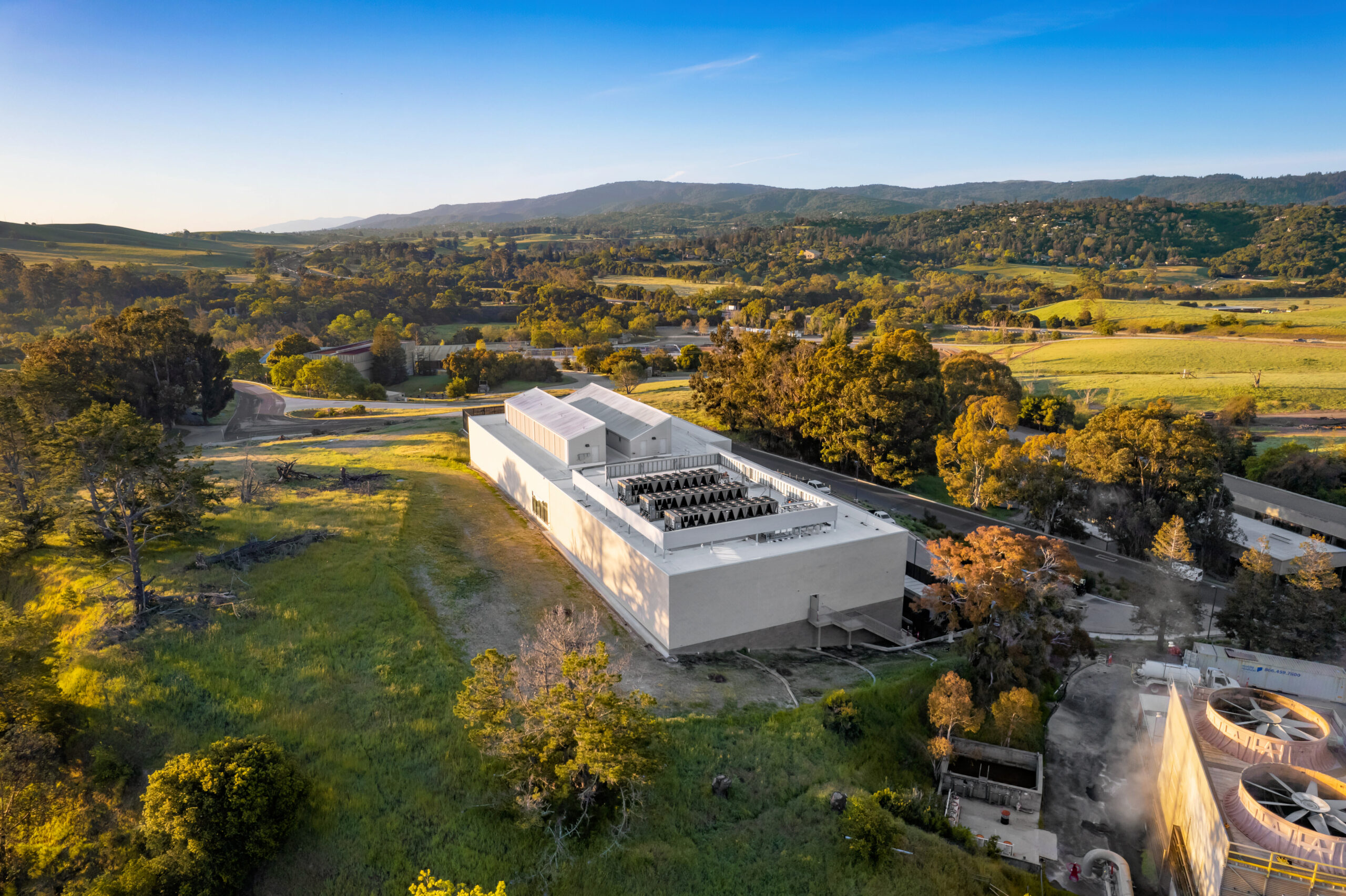
Image: Stanford Research Computing Facility (SRCF) at sunrise on SLAC campus (SRCF-data-center-CC).jpg | Stanford Research Computing Facility (SRCF) at sunrise on SLAC campus | License: CC BY 4.0 | Source: Wikimedia | https://commons.wikimedia.org/wiki/File:Stanford_Research_Computing_Facility_(SRCF)_at_sunrise_on_SLAC_campus_(SRCF-data-center-CC).jpg