Privacy used to be understood as a question of control: who can see your data, where it is stored, and whether it is shared. AI changes that equation. Modern systems do not just hold information; they extract patterns, make predictions, and generate new data about people from fragments they never intended to disclose.
That matters well beyond Silicon Valley. AI now shapes how a bank assesses risk, how an employer screens applicants, how a retailer prices products, how a school monitors student behavior, and how a city deploys cameras and software. The privacy issue is no longer only about whether a company leaks your email address. It is about whether an algorithm can reconstruct your habits, preferences, health concerns, political leanings, or work patterns from data that looks harmless on its own.
That is the central shift: privacy in an AI world is less about what you hand over and more about what systems can infer.
Why the old privacy model is breaking
Traditional privacy law and compliance programs were built around data categories: names, addresses, Social Security numbers, account details, location records, biometric identifiers. If a company collected sensitive data, it had obligations around notice, consent, retention, and security. If it did not collect sensitive data, the assumption was that risk was limited.
AI undermines that assumption in two ways.
First, it can combine ordinary data into something highly revealing. A shopping history, device identifiers, location pings, and browsing behavior may be enough to estimate income level, family status, health concerns, or whether someone is likely to quit a job. None of those conclusions has to be explicitly stored in a database to become useful. In other words, the model can create a sensitive profile even if the source data never looked sensitive on its own.
Second, AI systems can be reused for purposes users did not anticipate. Data gathered for customer support can be fed into a chatbot. Video collected for building security can be used for behavioral analytics. Voice data captured for transcription can be repurposed to train systems or identify speakers. The privacy harm is not only exposure. It is function creep.
This is why many privacy debates now focus on inference, purpose limitation, and data minimization. Those are dry terms, but they describe a very practical problem: once data is inside an AI pipeline, it is often easier to imagine new uses than to stop them.
The new daily-life privacy risks
For most people, AI privacy risks show up in ordinary settings, not dystopian ones.
At work, a company may use AI tools to summarize meetings, draft emails, score support tickets, or review employee performance. That sounds efficient, but the same system can also capture who speaks most often, who seems disengaged, who asks for accommodation, or who sounds uncertain. Even if managers never intend to monitor employees that closely, the data trail can make that possible.
In schools, AI-based tutoring and proctoring tools may analyze behavior, speech patterns, and attention signals. Supporters argue that these tools improve learning and reduce cheating. Critics note that students often have little meaningful choice and limited visibility into what the systems infer about them. A child’s writing style or camera feed can become part of a behavioral profile that persists beyond a single assignment.
In consumer life, voice assistants, health apps, connected cars, and smart home devices create a steady stream of intimate data. A smart thermostat can reveal occupancy patterns. A fitness app can hint at medical conditions. A car’s infotainment system may record location and behavior data that can be valuable to insurers, advertisers, or law enforcement depending on policy and jurisdiction. The issue is not just that these systems collect data. It is that the data can be cross-referenced into a fuller picture of a person’s life.
Insurance is another area where AI changes privacy stakes. Risk pricing has always depended on information. But AI can turn a broad set of signals into more granular predictions about behavior and health. That raises obvious fairness concerns: if the model can infer too much, a consumer may never know why a premium changed or why an offer disappeared.
Privacy is now a compute problem
One reason AI privacy is so hard to manage is that the threat is not confined to storage. It extends into compute.
Training large models often requires collecting vast datasets and running them through expensive GPU clusters. During that process, companies may use data pipelines that copy, transform, label, and cache information across multiple environments. Each stage creates risk. The more systems that touch the data, the more places a sensitive record can leak, be retained too long, or be accessed by the wrong people.
There is also the problem of model memorization. AI models can sometimes reproduce training data, including private or copyrighted material, if the data was not properly filtered or if the model has been overfit. That is one reason why organizations are moving toward stronger dataset governance, redaction, differential privacy techniques, and controlled fine-tuning rather than indiscriminate data collection. These are not perfect fixes, but they reflect a broader truth: privacy has become an engineering issue, not just a legal one.
On the deployment side, AI systems often run in cloud environments, edge devices, and third-party APIs. Each configuration changes the risk profile. A locally run model on a phone may keep some data on device, reducing exposure. A hosted model accessed through an API may create new logs, retention policies, and vendor relationships that users never see. The architecture matters as much as the policy.
Why consent alone is not enough
For years, privacy regulation leaned heavily on notice and consent. In theory, users were told what data was collected and could agree or decline. In practice, that approach is failing in an AI world.
Most people do not read long privacy policies. Even if they did, they would struggle to predict how future AI systems might use today’s data. A consent form can say a company may use information to “improve services,” but that phrase can cover a very wide range of processing: analytics, model training, personalization, fraud detection, experimentation, and partner sharing.
AI also makes consent less meaningful when participation is unavoidable. A worker may have to use company software. A student may need a school platform. A consumer may need a service that has become effectively essential. In those contexts, “agree or leave” is not real choice.
That is why privacy advocates increasingly emphasize rules that limit collection in the first place, require purpose-specific use, and make inference itself subject to oversight. The European Union’s General Data Protection Regulation already treats some forms of automated decision-making carefully, and the EU AI Act adds another layer of risk-based obligations. In the United States, privacy remains more fragmented, with a patchwork of state laws and sector-specific rules. The direction of travel is clear even if the legal map is messy: companies will be asked to justify not only what they collect, but why they need it and what their models do with it. Specific legal obligations should be verified against current statutes and enforcement guidance.
What better privacy design looks like
The next phase of privacy will not be won by a single feature or regulation. It will depend on design choices across the stack.
One important principle is data minimization: collect less, keep it for shorter periods, and restrict reuse. That sounds simple, but it is often the hardest change for AI teams because better model performance usually tempts engineers to retain more data for longer. The challenge is to prove that “more data” is not always the same as “better product.”
Another is on-device or edge processing, where feasible. If a task can be done locally on a phone, laptop, or industrial device, sensitive data may never need to leave the device. Apple, Google, and other platform companies have increasingly pushed some AI tasks onto local hardware for latency and privacy reasons. This is not a cure-all; local models still collect logs and can still leak data. But keeping certain workflows on device narrows exposure.
Organizations also need stronger access controls and auditability. That means knowing which employees, vendors, and automated systems can access raw data, which prompts are logged, how long outputs are stored, and whether training data can be traced back to a source record. Many failures happen not because a company has no policy, but because the policy is invisible in practice.
Finally, privacy-preserving machine learning methods deserve more attention than they usually get in public debates. Differential privacy, federated learning, secure enclaves, and synthetic data can reduce risk in some use cases. None eliminates trade-offs. Differential privacy can limit utility. Federated learning can still expose metadata. Synthetic data can reproduce bias or leak patterns if it is not carefully validated. But these tools show that privacy and AI do not have to be treated as opposing goals.
What businesses should expect next
For companies, the privacy question is becoming strategic. Customers are increasingly aware that AI systems can infer more than they reveal. Employees are sensitive to monitoring. Regulators are paying closer attention to automated decisions. And enterprise buyers want assurances that their data will not be used to train a public model without permission.
That creates a competitive advantage for vendors that can explain their data practices in plain English. Businesses that can answer basic questions clearly—What do you collect? What do you infer? What stays local? What is retained? What is used for training? Who can audit it?—will have a much easier time earning trust.
There is also a cost angle. Privacy-by-design can reduce legal and reputational risk, but it can also require real technical investment: better data catalogs, model governance, red-team testing, access controls, log management, and compliance workflows. In an industry obsessed with speed, that can look like friction. It is also a sign of maturity. The companies most likely to survive the next privacy backlash will be the ones that build systems they can explain and defend.
The real question is who gets to know what
The future of privacy in an AI world is not a battle between privacy and progress. It is a negotiation over power.
AI systems expand the ability of institutions to observe, predict, and influence behavior. That can improve medicine, safety, accessibility, logistics, and customer service. It can also make people more legible to systems that were never designed with their interests in mind. The same model that helps a hospital identify risk may also help an insurer segment customers. The same transcription system that saves time in a meeting may also create a record an employee never expected. The same camera network that improves security may also normalize surveillance.
So the core privacy question is not whether AI will collect data. It already does. The question is whether society will set meaningful limits on what can be inferred, retained, shared, and automated from that data.
That is a far bigger issue than the tech industry. It affects wages, access to services, civil liberties, education, healthcare, and trust in institutions. In that sense, privacy is no longer a niche compliance topic. It is becoming part of the infrastructure of modern life.
Sources and further reading
- European Commission: General Data Protection Regulation (GDPR)
- European Union: AI Act documentation and legislative materials
- NIST: AI Risk Management Framework
- OECD: AI Principles and privacy-related policy materials
- FTC: guidance and enforcement actions on data privacy and automated decision-making
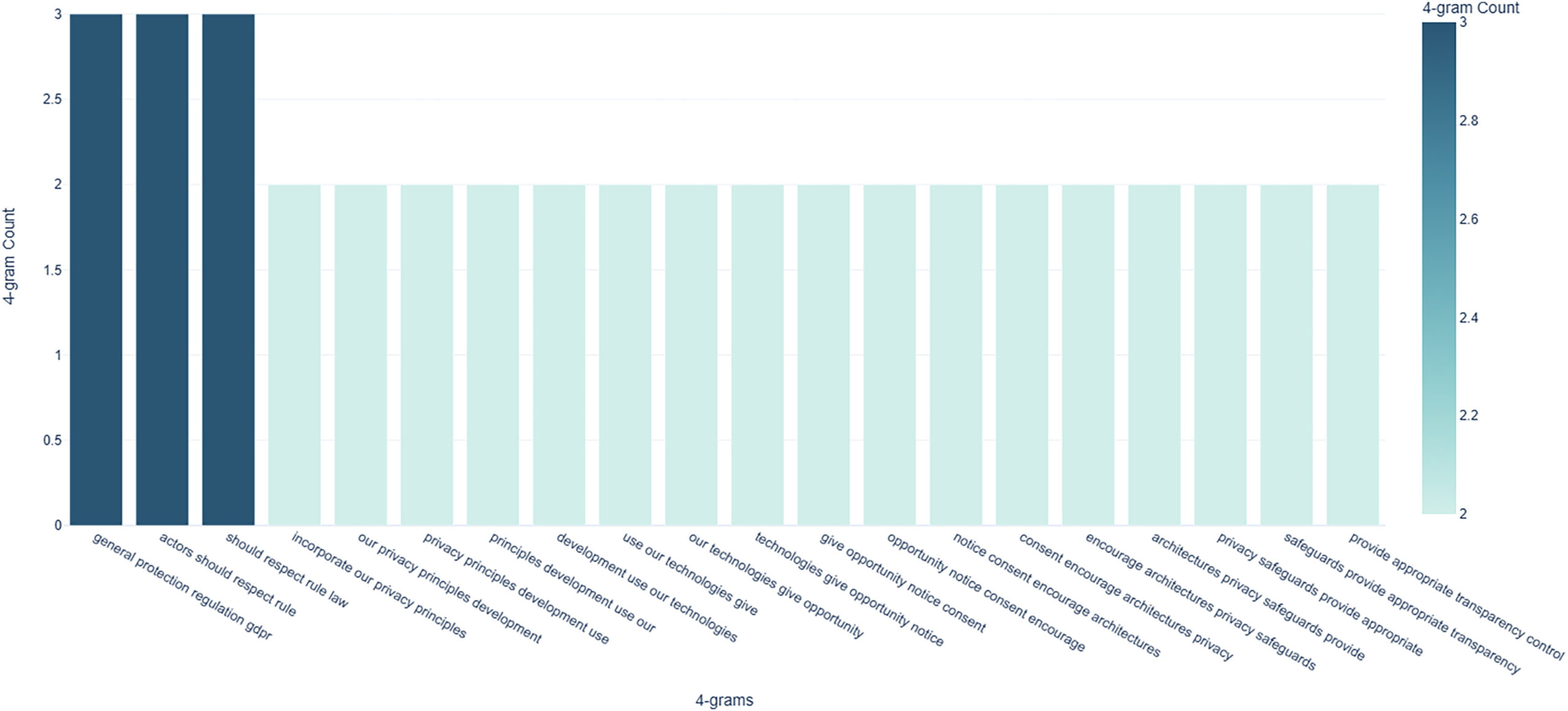
Image: N-gram analysis results – top 20 recurrent 4-g for the 137 descriptions of "privacy" in AI governance guidelines.jpg | https://www.cell.com/patterns/fulltext/S2666-3899(23)00241-6 | License: CC BY 4.0 | Source: Wikimedia | https://commons.wikimedia.org/wiki/File:N-gram_analysis_results_%E2%80%93_top_20_recurrent_4-g_for_the_137_descriptions_of_%22privacy%22_in_AI_governance_guidelines.jpg