AI is driving data center expansion because the old idea of a data center as a place to store files and serve websites no longer matches the workload. Modern AI systems are compute-hungry, power-dense, and impatient. They do not just want more racks; they want more electricity, more cooling, faster networking, and tighter physical integration between chips and the systems around them. That is why the current buildout is not simply a real estate story. It is an infrastructure redesign story.
The clearest way to understand the shift is to compare AI against the workloads that shaped the last two decades of data center planning. Traditional enterprise applications and even much of cloud computing scale relatively predictably. They use CPUs, modest memory footprints, and network traffic that can usually be handled with mature, standardized designs. AI training and inference are different. They rely heavily on GPUs or other accelerators, require far more power per rack, and often depend on low-latency, high-bandwidth communication between many chips at once. That combination forces operators to build for density rather than just capacity.
AI Changes the Unit of Planning
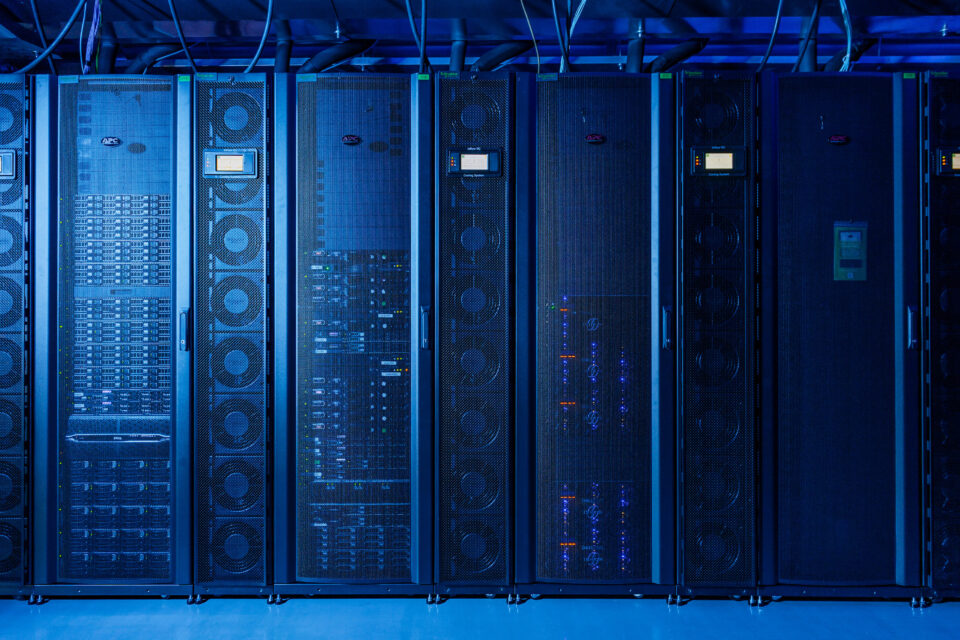
In the pre-AI era, a data center operator could think in terms of servers, storage arrays, and general-purpose networking. With AI, the unit of planning shifts toward clusters: hundreds or thousands of accelerators linked together as one distributed machine. A single rack may now draw so much power that it would have been considered extreme only a few years ago. That creates a chain reaction. Higher rack density means more heat. More heat means more advanced cooling. More cooling means larger electrical and mechanical systems. And those systems consume space, capital, and time before the first model ever trains.
This is why AI demand hits infrastructure providers unevenly. A building that looks adequate on paper may fail the real test once the operator tries to support high-density GPU deployments. The ceiling is often not the building shell, but the utility feed, the substation, the switchgear, or the cooling plant. In many markets, the easiest part of expansion is constructing the structure itself. The hardest part is getting enough power to it and enough thermal headroom to keep the equipment running reliably.
Training vs. Inference: Two Workloads, Two Infrastructure Problems
AI is often discussed as if it were one workload, but training and inference stress infrastructure in different ways. Training is the more dramatic case: huge clusters, high utilization, aggressive networking, and long periods of sustained power draw. It tends to favor hyperscale campuses and purpose-built facilities because the economics work best when operators can spread the cost of land, substations, and cooling across very large deployments.
Inference is more distributed. Once models are deployed into products and services, they need to respond quickly and often close to users. That opens the door to a mix of hyperscale data centers, regional edge locations, and colocation facilities. But inference does not necessarily mean “lightweight.” Popular AI applications can generate enormous request volumes, and latency-sensitive use cases push operators to place compute closer to where users are. The result is an expansion not just in the size of the biggest campuses, but in the number of sites that need GPU-ready infrastructure.
This distinction matters because it explains why AI is creating demand across multiple deployment paths. Hyperscalers are racing to add capacity for training and large-scale inference. Colocation providers are trying to adapt facilities for higher density tenants. Edge and regional operators are positioning themselves for lower-latency inference. Each model solves a different part of the problem, but none solves everything.
Why Power, Not Space, Is the Real Constraint
People still imagine data center shortages as a land problem. In reality, AI makes the power problem dominant. A site can have room for more buildings and still be unable to expand because the local grid cannot deliver enough megawatts quickly enough. Utilities move on long timelines. Interconnection queues are slow. Substation upgrades are expensive. Transmission constraints can delay projects for years. AI workloads do not wait politely for those upgrades.
That gap between demand and power availability is one reason data center developers are chasing markets with favorable utility access, available transmission capacity, or proximity to generation. It is also why some operators are exploring on-site or near-site power solutions, including natural gas generation, fuel cells, batteries, and long-term power purchase agreements tied to renewables. These choices are not just about sustainability branding. They are increasingly about whether a project is buildable at all.
Yet each path has tradeoffs. On-site generation can improve reliability and speed to power, but it can also raise emissions concerns and add operational complexity. Grid-connected renewable contracts can support corporate decarbonization goals, but they do not always solve the immediate physical problem of delivering electrons to a specific facility. Batteries help with short-duration balancing, not with sustained multi-megawatt AI loads. In other words, there is no single clean fix for a system that is fundamentally constrained by physics and permitting.
Cooling Is Becoming a Competitive Feature
Cooling used to be a support function. For AI deployments, it is strategic. Air cooling can still work in many cases, but the highest-density GPU clusters increasingly require liquid cooling or hybrid systems. Direct-to-chip liquid cooling and rear-door heat exchangers are no longer niche engineering experiments; they are becoming practical responses to the thermal load generated by modern accelerators.
This shift changes the economics of data center expansion. Operators that can support liquid cooling have access to a broader class of AI tenants and can extract more revenue from each square foot. Those that cannot may be locked out of the fastest-growing demand segments. But liquid cooling also raises the bar on design, maintenance, and capital expenditure. It is not simply “better cooling.” It is a different facility architecture with different failure modes, service requirements, and deployment timelines.
That is why the market is separating into facilities that are AI-ready and facilities that are merely online. The difference is not cosmetic. It determines what kinds of chips can be deployed, how efficiently they can run, and how much of the building’s capacity is left unusable because the thermal or electrical envelope was designed for a prior generation of compute.
Hyperscale, Colocation, and Edge Each Solve a Different Problem
The current expansion boom is also a contest between deployment models. Hyperscalers have the balance sheets, software stacks, and procurement scale to build massive campuses tailored for AI. They are best positioned for training and for large pools of inference demand. Colocation providers offer speed and geographic flexibility, which matters for enterprises that want AI infrastructure without owning every piece of the stack. Edge deployments address latency, data sovereignty, and specific industrial use cases, from retail personalization to factory automation.
But each approach has limits. Hyperscale can move fast only where power and land are available. Colocation can adapt existing facilities, but retrofitting older sites for GPU density is often expensive and incomplete. Edge sites solve proximity problems but are difficult to operate at scale, especially when AI workloads require frequent hardware refreshes and specialized cooling. The broader the deployment footprint, the harder it becomes to maintain uniform efficiency and reliability.
This is why the infrastructure conversation cannot be reduced to a single “winner.” AI is expanding data centers because the market needs all three layers: huge centralized clusters for model development, regional capacity for latency-sensitive services, and edge nodes for specialized applications. The tradeoff is that each layer brings its own capital intensity, power demand, and operational complexity.
Where the Expansion Breaks Down
The boom has real limits. Permitting can slow projects before construction begins. Utility interconnection can delay power availability long after a site is announced. Supply chains for transformers, switchgear, generators, and cooling equipment remain tight. Skilled labor is in short supply. And even when a facility comes online, utilization can be uneven if demand shifts or if the operator cannot source enough chips to fill the space.
There is also a mismatch between AI enthusiasm and infrastructure realism. Companies may announce ambitious capacity plans, but actual deployment depends on hardware availability, software demand, and financing discipline. A data center is only valuable if it can be populated with useful compute. Empty shells do not train models. Unpowered shells do not generate revenue.
That is the practical lesson of the AI buildout. The industry is not expanding because everyone suddenly needs more server rooms. It is expanding because AI changes the physics of compute and makes old infrastructure assumptions obsolete. The sites that win will be the ones that can deliver reliable power, manage heat at high density, and support the right mix of centralized and distributed AI workloads. The sites that lose will be the ones built for the previous era of cloud growth.
The Real Takeaway
AI is driving data center expansion because it raises the floor on what infrastructure must provide. More compute is the obvious demand, but the real pressure points are power delivery, cooling, networking, and deployment flexibility. In that sense, the AI boom is less about adding capacity than about redesigning the entire stack around a more demanding class of work.
For operators, the winning strategy is no longer simply to build bigger. It is to build for the specific mix of training and inference they expect to serve, in locations where the grid, permitting environment, and cooling architecture can actually support that ambition. For everyone else, the lesson is equally blunt: AI is not virtual. It lands somewhere, consumes real power, and forces physical infrastructure to adapt.
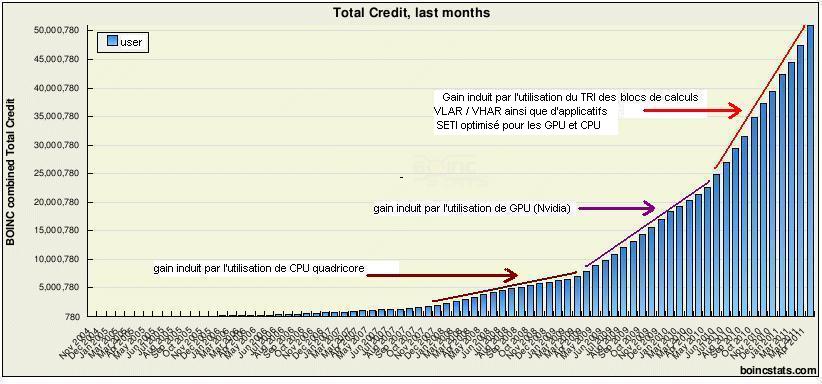
Image: Gain induit CPU- GPU- TRI2.JPG | printed screen of my own statistique from http://boincstats.com/stats/boinc_user_graph.php?pr=bo&id=1210 | License: CC BY-SA 4.0 | Source: Wikimedia | https://commons.wikimedia.org/wiki/File:Gain_induit_CPU-_GPU-_TRI2.JPG