In AI, the model gets the headlines. The data pipeline does the work.
That may sound like an engineering slogan, but it captures a real business reality. The quality, speed, and governance of the data pipeline determine whether an AI system is useful in production or merely impressive in a demo. In practice, a data pipeline is the series of steps that collects, cleans, transforms, routes, stores, and serves data so it can train a model or feed predictions in real time.
For many organizations, the bottleneck in AI is no longer access to a model. It is the ability to move trustworthy data through a system that is fast enough, cheap enough, and compliant enough to support the business.
What a data pipeline actually is
A data pipeline is the infrastructure layer that turns raw data into something an AI system can use. That sounds simple, but in production it spans a lot of moving parts: ingesting data from applications, sensors, logs, databases, or third-party feeds; validating and cleaning it; standardizing formats; enriching it with labels or metadata; and delivering it either to training jobs or to inference systems.
In a basic machine learning workflow, a pipeline may look like this: data arrives from source systems, is transformed into features, is split into training, validation, and test sets, then stored for later retraining or evaluation. In a real-time AI application, the same data may also need to move into a low-latency serving layer so a model can make predictions in milliseconds.
The important point is that the pipeline is not just a file transfer mechanism. It is where data quality, timing, lineage, security, and cost are decided.
Why AI systems depend on pipeline design
The modern AI stack is often described in terms of models, chips, and cloud scale. But large language models, computer vision systems, recommendation engines, fraud detectors, and industrial control tools all depend on data that is current, consistent, and properly governed. If the pipeline is weak, the model inherits those weaknesses.
That creates several practical risks.
First, stale or incomplete data can degrade model accuracy. A model trained on outdated customer behavior, inventory records, or sensor readings will usually perform worse once deployed. That is especially true in dynamic environments like logistics, finance, and cybersecurity, where the underlying patterns shift quickly.
Second, poorly governed data can create compliance exposure. If personal data, regulated records, or proprietary information moves through unmanaged systems, the organization may lose control over retention, access, or auditability. For companies operating under regimes such as GDPR, sector-specific financial rules, or emerging AI governance frameworks, this is not a side issue. It is a deployment constraint.
Third, inefficient pipelines increase compute cost. AI systems are expensive not only because GPUs are expensive, but because data has to be copied, transformed, reprocessed, and sometimes moved across regions or clouds. Waste in the pipeline can drive up storage, network, and compute bills long before a model is even trained.
The difference between training data and inference data
One of the most important distinctions in AI infrastructure is between training and inference.
Training data is the historical material used to build or fine-tune a model. It can be large, messy, and batch-oriented, but it still needs structure. Training pipelines often handle deduplication, label creation, feature engineering, and data versioning so teams can reproduce a model later if necessary.
Inference data is the live input a model sees when it is used in production. This is where latency matters. A recommendation engine, a chatbot, a robotic control system, or a fraud detector may need fresh data in near real time. The pipeline feeding that model has to be reliable enough to keep the system responsive and accurate.
These are not interchangeable problems. A pipeline optimized for overnight training jobs may be too slow for live fraud scoring. A pipeline designed for fast inference may not preserve the metadata needed for audit or retraining. Good AI infrastructure separates these use cases while keeping them aligned.
Where data pipelines meet GPUs and data centers
Data pipelines are often discussed as software, but they have real physical consequences. AI workloads consume large amounts of storage, network bandwidth, and high-performance compute. When a training job pulls petabytes of data from distributed storage, the pipeline determines whether GPUs stay busy or sit idle waiting for inputs.
That matters because expensive accelerators are only valuable when they are fed efficiently. In AI training, idle GPU time is pure waste. Inference systems face a different constraint: they need low latency, which means data may have to be cached close to compute, moved across fast interconnects, or preprocessed ahead of time at the edge.
This is why AI infrastructure planning increasingly includes not just chip procurement, but storage tiering, data locality, network design, and workload placement. Data pipelines are the connective tissue between the model and the facility that powers it.
For hyperscalers and enterprise buyers alike, that changes purchasing decisions. A company may choose a cloud region not because it is cheapest on paper, but because it keeps data near the accelerators that need it. It may invest in faster storage or local caching to reduce the time GPUs spend waiting. It may redesign the pipeline to reduce unnecessary data movement because network egress and cross-region replication can become material line items.
The operational layer most teams underestimate
The first version of an AI project is often built with a narrow objective: get a model working on a sample dataset. The second version has to survive contact with the business.
That is where pipeline maturity becomes visible. Production systems need monitoring for broken data feeds, schema changes, missing values, distribution drift, and access failures. They need lineage tracking so teams can answer basic questions: Where did this data come from? Who touched it? Which version of the pipeline produced this model? Can we reproduce the result if it is challenged later?
These questions sound administrative, but they are central to operational trust. A model with excellent benchmark performance can still fail in the field if the upstream pipeline silently changed. In regulated sectors, that failure can become a legal and reputational problem.
As a result, many organizations are moving toward more disciplined MLOps and data engineering practices: versioned datasets, automated validation tests, feature stores, clear access controls, and pipeline observability. None of this guarantees success. But without it, AI systems tend to become fragile, opaque, and expensive to maintain.
Why governance is becoming part of pipeline design
Data pipelines used to be an internal engineering concern. That is no longer true.
As AI systems touch hiring, lending, healthcare, manufacturing, content moderation, and public services, pipeline design is becoming a governance issue. The pipeline controls whether sensitive data is masked, whether records are retained longer than necessary, whether human review is possible, and whether a model can be explained after the fact.
Policy is pushing in the same direction. Even where rules do not name “data pipelines” explicitly, they increasingly require documentation, traceability, risk management, and accountability. That means pipeline architecture now has policy consequences. A company that cannot show how its data was processed may struggle to prove that its AI system is compliant, fair, or even properly monitored.
For businesses, this turns pipeline work into strategic infrastructure rather than back-office plumbing. The engineering team may own it, but legal, risk, security, and procurement all have a stake in how it is built.
The business case: speed, trust, and lower waste
Why do mature data pipelines matter commercially? Because they reduce three forms of waste.
Waste of time: Teams spend less time hand-fixing data issues, chasing missing fields, or rerunning jobs because of brittle inputs.
Waste of compute: Better pipeline design reduces unnecessary copying, reprocessing, and idle accelerator time.
Waste of trust: Auditable, consistent data flows make it easier to defend model outputs to customers, regulators, and internal stakeholders.
That last point is often underestimated. In many enterprises, AI adoption stalls not because the model is incapable, but because the organization does not trust the inputs or the outputs enough to deploy it widely. A strong pipeline does not solve every problem, but it gives decision-makers something tangible to rely on.
What to look for in a modern AI data pipeline
For teams building or buying AI systems, a useful checklist is more practical than a grand theory. A credible pipeline should support:
- Data quality checks for missing, duplicate, malformed, or out-of-range records.
- Versioning for datasets, features, and transformations.
- Lineage tracking so inputs and outputs can be traced end to end.
- Access control and encryption to limit who can see or move sensitive data.
- Low-latency serving paths for real-time inference where needed.
- Batch processing for training and periodic retraining.
- Monitoring and alerts for drift, failure, and schema changes.
- Cost visibility across storage, compute, and network usage.
If a vendor or internal team cannot explain these elements clearly, that is a warning sign. In AI, pipeline shortcuts often show up later as model failures, compliance friction, or surprise infrastructure bills.
The bottom line
Data pipelines are not the most glamorous part of AI systems, but they are the part that determines whether the rest of the stack is useful. Models learn from what the pipeline gives them. GPUs accelerate what the pipeline can feed them. Compliance teams judge what the pipeline can prove.
As AI moves deeper into production use, the competitive advantage is shifting from simply having a model to operating the whole system well. That means treating data pipelines as core infrastructure: engineered carefully, monitored continuously, and designed with both compute economics and policy constraints in mind.
In the end, AI is not only a model problem. It is a data movement problem.
Sources and further reading
- Google Cloud documentation on data pipelines and MLOps concepts
- Microsoft Azure Machine Learning documentation on data management and model lifecycle
- AWS guidance on data engineering, ETL, and ML pipelines
- OECD AI Principles and related governance documents
- NIST AI Risk Management Framework
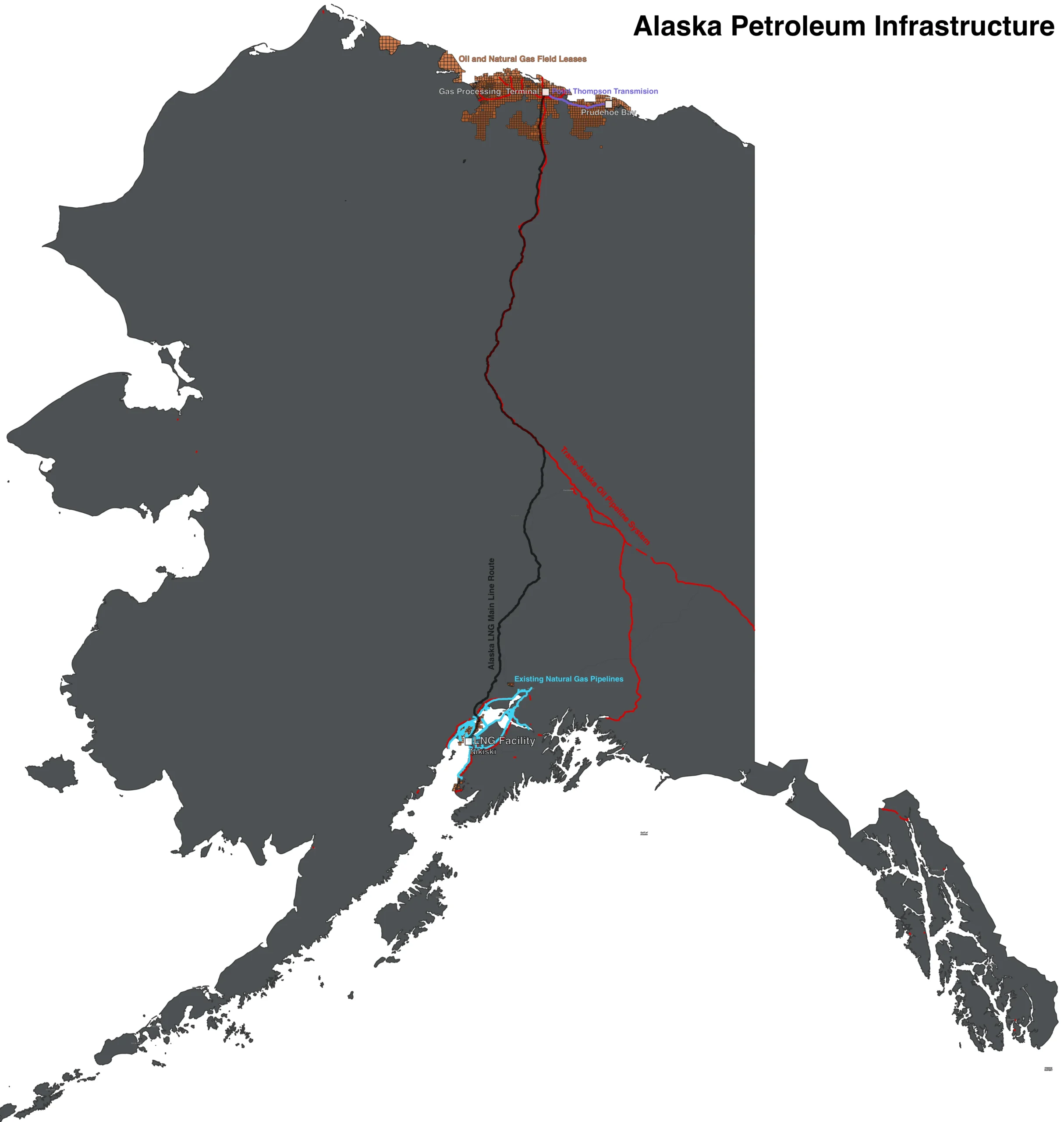
Image: Alaska oil and natural gas pipelines.webp | Own work made with QGIS and data from
https://dog-soa-dnr.opendata.arcgis.com/datasets/78c67a9ed5994d0a8165b85b12ff18f0_0/explore?location=63.927982%2C26.345542%2C5.63
https://gis.data.alaska.gov/datasets/SOA-DNR::pipeline-163360/explore?location=64.976681%2C-147.861610%2C5.88
https://experience.arcgis.com/experience/f59beb7effe74d1f95389a9350abcf49 | License: CC0 | Source: Wikimedia | https://commons.wikimedia.org/wiki/File:Alaska_oil_and_natural_gas_pipelines.webp