The real disruption is not style, but structure
Artificial intelligence has entered art through the front door of convenience. A text prompt can now produce a painting, a logo concept, a storyboard frame, a soundtrack sketch, or a photorealistic scene in seconds. That convenience is the obvious story. The deeper story is structural: AI is changing the economics of creativity by reducing the cost of generating endless variations, and in doing so it is putting pressure on the labor, licensing, and institutional norms that have long supported human-made work.
This is why the debate around AI and art keeps circling the same unresolved question: not whether machines can make things that look creative, but what happens to a culture when the supply of convincing creative output becomes effectively abundant. In economics, abundance usually drives prices down. In creative markets, it can also push audiences, clients, and platforms to treat originality as a feature rather than a default expectation.
That shift has consequences. Some are productive. Many are destabilizing. And almost all of them depend on who owns the models, who gets paid, and who gets to decide what counts as legitimate creative work.
Creativity is not disappearing; its market is being split
It is tempting to frame generative AI as a replacement for artists. That is too blunt. What is actually happening is a market segmentation of creativity. The bottom end of the market—fast, iterative, low-stakes visuals and copy—has become highly automatable. At the high end—work tied to reputation, taste, relationships, narrative coherence, or live performance—human authorship still matters enormously.
That split matters because most creative labor does not live at the high end. It lives in the middle: editorial illustration, marketing assets, concept art, design mockups, stock imagery, background music, social video, and production support. These are not trivial categories. They are the economic substrate for many working creatives, freelancers, and small studios.
AI systems are particularly strong where the brief is broad and the acceptable output is “good enough.” A designer who used to be paid to produce twenty rough concepts may now be asked to produce the one polished version after a prompt-generated draft. A junior illustrator may find that the first round of client exploration has been outsourced to software. A copywriter may be retained for editing rather than ideation. In each case, the machine does not erase the profession outright; it compresses the billable hours attached to it.
That compression is the core labor issue. When the time required to create a first draft falls sharply, the value of that draft falls too. The creative workers most exposed are not famous artists with devoted audiences. They are the people whose jobs rely on repeatable production for commercial clients.
Training data turned art into a governance problem
The most consequential disputes around AI and art are not about aesthetics. They are about data rights and consent. Foundation models are built by training on large corpora of text, images, audio, and video. In the visual arts, that has led to intense criticism from artists who argue that their work was used to train systems without permission, compensation, or meaningful opt-out mechanisms.
The legal framework is still unsettled and varies by jurisdiction. In the United States, fair use arguments remain central to ongoing disputes, but outcomes are fact-specific and not yet fully settled across all use cases. In Europe and the United Kingdom, copyright and text-and-data-mining exceptions create a different policy landscape, though implementation and rights reservations remain contested. These details matter because they determine whether the creative economy is governed by negotiated licensing or by a de facto extractive model in which companies can ingest vast archives first and litigate later.
That governance question is not abstract. It affects the incentives of galleries, stock-photo libraries, publishers, and digital platforms. If model developers can obtain scale by scraping existing creative output at low cost, then human creators bear the cost of the system while the upside accrues to infrastructure owners. If, instead, training data is licensed and compensated, the economics change: model training becomes more expensive, but the ecosystem may become more durable and less adversarial.
There is a strategic comparison here to other compute-intensive industries. Just as data-center growth forces energy and supply-chain tradeoffs onto local communities, AI training forces cultural and legal tradeoffs onto creators. A model is not just a piece of software. It is an industrial process whose inputs are intellectual property, labor, and compute. The question is who pays for those inputs.
The new creative stack favors scale, not singularity
AI tools are often described as democratizing creativity because they lower the cost of entry. That is true, but incomplete. They also centralize leverage. The most capable systems require large-scale compute, expensive chips, disciplined data pipelines, and strong distribution channels. In practice, that means the tools most likely to shape mainstream creative markets are controlled by a small set of platform companies and well-capitalized startups.
That concentration has familiar consequences. When the same infrastructure powers millions of outputs, the system tends to optimize for statistical plausibility and engagement rather than cultural specificity. This is not because the models are malicious. It is because they are trained to predict what resembles the training distribution. As a result, they can produce aesthetically fluent work that still feels generic, derivative, or oddly flattened.
For some uses, that is acceptable. For others, it is a problem. Advertising teams may accept a high-volume workflow that produces adequate imagery for campaign tests. Independent filmmakers, game studios, and museums may not. Their work depends on distinct voice, artistic intent, and the ability to justify why something should look or sound the way it does. AI can assist in those processes, but it does not automatically supply meaning.
This distinction is important because creative labor is not only about output. It is also about judgment under constraints. What to omit, what to emphasize, which references to keep, which texture belongs in the frame, what rhythm serves the scene—these decisions encode experience and taste. AI is very good at recombination. It is much less reliable as a bearer of cultural accountability.
Artists are already adapting, but adaptation has a cost
Many artists are not rejecting AI outright. They are incorporating it into their workflow in ways that preserve authorship while speeding up production. Concept artists use image generation to explore silhouettes or lighting. Writers use models to test phrasings or outline structures. Musicians use AI-assisted tools for stems, mastering, or rough composition. In these cases, AI functions less like a substitute and more like an amplifier.
But adaptation is not frictionless. It requires technical literacy, new editorial discipline, and a willingness to work inside software environments that can be opaque about what they are doing with user inputs. It also creates a new expectation from clients and employers: if the software can do the rough cut in minutes, why does the human part take so long? That question quietly redefines standards for speed and compensation.
There is also a psychological cost that rarely shows up in productivity narratives. For many creators, art is not just output but identity. If the market begins rewarding speed over interpretation, or if audiences start valuing “AI-assisted” work while assuming the machine did the important part, then the social status of creative expertise weakens. That may sound intangible, but status shapes career choice. Young people notice which professions are respected, which are precarious, and which can be replaced by a prompt.
In that sense, the long-term societal impact may be less about the disappearance of artists than the narrowing of the pipeline that produces them. If entry-level creative work becomes harder to monetize, fewer people will be able to build the portfolio, skill, and confidence needed to move into more advanced roles. The labor market problem today can become a cultural supply problem tomorrow.
Copyright will not solve the whole problem, but it will set the rules
Copyright law is not equipped to settle the entire creative-AI debate, but it will shape its boundaries. Three policy questions are especially important.
First, should training on copyrighted works require permission, compensation, or neither? If the answer is neither, then the creative commons effectively becomes a free resource for model builders. If the answer is permission or payment, then AI companies will need to build licensing infrastructure the way streaming companies once had to build music rights systems.
Second, what counts as derivative use? If a model can imitate a living artist’s style closely enough that the market confuses the two, the issue is not merely philosophical. It becomes a question of competition, attribution, and consumer deception.
Third, what obligations should platforms have around provenance? As synthetic images, voices, and videos become more convincing, labels and content credentials become increasingly important. Technical standards such as C2PA, which is being developed to support content provenance, may help—but only if platforms adopt them widely and if users understand what the labels mean. Verification is useful only when it is visible.
Policy will not eliminate the tension between access and protection. But without policy, the strongest actors will define the terms by default. That is usually a poor outcome for both artists and audiences.
The cultural risk is sameness
The most subtle risk of AI-generated art is not fraud or job loss. It is homogenization. When creative systems are optimized to please large numbers of users, they often converge toward recognizable tropes, polished averages, and the safest possible aesthetic. Over time, that can flatten the visual and narrative texture of the internet, especially in commercial media where cost and speed matter most.
We have seen this dynamic before in other media environments. Recommendation systems can narrow taste by rewarding familiarity. Short-form video can compress narrative into attention-efficient fragments. AI can extend the logic further by producing content that is instantly legible but weakly grounded in lived experience.
That does not mean AI art is inherently shallow. It means that without strong editorial standards, the default incentive structure points toward repetition. Human artists are often valuable precisely because they interrupt that pattern. They bring friction, obsession, and idiosyncrasy—qualities that are inefficient in a model-driven pipeline but essential to cultural memory.
The practical question is where human authorship still matters most
The future of creativity is unlikely to be a simple split between human and machine. It is more likely to be a layered system in which AI handles ideation, variation, and mechanical production while humans retain roles in direction, interpretation, accountability, and final judgment. The sectors that succeed will be the ones that define those boundaries clearly.
For publishers, studios, agencies, and brands, that means deciding in advance where AI is acceptable, where disclosure is required, and where human-only work is part of the value proposition. For policymakers, it means treating AI not just as an innovation issue but as a labor and intellectual-property issue. For artists, it means understanding that the market is no longer asking simply, “Can you make this?” but also, “Can you make this in a world where the first draft is free?”
That is the central tradeoff. AI lowers the cost of making things that resemble art. In exchange, it raises the stakes of proving why a particular work, and a particular worker, still matters. Society can choose to value that distinction—or let it erode. The outcome will shape not only the creative economy, but the texture of culture itself.
Sources and further reading
- U.S. Copyright Office guidance and registration materials on AI-generated content
- European Union AI Act and related copyright/text-and-data-mining provisions
- UK Intellectual Property Office materials on AI and copyright
- Content Authenticity Initiative and C2PA technical specifications
- World Intellectual Property Organization discussions on AI and IP
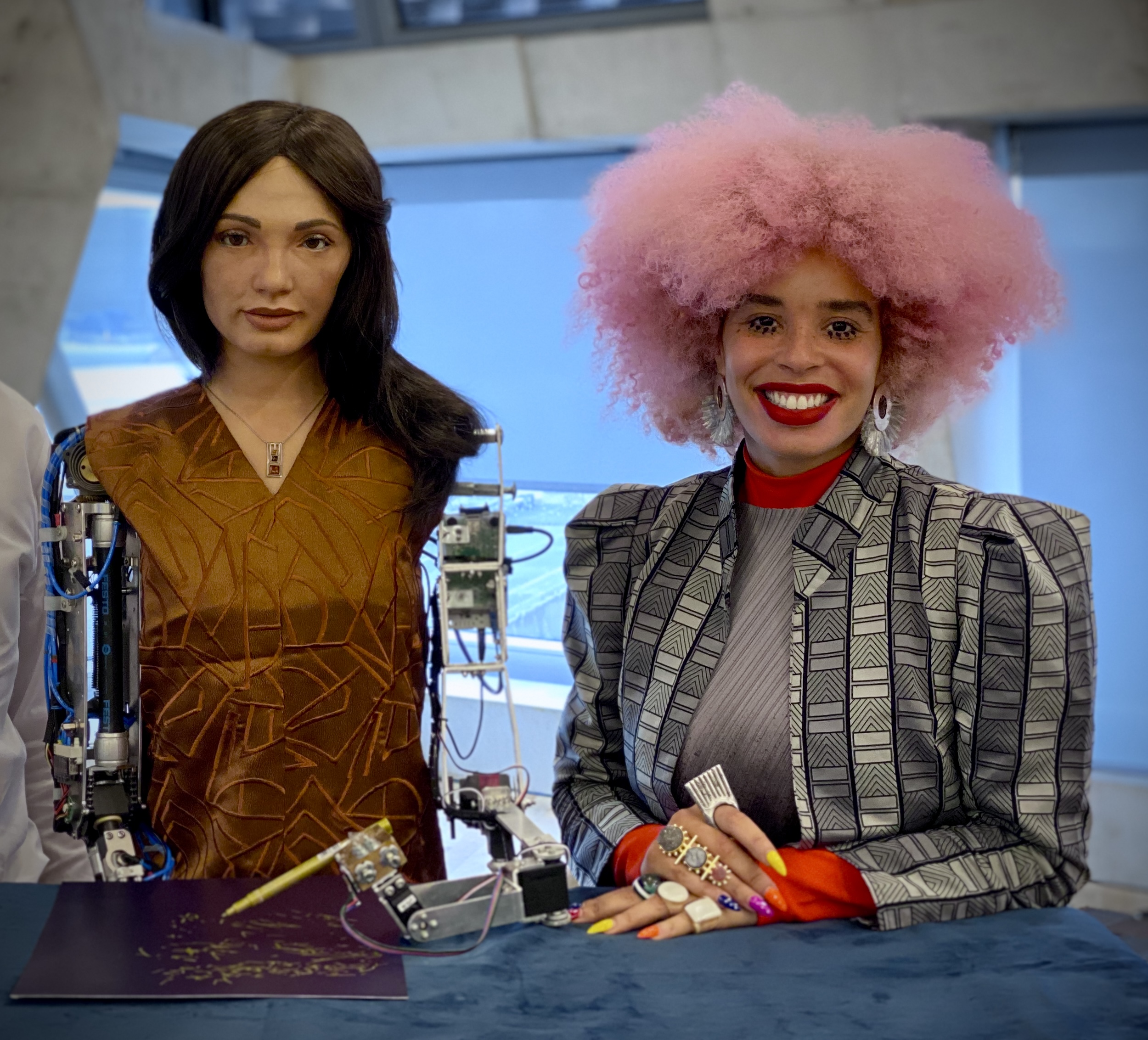
Image: Ai-Da and Sadie Clayton at Tate Modern.jpg | Own work | License: CC BY 4.0 | Source: Wikimedia | https://commons.wikimedia.org/wiki/File:Ai-Da_and_Sadie_Clayton_at_Tate_Modern.jpg