The market is not short on AI demand. It is short on usable infrastructure.
The most important thing startups have exposed about AI infrastructure is that the bottleneck is no longer a single chip or a single cloud provider. It is the whole stack around them: power delivery, GPU availability, memory bandwidth, networking, cooling, deployment software, and the pricing model that turns all of that into something customers can actually use.
That is why the most interesting new companies in this market are rarely trying to “beat NVIDIA” in the abstract. They are finding narrow but expensive friction points and attacking those directly. Some are building inference-focused cloud layers. Others are designing chips for specific workloads, rethinking cluster orchestration, or packaging GPU access in a way that makes enterprise spending more predictable. The broader signal is more revealing than any single company: AI infrastructure is fracturing into specialized layers because the old one-size-fits-all model is too slow, too power-hungry, and too expensive for what customers now need.
Why startups can move faster than the hyperscalers
Large cloud providers still control the dominant AI distribution channels. Amazon Web Services, Microsoft Azure, and Google Cloud have the relationships, capital, and scale to buy enormous quantities of accelerators and build massive data center footprints. But that scale is also a constraint. Their infrastructure products have to serve everything from basic storage to frontier model training, which means product decisions are slower and pricing is often optimized for broad internal economics rather than a single workload.
Startups do not have that burden. They can build for one problem: serving inference cheaply, scheduling jobs more efficiently, or reducing the time GPUs sit idle. That narrower focus matters because AI infrastructure is ultimately an economics problem. The value of a GPU cluster is not just how many chips it contains; it is how consistently those chips are fed, cooled, networked, and monetized.
This is where smaller companies have found leverage. If they can improve utilization by even modest amounts, they can unlock real savings for customers. If they can reduce latency enough to support interactive applications, they can open a new product category. If they can offer stable pricing in a market where on-demand GPU capacity is volatile, they can win operators who care less about brand and more about predictable margins.
Supply chains are the real battlefield
AI infrastructure startups often market themselves as software companies, but their true differentiator is usually supply-chain execution. In a market where leading-edge GPUs are constrained by manufacturing capacity, packaging, memory supply, and data center power availability, the ability to source, assemble, and deploy hardware quickly is strategic.
Advanced accelerators do not exist in isolation. They depend on high-bandwidth memory, advanced packaging, robust interconnects, and systems that can handle large power envelopes. A startup that can secure compute hardware but cannot get enough HBM, switchgear, or transformer capacity is still stuck. Likewise, a company offering “AI cloud” capacity may look scalable on paper while waiting months for rack power, liquid cooling, or network gear.
This is why the startup playbook increasingly includes long-term supply agreements, tightly managed deployment locations, and hardware choices that reflect available constraints rather than theoretical performance. Some operators place clusters where power is cheaper or more available. Others partner with colocation providers instead of building everything themselves. Many are discovering that access to utility capacity and site readiness can matter as much as accelerator performance.
The result is a more fragmented market. One startup may specialize in high-density inference nodes near urban latency-sensitive demand. Another may build lower-cost training capacity in power-rich regions. Another may sit in the middle, aggregating and abstracting capacity for enterprises that do not want to negotiate directly with data center operators, utilities, and GPU suppliers.
Pricing is becoming the product
In AI infrastructure, pricing is no longer just a commercial detail. It is part of the technical offer.
Traditional cloud pricing is built around generalized consumption: compute instances, storage tiers, outbound traffic, and managed services layered on top. That model works when demand is broad and workloads are varied. AI workloads are different. They are spiky, expensive, and increasingly sensitive to efficiency. Training may require large blocks of uninterrupted capacity. Inference may require low latency and elastic scale. Enterprises want to know not only what capacity costs today, but whether it will still exist next quarter.
Startups have turned that uncertainty into a wedge. Some sell reserved GPU capacity at lower effective rates than hyperscalers, especially if customers are willing to commit. Others build marketplaces for excess capacity, where idle accelerators can be rented out more flexibly. Some charge for outcomes such as throughput, tokens served, or workflow completion rather than raw hardware time. That can make the infrastructure easier to budget against, even if the underlying economics remain complex.
But pricing innovation cuts both ways. A company that offers capacity below its true cost will eventually run into supply or margin problems. The best startups in this category are those that pair a pricing model with a real operational advantage: better utilization, lower overhead, more targeted workloads, or a hardware stack tuned for one class of customer. The market is punishing to companies that assume cheap access to GPUs is the same thing as a durable business.
Inference is where the business model is getting sharper
Training gets the headlines, but inference is where the infrastructure market is becoming more commercially disciplined. Once models move into production, economics change. The customer is no longer paying to experiment with a large cluster; they are paying to keep a product alive, continuously, at acceptable latency and cost.
That shift favors startups that can optimize serving rather than raw model building. It also favors companies that understand the hardware/software boundary. Inference performance depends on more than accelerator choice. Model quantization, batching strategy, memory movement, network topology, and runtime scheduling all affect cost per token and user experience.
This is why some startups focus on inference-specific software layers, while others design chips or systems around the inference workload itself. A chip that is less versatile than a top-end training accelerator may still be commercially compelling if it can serve common inference tasks at lower power and cost. Likewise, a software layer that extracts more work from the same GPU pool may create more economic value than another generation of raw compute.
The market signal here is clear: customers do not want more AI infrastructure in the abstract. They want a lower cost per useful response. Startups that understand that distinction are building businesses around measurable gains rather than broad claims.
Execution is now a hardware problem and a customer problem
One reason startup disruption in AI infrastructure has been real, not theatrical, is that execution requires competence in two directions at once. The company has to manage physical constraints—power, cooling, procurement, and deployment—and also sell into buyers who are increasingly sophisticated about performance and cost.
Enterprise buyers now ask practical questions: How much power does the cluster draw per rack? What is the expected queue time? How quickly can capacity be expanded? Is the workload isolated? What happens if a preferred accelerator is unavailable? Can the vendor support compliance, logging, and data residency requirements? These are not branding questions. They are operational ones.
Startups that succeed tend to answer them with specificity. They publish clear SLAs, expose utilization data, or offer managed deployment paths that reduce integration friction. Some use software abstractions to make heterogeneous hardware easier to consume. Others bundle infrastructure with support so customers can buy an outcome rather than assemble a stack from separate vendors. This is especially attractive to smaller AI companies that do not have a dedicated infrastructure team.
There is a deeper strategic lesson here: AI infrastructure startups are often doing the work that the broader market has not yet standardized. They are taking pain points that hyperscalers cannot prioritize and turning them into products. If the product works, the market learns from it. If it fails, the failure usually reveals an underlying constraint that was already there.
What this says about the broader market
The rise of these startups says the AI infrastructure market is still early in its normalization cycle. The basic ingredients—GPUs, memory, power, networking, software orchestration—are all known. What is not settled is how to package them efficiently enough for a market that is growing fast but remains highly uneven across workloads.
That leaves room for specialization. It also means incumbents are vulnerable in narrow bands where their general-purpose architectures are too expensive or too rigid. The startup opportunity is not to replace hyperscale cloud or chip giants wholesale. It is to capture the layers between the chip and the application where inefficiency still lives.
Over time, some of these startups will get acquired, some will merge into broader platform companies, and some will disappear when pricing pressure catches up with their cost structure. That is normal. The more important point is that they are mapping the market’s real fault lines: power availability, supply-chain access, utilization, and the economics of inference.
If you want to know where AI infrastructure is heading, do not just look at the biggest GPU orders or the loudest platform announcements. Look at the startups solving the unglamorous problems. They are revealing which parts of the stack are still broken, which buyers are underserved, and which economics will matter once the hype cycle cools.
Sources and further reading
- NVIDIA annual reports and investor presentations
- SEC filings from major cloud and semiconductor companies
- Uptime Institute research on data center power and resilience
- Open Compute Project documentation on data center infrastructure
- Energy and utility filings relevant to new data center interconnects
- Company product docs and pricing pages from AI infrastructure startups for editorial verification
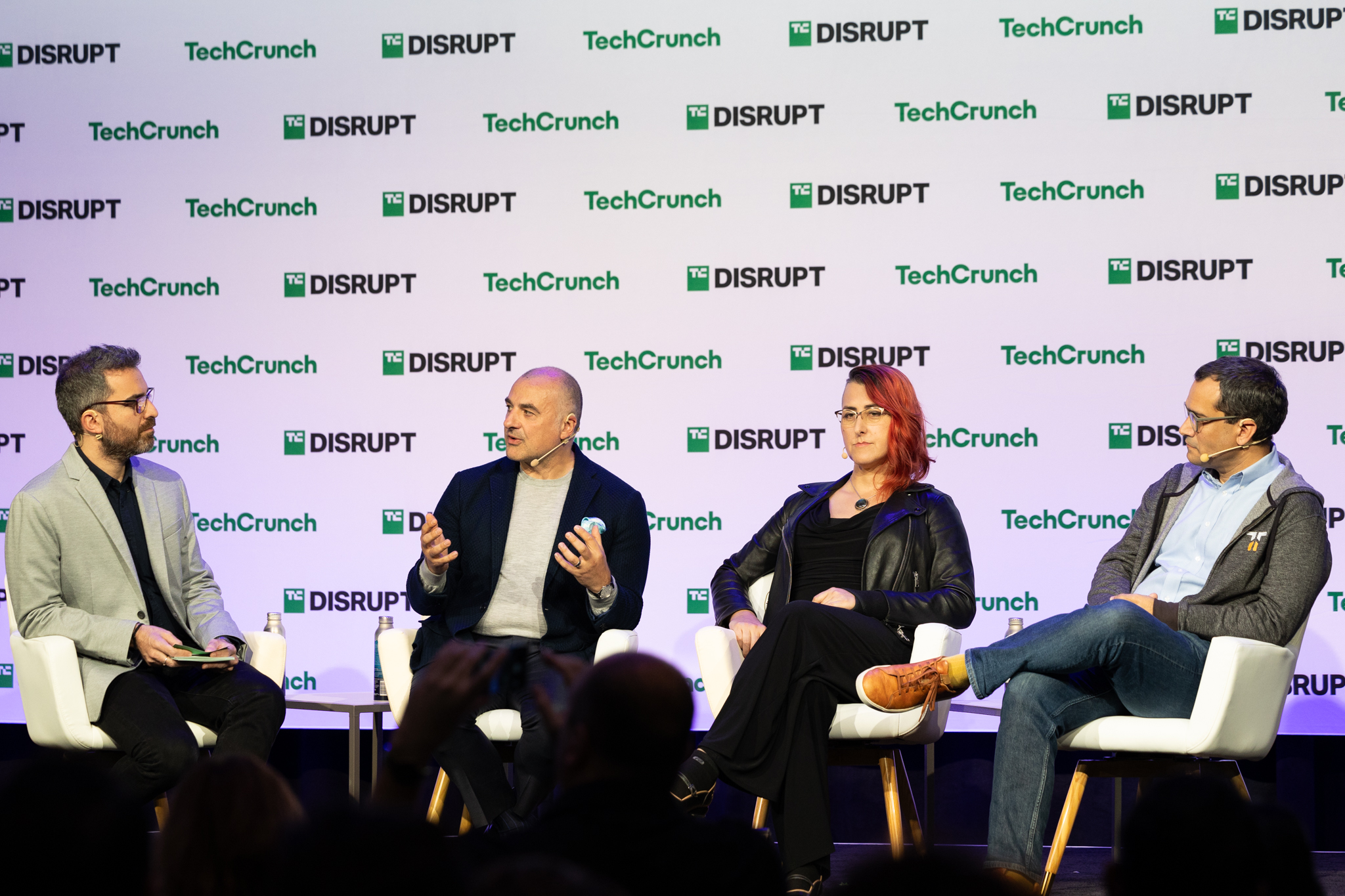
Image: TC Distrupt 2024 Day 3 Builders Stage Startup Free but Not Cheap the Open-Source Dilemma-10 (54105930186).jpg | TC_Distrupt 2024_Day 3_Builders Stage_Startup_Free but Not Cheap_the Open-Source Dilemma-10 | License: CC BY 2.0 | Source: Wikimedia | https://commons.wikimedia.org/wiki/File:TC_Distrupt_2024_Day_3_Builders_Stage_Startup_Free_but_Not_Cheap_the_Open-Source_Dilemma-10_(54105930186).jpg