The AI infrastructure market is no longer being defined only by the biggest cloud platforms or the largest GPU buyers. A growing set of startups is reshaping the stack by focusing on the hard, unglamorous problems that determine whether AI systems are affordable, fast, and reliable at scale. In practice, that means rethinking how compute is scheduled, how models are served, how memory is used, how traffic moves through clusters, and how tightly software should be coupled to expensive hardware.
This matters because AI infrastructure is not one product category. It is a layered system built across chips, servers, networking, storage, cooling, and software orchestration. The startups making the biggest impact are often not trying to replace the cloud. They are trying to change the economics of the cloud by making every GPU cycle, every watt, and every network hop count a little more.
Why startups found an opening
For years, AI infrastructure was dominated by hyperscalers because they had the capital to buy hardware, the data centers to run it, and the internal engineering teams to glue everything together. That is still true at the top end. But the market changed once model training and inference became a recurring operational expense rather than a research project.
Suddenly, customers started asking different questions. Not just “Can I train a model?” but “Can I serve it at 5x lower cost?” Not just “Do you support GPUs?” but “Can you keep utilization above 80%?” Not just “Can the cluster run?” but “Can I move workloads between regions, clouds, and chip types without rewriting everything?” Those questions created space for startups that could solve specific bottlenecks better than general-purpose platforms.
That opening is especially visible in the software layer. Startups have been building scheduling systems, inference engines, observability tools, and storage layers designed specifically for AI workloads. Their pitch is simple: traditional cloud primitives were built for broad enterprise computing, not for the bursty, memory-hungry, bandwidth-sensitive workload patterns that modern AI systems create.
The product strategy: narrow the scope, deepen the value
The strongest AI infrastructure startups rarely begin with a broad platform story. They begin with a painful bottleneck and solve it in a way that is hard for large vendors to copy quickly. That is a classic startup strategy, but AI infrastructure makes it more valuable because the stack is so fragmented.
One company may focus on inference optimization, where small gains in token throughput translate into immediate margin improvements for AI product teams. Another may focus on cluster orchestration, helping customers pack more jobs onto fewer GPUs. Another may focus on data movement, because feeding accelerators efficiently can be just as important as the accelerators themselves.
This product discipline matters structurally. By staying narrow at first, these companies can build a sharper feedback loop with customers. They learn where latency spikes, where memory fragmentation hurts performance, where developers waste time on manual tuning, and where the real cost center sits. In AI infrastructure, that kind of operational visibility often becomes the product moat.
Case study logic: from tool to market structure
The most interesting startups are not just selling tools. They are changing how the market is organized.
Consider a startup that helps customers run inference across multiple GPU types and cloud providers. The initial product may look like a scheduling layer or a deployment abstraction. But the strategic effect is larger. It reduces dependence on any single cloud, weakens lock-in to one accelerator family, and gives buyers more leverage in procurement. If a company can shift workloads between hardware options based on price, availability, or performance, then the market for compute becomes more competitive.
That is a serious shift in market structure. Historically, AI buyers often accepted whatever capacity the hyperscaler or GPU vendor made available. Startups that improve portability and workload efficiency create something closer to a real market, where buyers can compare options and arbitrage cost across infrastructure choices.
That same logic applies to startup-built observability layers. Better monitoring does more than surface dashboards. It gives operators the data needed to understand where money is being spent and where performance is lost. Once teams can see utilization, queueing, memory pressure, and network congestion in one place, they can make more rational decisions about deployment architecture. That pushes the whole market toward transparency and away from ad hoc infrastructure spending.
Hardware still matters, but software decides the bill
It is tempting to think of AI infrastructure as a GPU story. GPUs are central, but they are only one part of the economics. The real question is how well the surrounding stack uses them.
A cluster with excellent accelerators but poor scheduling can underperform a cheaper system with smarter orchestration. A data center with abundant power but weak cooling design may face throttling or density limits. A network fabric with insufficient bandwidth can leave high-end silicon waiting for data instead of computing. In other words, the hardware bill is only the starting point; the software stack determines how much value the hardware actually produces.
Startups exploit this gap by concentrating on efficiency. They often win deals not because they offer the fastest raw hardware, but because they help customers extract more useful work from the same chips. In a market where access to GPUs is expensive and sometimes constrained, efficiency is a form of supply.
Why incumbents are vulnerable
Big cloud providers and large infrastructure vendors have undeniable advantages: capital, distribution, and installed customer relationships. But they also carry organizational baggage. Their products must serve many use cases, not just AI. That makes them slower to redesign around one workload class.
Startups can move faster because they do not need to support every legacy path. They can assume that the customer is running LLM inference, distributed training, vector search, or AI-agent workloads, and optimize accordingly. That focus lets them make stronger tradeoffs in product design. They can sacrifice generality for performance, or abstract away complexity in ways that would be too risky for a broad platform provider.
This is why the disruption is not necessarily a head-on battle for the entire cloud. It is a wedge strategy. Startups win the control plane, the cost layer, or the serving layer first. Once they sit in that operational path, they become embedded in how infrastructure is bought and managed.
The market is moving from scarcity to optimization
The first phase of the AI boom was defined by scarcity: not enough GPUs, not enough capacity, not enough power. That scarcity benefited whoever could secure supply. The next phase is defined by optimization: how to get more output from the assets already deployed.
That change favors startups because optimization markets reward specialized software. When capacity is tight, customers will pay for tools that reduce waste, improve throughput, or shorten deployment time. They will also experiment more aggressively with alternative stacks if those stacks promise lower unit economics.
We are already seeing the implications. More teams are evaluating non-hyperscaler options for inference. More operators are willing to mix hardware vendors. More data center builders are treating AI workload patterns as a design input rather than a generic server problem. Even chip vendors are being pushed to support more open software ecosystems because infrastructure buyers want choice, not dependency.
What to watch next
The next wave of AI infrastructure startups will likely focus on three areas: making inference dramatically cheaper, improving multi-cloud and multi-chip portability, and helping operators manage power, cooling, and utilization as first-class variables. Those are not flashy problems. They are the problems that determine whether AI economics work in the real world.
That is why this category matters so much. The startups disrupting AI infrastructure are not just building better tooling. They are changing the terms on which compute is consumed, priced, and controlled. In a market where every percentage point of efficiency can mean millions of dollars, that is a structural shift—not a feature update.
The companies that win here will be the ones that understand a simple truth: in AI infrastructure, product design is market design.
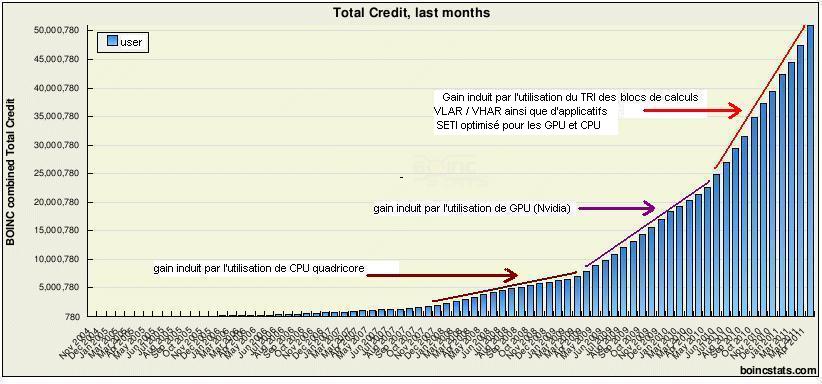
Image: Gain induit CPU- GPU- TRI2.JPG | printed screen of my own statistique from http://boincstats.com/stats/boinc_user_graph.php?pr=bo&id=1210 | License: CC BY-SA 4.0 | Source: Wikimedia | https://commons.wikimedia.org/wiki/File:Gain_induit_CPU-_GPU-_TRI2.JPG