The simple distinction, and why it matters
Cloud computing and edge computing are not competing religions. They are different ways of placing compute, storage, and software closer to the work that needs to be done. Cloud computing concentrates those resources in large, centralized data centers. Edge computing pushes some of them outward, toward devices, factories, vehicles, stores, cell towers, and other places where data is created and decisions need to happen quickly.
The difference sounds neat on paper, but in practice it changes everything: latency, bandwidth use, operating cost, reliability, privacy, and even the architecture of applications. If cloud computing is the central nervous system of modern digital infrastructure, edge computing is the reflex arc. One is optimized for scale and coordination. The other is optimized for speed and proximity.
For most real systems, the answer is not cloud or edge. It is cloud and edge, with a clear division of labor.
What cloud computing actually means
Cloud computing refers to delivering computing resources as a service over a network, usually from large data centers run by providers such as Amazon Web Services, Microsoft Azure, and Google Cloud. Instead of buying and managing every server, company storage array, and networking appliance on-premises, organizations rent access to infrastructure, platforms, and software as needed.
That model has three practical layers:
- IaaS (Infrastructure as a Service): virtual machines, storage, and networking.
- PaaS (Platform as a Service): managed runtime environments, databases, and application services.
- SaaS (Software as a Service): complete applications like email, collaboration, and CRM.
The cloud’s core advantages are scale and elasticity. A company can spin up thousands of servers for a training run, then shut them down. It can store vast amounts of data in one place and run analysis where the compute is already abundant. It can centralize identity, security policy, backup, logging, and analytics. That is why the cloud became the default home for enterprise software, web applications, and data-heavy workloads.
But the cloud has a physical reality that marketing often obscures: every request still has to travel across networks to a distant data center and back. For many applications, that is fine. For others, it is the defining constraint.
What edge computing adds
Edge computing moves computation closer to where data is generated or where a response is needed. The edge can mean many things: a factory machine controller, a retail checkout system, a gateway in a hospital, an on-premises server in a warehouse, a 5G base station, a smart camera, or a vehicle’s onboard computer.
The reason to use the edge is straightforward: some jobs are too time-sensitive, too bandwidth-intensive, or too privacy-sensitive to send entirely to the cloud. If a production line must shut down a robot arm in milliseconds, a round trip to a distant region is too slow and too fragile. If thousands of cameras are generating continuous high-resolution video, shipping every frame to a cloud region can be expensive and unnecessary. If a hospital system needs local processing for patient data, reducing data movement may simplify compliance and limit exposure.
Edge computing is therefore less about replacing the cloud than about reducing dependence on it for specific tasks. The edge can filter, compress, aggregate, pre-process, or infer locally before sending only the important data upstream.
Latency is the most visible difference
The most commonly cited reason to choose edge over cloud is latency, meaning the time between a request and a response. In systems where a few hundred milliseconds barely matter, the cloud is often ideal. In systems where timing determines safety, efficiency, or product quality, latency becomes a design constraint.
Consider a logistics warehouse using autonomous mobile robots. Route planning, fleet coordination, and historical analytics can live in the cloud. But immediate obstacle detection and emergency stop decisions must happen locally. Waiting on a network round trip would be the wrong engineering choice.
The same logic applies to industrial automation, gaming, augmented reality, telemedicine, and connected vehicles. The more tightly a workload is coupled to the physical world, the more likely it is to need some edge processing.
Bandwidth, cost, and the economics of moving data
Not every problem is about speed. Some are about cost. Raw data is expensive to move, especially when it arrives continuously in high volume. Cameras, sensors, and industrial equipment can produce streams that are useful only after local filtering. Sending everything to the cloud can inflate network usage, storage bills, and downstream processing costs.
This is why edge architectures often perform simple but important tasks locally:
- discarding irrelevant frames from a video stream
- compressing sensor data
- running a small machine learning model for anomaly detection
- aggregating events before transmission
Once the edge has done that first pass, the cloud can take over for deeper analysis, model retraining, reporting, and long-term retention. This split is not just technically elegant; it is economically rational.
Reliability and control are part of the trade
Cloud systems are powerful, but they depend on network connectivity. Edge systems are more resilient when connectivity is intermittent or when local continuity matters more than centralized orchestration. A remote mine, a maritime vessel, a clinic in a rural area, or a factory with strict uptime requirements may not want its core operations to stop because a link to a cloud region is degraded.
That said, edge computing introduces its own operational burden. A cloud provider manages fleets of standardized servers in a handful of regions or availability zones. Edge deployments may involve hundreds or thousands of distributed nodes in less controlled environments. They are harder to patch, monitor, secure, and replace. Physical tampering, power variability, environmental conditions, and inconsistent hardware all become part of the problem.
The edge often improves operational independence, but it does not remove complexity. It redistributes it.
Where the cloud still wins
The cloud remains the better choice for many workloads because it is good at what centralized infrastructure does best: massive scale, shared services, and coordination across users and systems.
Cloud is usually the right place for:
- large-scale data warehousing and analytics
- model training for machine learning and generative AI
- backup, disaster recovery, and archival storage
- enterprise applications used across many locations
- batch jobs that are not time-sensitive
Training large AI models is a clear example. The process requires enormous clusters of GPUs, high-bandwidth networking, fast storage, and tight orchestration. Those needs are best served by centralized hyperscale data centers. Even when inference moves to the edge, training often stays in the cloud because it benefits from pooled compute and concentrated infrastructure.
That division is one reason the cloud remains foundational even as edge deployments expand. The cloud is where the system’s heavy lifting, long-term memory, and global coordination often live.
Where the edge becomes indispensable
Edge computing becomes indispensable when the physical world cannot wait for the cloud. A few examples make the pattern clearer.
Manufacturing: Vision systems inspect products on a line. If a defect is detected, the local controller rejects the part immediately. The cloud may receive images and logs later for audit and model improvement.
Retail: Stores use local systems for checkout, inventory tracking, and computer vision-based loss prevention. Central systems can synchronize across locations, but the store still needs to function if the WAN link blips.
Healthcare: Medical devices and hospital systems may keep sensitive data local while forwarding only de-identified summaries or events for broader coordination.
Automotive and robotics: Robots and vehicles use onboard compute for perception and control. They cannot depend on a remote server to avoid a collision.
Telecom: Some network functions are pushed closer to users to reduce latency and relieve backbone traffic, especially in 5G architectures and multi-access edge computing deployments.
Cloud and edge are increasingly intertwined
In real deployments, the cloud and edge are usually connected by an application pipeline. The edge collects data, makes immediate decisions, and handles local resilience. The cloud stores the history, coordinates fleets of devices, performs analytics, and updates models or software back down to the edge.
This creates a distributed system with different tiers of responsibility:
- Device: sensors, cameras, actuators, robots
- Edge node: local processing, filtering, inference, control
- Cloud: orchestration, storage, training, analytics, policy management
That layered architecture is increasingly common in industrial IoT, autonomous systems, smart cities, and enterprise AI deployments. The frontier is not a simple migration from one model to the other. It is a redesign of where computation should live at each step of the workflow.
The infrastructure implications are real
The cloud-edge split is also reshaping infrastructure spending. Cloud data centers demand immense power, cooling, networking, and GPU supply. Edge deployments demand a different kind of investment: ruggedized hardware, local servers, embedded accelerators, management software, and secure remote provisioning. Both rely on semiconductors, but they stress different parts of the stack.
For chip vendors, this matters. Cloud data centers tend to consume high-end CPUs, GPUs, accelerators, networking silicon, and high-capacity memory. Edge devices may need smaller AI accelerators, power-efficient CPUs, and specialized networking chips optimized for constrained environments. The economic value moves with the workload.
That shift is one reason the cloud-edge debate has practical consequences far beyond IT departments. It influences factory design, telecom architecture, automotive platforms, and the shape of future compute demand.
What to ask before choosing one
If you are evaluating cloud versus edge for a product or system, the right question is not “Which is better?” It is “Where does this function belong?”
Start with five questions:
- How fast must the response be? If milliseconds matter, edge is likely required.
- How much data is generated? If the volume is high, local filtering can reduce cost.
- What happens if connectivity drops? If the system must keep working offline, edge capacity matters.
- How sensitive is the data? If privacy, locality, or compliance are major issues, keeping data nearer the source may help.
- What needs centralized coordination? If global visibility, analytics, or model training matter, the cloud is still essential.
In practice, most teams end up with hybrid systems: edge for immediate action, cloud for scale and oversight. That is not a compromise. It is usually the correct architecture.
The bottom line
Cloud computing and edge computing solve different parts of the same problem: how to process the world’s growing volume of data efficiently, securely, and quickly. The cloud gives organizations scale, flexibility, and centralized control. The edge gives them proximity, responsiveness, and resilience.
The sharpest way to think about the difference is this: the cloud is where systems remember and coordinate; the edge is where systems react and survive. Modern infrastructure increasingly needs both.
Sources and further reading
- NIST cloud computing definitions and security guidance
- Microsoft Azure Architecture Center: edge computing and hybrid cloud patterns
- Amazon Web Services: edge computing and hybrid infrastructure documentation
- Google Cloud architecture guidance on distributed systems and edge deployments
- ETSI Multi-access Edge Computing (MEC) specifications
- OpenFog Reference Architecture
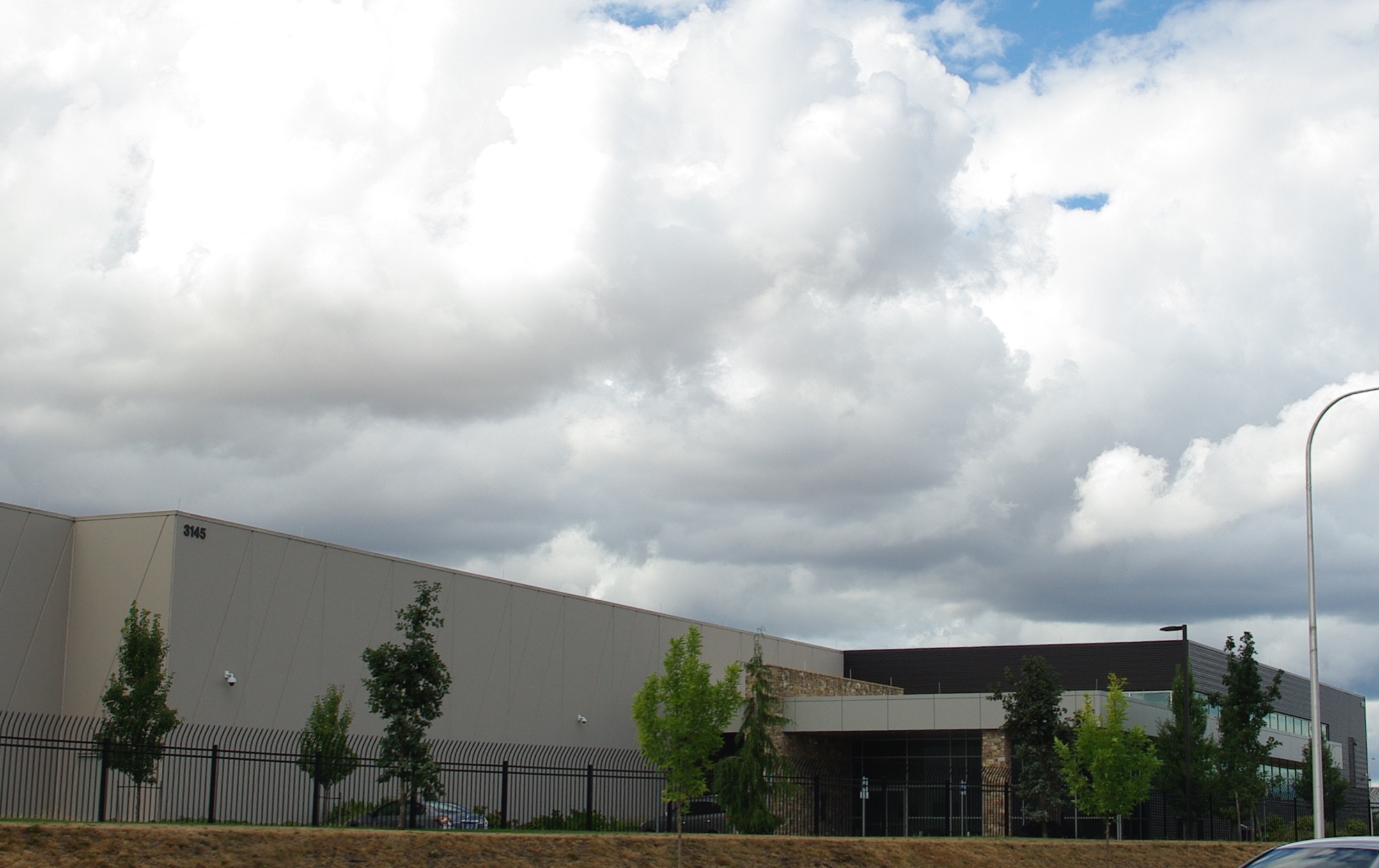
Image: Stack Infrastructure data center – Hillsboro, Oregon.jpg | Own work | License: CC BY-SA 4.0 | Source: Wikimedia | https://commons.wikimedia.org/wiki/File:Stack_Infrastructure_data_center_-_Hillsboro,_Oregon.jpg