Why semiconductor manufacturing is really a story about power
Semiconductor manufacturing is often described as a race for smaller transistors. That is true, but incomplete. The bigger story is that chipmaking has become a concentration of industrial power: a small number of companies control the tools, the process knowledge, the capital, and the execution required to turn designs into functioning silicon at scale.
That concentration matters because nearly every modern industry depends on chips that are difficult to make and even harder to replace. The most advanced AI accelerators, smartphone processors, high-end networking silicon, automotive controllers, and power-management chips all sit somewhere on the same manufacturing map. A company that can reliably make leading-edge chips does not just supply technology markets; it shapes them.
The semiconductor manufacturing landscape is therefore best understood not as a list of foundries and fabs, but as a layered system. At the center are a few major players: Taiwan Semiconductor Manufacturing Co. (TSMC), Samsung Electronics, and Intel. Around them sit large integrated device manufacturers, specialty fabs, and critical equipment suppliers such as ASML, Applied Materials, Lam Research, and Tokyo Electron. Each has a different role, and each reveals something important about how the industry actually works.
TSMC: the market’s clearest signal
TSMC is the most important semiconductor manufacturer in the world because it represents the modern foundry model at full scale. In plain English, TSMC does not primarily design chips for itself; it manufactures chips for other companies. That includes designers in smartphones, data centers, networking, automotive, and high-performance computing. The result is a company that sits at the center of the most valuable parts of the chip economy without competing directly in most end markets.
What TSMC reveals about the market is this: advanced manufacturing has become a utility for the digital economy. If you want to build cutting-edge silicon, you need not only a good design but also access to a manufacturer that can execute complex process steps with extremely high yield. That includes extreme ultraviolet lithography where appropriate, sophisticated process control, advanced packaging, and the ability to ramp production without destroying economics.
The company’s dominance is not accidental. It comes from decades of accumulated process expertise, huge capital investment, and a customer model that rewards trust and scale. A leading-edge fab can cost tens of billions of dollars once equipment, facilities, and supporting infrastructure are included. The barrier is not only money, though money is enormous; it is the organizational discipline required to hit performance, power, and yield targets across multiple product generations.
TSMC also shows why geography is now inseparable from semiconductor strategy. The company’s concentration in Taiwan has made it central to discussions of supply chain resilience, industrial policy, and geopolitical risk. For customers, this means that chip sourcing is no longer just an engineering decision. It is also a logistics, continuity, and national security decision.
Samsung: the reminder that scale does not guarantee leadership
Samsung Electronics remains one of the largest and most capable semiconductor manufacturers, but its role is different from TSMC’s. Samsung operates across memory, logic, and foundry manufacturing, which gives it enormous scale and integration. That breadth is an advantage in some markets and a challenge in others.
Samsung’s memory business — especially DRAM and NAND flash — is a reminder that semiconductor manufacturing is not only about the newest node. Memory is a high-volume, capital-intensive industry where manufacturing efficiency, cost control, and market timing matter as much as pure transistor miniaturization. The logic and foundry side of the business, however, is where the company competes for advanced customers that often compare it directly with TSMC.
What Samsung reveals about the market is that vertical integration can be both strength and constraint. A company that makes many of its own chips can optimize internal supply and capture more of the value chain. But a foundry customer wants neutrality, guaranteed capacity, and confidence that its designs are not competing with the manufacturer’s own products. That tension is one reason TSMC’s pure-play model has been so successful.
Samsung also illustrates the technical difficulty of advancing leading-edge manufacturing. The most visible measure is not just node naming, which is increasingly non-comparable across companies, but whether a manufacturer can sustain yield, density, power efficiency, and design ecosystem support at the same time. In advanced chips, the process technology is only one part of the equation; the surrounding design rules, packaging options, and customer adoption matter just as much.
Intel: the importance of catching up in public
Intel is one of the most consequential names in semiconductor manufacturing because it is trying to do something unusually difficult: regain manufacturing leadership while still serving a massive product business. Historically, Intel was the emblem of integrated chipmaking, designing and manufacturing its own processors. That model gave it deep process control and, for years, an edge in performance.
Intel’s recent story reveals how unforgiving semiconductor manufacturing has become. If a company slips on process execution, competitors can move faster, customers can diversify, and the recovery becomes a multiyear industrial project rather than a simple product refresh. Intel’s effort to re-establish manufacturing credibility has therefore become a public test of whether a once-dominant integrated manufacturer can re-enter the very front of the process race.
The company’s foundry ambitions are particularly important. Intel Foundry is meant to make Intel more than a captive manufacturer for Intel-designed chips. If successful, it could give the United States a major alternative source for advanced manufacturing and reduce some dependence on Asia-centered supply chains. But that is a formidable task. Foundry customers demand not only leading process nodes, but also predictable roadmaps, strong IP protection, diverse packaging options, and a mature ecosystem of design tools and verification support.
Intel reveals another truth about this market: manufacturing leadership is no longer a permanent title. It must be earned, maintained, and financed continuously. In semiconductors, yesterday’s process advantage does not stay valuable for long if the next generation slips.
Why the equipment makers belong in the same conversation
The biggest semiconductor manufacturers do not operate alone. Their capabilities depend on a global machinery stack that is itself highly concentrated. ASML is the most obvious example because its EUV lithography systems are indispensable for advanced chipmaking. Without those machines, the most advanced process nodes would be far more difficult and in some cases impossible to manufacture economically at scale.
Applied Materials, Lam Research, and Tokyo Electron matter for a different reason: they supply deposition, etch, and process tools that define what a fab can actually do. Semiconductor manufacturing is not a single machine but a long sequence of tightly controlled steps. The quality of a transistor depends on how carefully films are deposited, patterns are transferred, materials are etched, and defects are minimized. The equipment layer is where the physics of chipmaking meets industrial reality.
This matters because a fab’s success is often limited less by design ambition than by tool availability, process integration, and supply-chain execution. Even a company with deep capital reserves cannot simply order leadership on demand. It must secure tools, qualify processes, train teams, and ramp production with extraordinary precision.
Foundries versus integrated manufacturers: two different kinds of scale
One of the most useful ways to understand semiconductor manufacturing is to separate foundries from integrated device manufacturers, or IDMs. Foundries like TSMC manufacture chips designed by other companies. IDMs like Intel and Samsung design at least some of their own chips and also manufacture them, though Samsung and Intel each have elements that blur the line depending on the product segment.
Foundries thrive on customer trust, neutrality, and process specialization. IDMs thrive on control, product integration, and the ability to tune design and manufacturing together. Neither model is universally better. The foundry model has won in many advanced logic segments because it spreads the cost of massive fabs across many customers. The IDM model remains powerful in areas like memory, mature-node industrial chips, and tightly integrated product lines.
What this reveals about the broader market is that semiconductor manufacturing is not becoming simpler as it becomes more specialized. The industry has split into layers because no single company can easily dominate every product class, every node, and every geography. Instead, each major manufacturer becomes excellent in a narrow but critical domain.
The real bottlenecks are not just chips
When readers hear about semiconductor manufacturing, they often imagine a factory making tiny transistors. The reality is broader and more fragile. A leading fab requires ultra-clean water, stable power, specialized chemicals, advanced packaging capacity, logistics that can handle delicate components, and a workforce that understands both software-driven automation and analog process control.
That is why semiconductor manufacturing increasingly intersects with energy infrastructure and public policy. New fabs need reliable electricity, resilient grids, and in many regions government support through grants, tax incentives, or permitting reform. The CHIPS and Science Act in the United States, as well as similar industrial policies in Europe and parts of Asia, reflect the recognition that manufacturing capacity is now strategic infrastructure.
Advanced packaging is also becoming more important. As transistor scaling becomes harder and more expensive, performance gains increasingly come from chiplets, 2.5D interconnects, and high-density packaging technologies. This shifts value toward manufacturers that can assemble complex systems, not just print smaller features on silicon. The companies best positioned in the next phase may be those that can combine front-end wafer fabrication with back-end integration.
What the biggest manufacturers tell us about the next decade
The biggest players in semiconductor manufacturing are not just large because they make many chips. They are large because they sit at the point where physics, capital, policy, and software-defined product demand all collide. TSMC shows the power of a pure-play foundry model. Samsung shows the strengths and tradeoffs of vertical integration. Intel shows how hard it is to rebuild manufacturing leadership once it has slipped.
For the broader market, the lesson is straightforward: chip manufacturing is no longer a background industrial activity. It is a strategic bottleneck that shapes AI infrastructure, consumer electronics, automotive electrification, defense systems, and data center buildouts. The companies that control this layer do not just participate in technology cycles. They help determine which cycles are possible.
That is why semiconductor manufacturing deserves attention even when the headlines focus elsewhere. A product launch may capture the market’s imagination, but the real constraint is often whether the silicon can be made at scale, on time, and in the right place. The biggest manufacturers are the ones that quietly decide that answer.
Sources and further reading
- TSMC annual report and investor presentations
- Intel annual report and Intel Foundry materials
- Samsung Electronics annual report and semiconductor division materials
- ASML annual report and EUV technology overview
- Applied Materials, Lam Research, and Tokyo Electron investor materials
- U.S. CHIPS and Science Act documentation
- European Chips Act materials
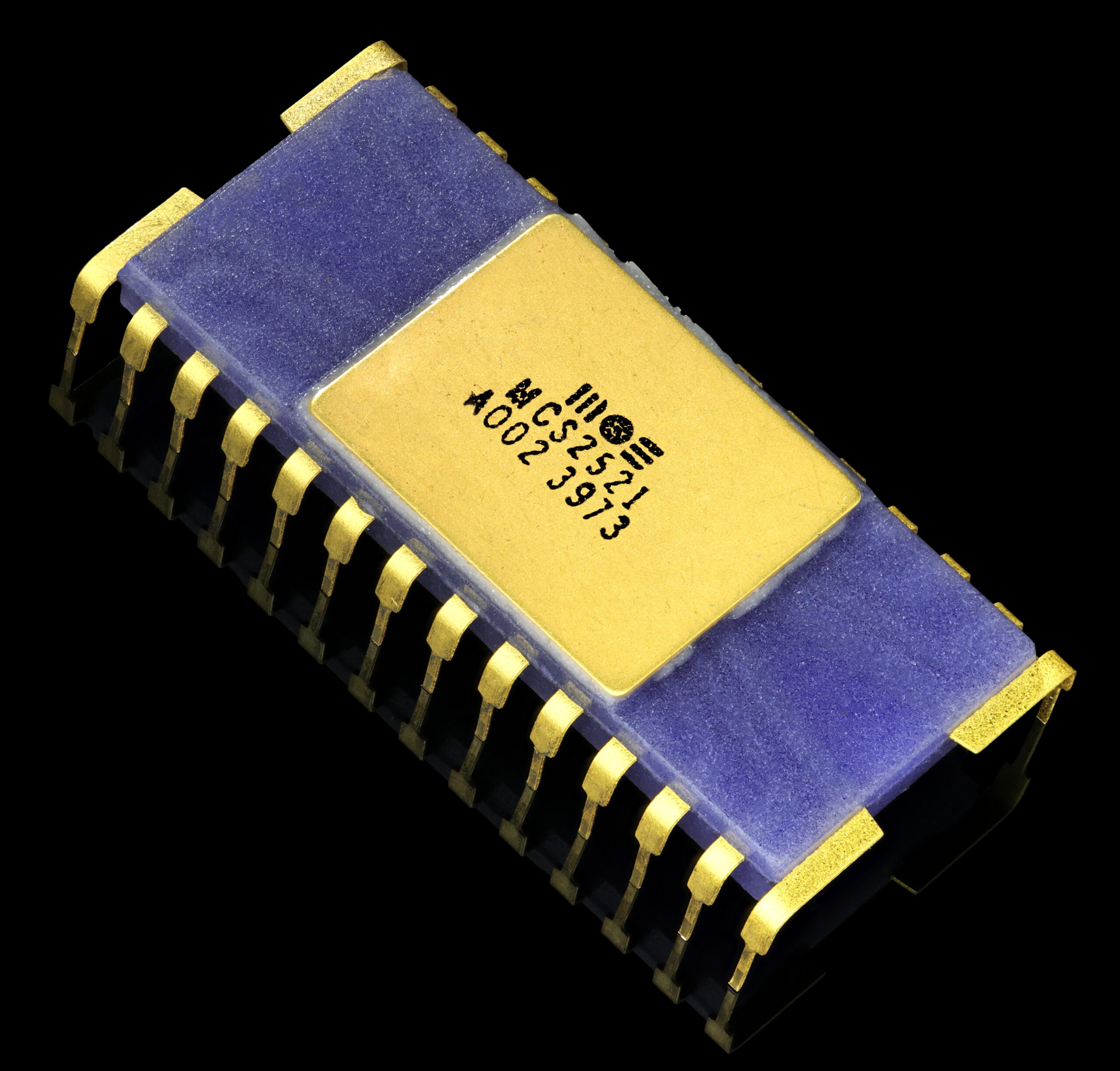
Image: MCS2521A.jpg | Own work | License: CC BY-SA 4.0 | Source: Wikimedia | https://commons.wikimedia.org/wiki/File:MCS2521A.jpg