Google still matters because it spans the whole AI stack
In AI, it is tempting to rank companies like a horse race. Who has the best model, the fastest chip, the most users, the biggest datacenter buildout. That framing misses why Google still matters. Google is not just another participant in the AI market; it is one of the few companies that sits across nearly every layer of it.
That matters because AI is not a single product category. It is a stack of interdependent systems: compute hardware, networking, cloud infrastructure, model training, inference serving, software integration, and a distribution layer that can put AI in front of billions of users. Google has meaningful exposure to all of those layers through Tensor Processing Units (TPUs), Google Cloud, DeepMind, Gemini, Android, Chrome, Search, YouTube, and its broader advertising business.
The company’s strategic importance is not that it always wins every headline contest. It is that its choices reveal where the market is under pressure: where margins are tightening, where compute is scarce, where model quality is not enough by itself, and where product distribution still determines whether AI becomes infrastructure or remains a demo.
Google’s real advantage is structural, not theatrical
Many AI companies look stronger in the short term because they are easier to explain. A startup can show a model, a product, and a growth curve. Google is harder to summarize because its AI position is embedded in a mature business that already runs at global scale.
That scale creates both opportunity and constraint. On one hand, Google can absorb the capital intensity of AI infrastructure better than most firms. On the other, it must introduce AI without damaging the economics of Search and advertising, which remain the core of the company’s business model. That tension is central to understanding why Google matters. The company is not simply building AI products; it is testing how AI changes one of the world’s most valuable information businesses.
That makes Google a useful proxy for the broader market. If AI can improve search quality, enterprise workflows, cloud margins, and consumer engagement at Google’s scale, it is more likely to become durable infrastructure. If it cannibalizes high-margin services faster than it creates replacement value, that is a signal for the rest of the industry too.
TPUs show the economics of AI are not settled
One of the clearest reasons Google still matters is its in-house chip strategy. Google developed TPUs to support machine learning workloads years before the current AI boom, and that history now looks strategically important. In a market dominated by demand for Nvidia GPUs, TPUs show that the compute layer is still open to specialization.
For training large models and serving inference at scale, hardware choices shape cost, latency, and supply-chain exposure. Nvidia’s general-purpose ecosystem remains the market standard, but Google’s TPUs point to a different industrial logic: if a company can design chips around specific workloads and own the surrounding software stack, it may reduce dependency on external suppliers and lower the cost of running AI at scale.
That does not mean TPUs are universally better than GPUs. It means the market is not settled. Specialized accelerators matter when workloads become predictable enough to justify custom silicon. In practical terms, Google’s chip work shows that the AI hardware market is moving toward segmentation, not monopoly. The broader lesson for the industry is that the compute stack is still up for grabs.
Google Cloud is where AI economics become visible
Cloud is where much of the AI market’s real economics are being worked out. Training frontier models consumes huge volumes of compute, but the bigger long-term business may be inference: the continuous cost of making models useful in products, services, and enterprise workflows.
Google Cloud matters because it gives the company a direct view into both sides of that equation. It sells infrastructure, supports AI development, and competes with AWS and Microsoft Azure for enterprise adoption. That makes it strategically important in a way that goes beyond revenue share. Cloud is where AI turns from research into repeatable operations.
For enterprises, the question is not whether a model is impressive. It is whether it can be integrated into existing identity systems, compliance frameworks, data pipelines, and application workflows without blowing up cost or complexity. Google’s cloud position matters because it has to solve those problems at commercial scale. The more Google can translate AI into usable cloud services, the more it validates the market for real deployment rather than experimental pilots.
This is also where the semiconductor and infrastructure story becomes concrete. AI workloads drive demand for accelerators, memory, networking, cooling, and power. Google’s cloud business sits directly on top of those constraints. In that sense, the company is not just a software player; it is a buyer and operator in the physical economy of AI.
Search is still the most important AI product test in the market
Google Search remains the most consequential consumer interface in AI, even if it no longer owns the narrative the way it once did. Search is where user behavior, advertising economics, and model quality collide.
Why does this matter? Because search is one of the hardest products to “AI-ify” without undermining its core function. A search engine must be fast, accurate, commercially viable, and trustworthy at massive scale. Adding generative answers can make the experience more helpful, but it can also introduce hallucinations, citation ambiguity, and traffic shifts that affect publishers and advertisers.
That balancing act makes Google one of the most important test cases in the industry. Every AI company wants to claim its product will transform knowledge work. Google has to do that while preserving a business that depends on precision, ad relevance, and user intent. If it succeeds, it will prove that AI can be integrated into the most demanding information product on the internet. If it struggles, it will show how difficult it is to combine generative models with monetized search at scale.
For readers tracking the sector, this is the key point: AI will not be judged solely by benchmark results. It will be judged by whether it can replace or enhance high-value workflows without destroying the economics of the platforms that deploy it. Google is where that tradeoff becomes visible.
The company’s competitive position is more complex than the headlines suggest
Google often gets described as lagging in AI because it does not always control the public conversation. That can be misleading. The company is still competitive in ways that matter most over time: infrastructure, model research, distribution, and product integration.
Against OpenAI, Google has scale, products, and direct control over a global consumer and enterprise ecosystem. Against Microsoft, it has its own cloud and a far broader native distribution surface through Search and Android. Against Amazon, it has a stronger direct research identity in frontier AI and a major consumer funnel. Against Nvidia, it is one of the clearest examples of a large customer trying to influence the compute stack rather than simply buy into it.
That does not guarantee victory in any single segment. But it does mean Google has leverage. The company can choose to internalize more of the AI value chain, push AI into existing products, or use cloud and infrastructure to compete on deployment economics. In a market where many players are narrow specialists, Google remains a systems company.
This distinction matters because AI competition is increasingly about integration, not isolated brilliance. A model can be impressive and still fail commercially if it cannot be distributed, priced, and run efficiently. Google understands that better than most because it has lived through multiple technology cycles where software quality alone was not enough.
Why Google’s challenges are also the market’s challenges
Google is valuable as an AI company because its problems are the industry’s problems. The company has to manage compute intensity, software quality, product risk, regulatory scrutiny, and internal business model conflict at the same time. Those are not unique issues; they are the issues.
AI’s future will be shaped by a few hard constraints:
- Compute scarcity: access to accelerators, memory, networking, power, and cooling remains a gating factor.
- Inference economics: serving models continuously may matter more than training them once.
- Distribution: products only matter if they reach users inside existing workflows.
- Revenue protection: companies with incumbent cash cows must avoid self-cannibalization too early.
- Trust and quality: inaccurate or unstable outputs limit adoption in high-stakes settings.
Google sits in the middle of every one of these constraints. That is why its moves deserve attention even when they do not produce the cleanest narrative. The company is not simply competing in AI; it is exposing the boundaries of the market.
The bottom line: Google remains a market signal, not just a competitor
Google still matters in AI because it is one of the few companies that can reveal how the market is actually evolving. Its chip strategy shows the hardware layer is not finished. Its cloud business shows the economics of deployment are still being negotiated. Its search and consumer products show that distribution remains decisive. Its AI efforts inside a mature advertising business show what happens when the future collides with a highly profitable past.
That is more than competitive drama. It is market structure. If you want to understand where AI is headed next, Google is still one of the best places to look—not because it is always first, but because it has to make AI work across the full stack, at scale, under real economic pressure.
Sources and further reading
For editorial review and fact-checking, consult: Alphabet annual report and earnings materials; Google DeepMind and Google Cloud product documentation; Google I/O announcements; Nvidia and major cloud provider earnings calls; U.S. regulatory filings and antitrust case documents related to Search and advertising; and semiconductor industry reporting on TPUs, AI accelerators, and datacenter power constraints.
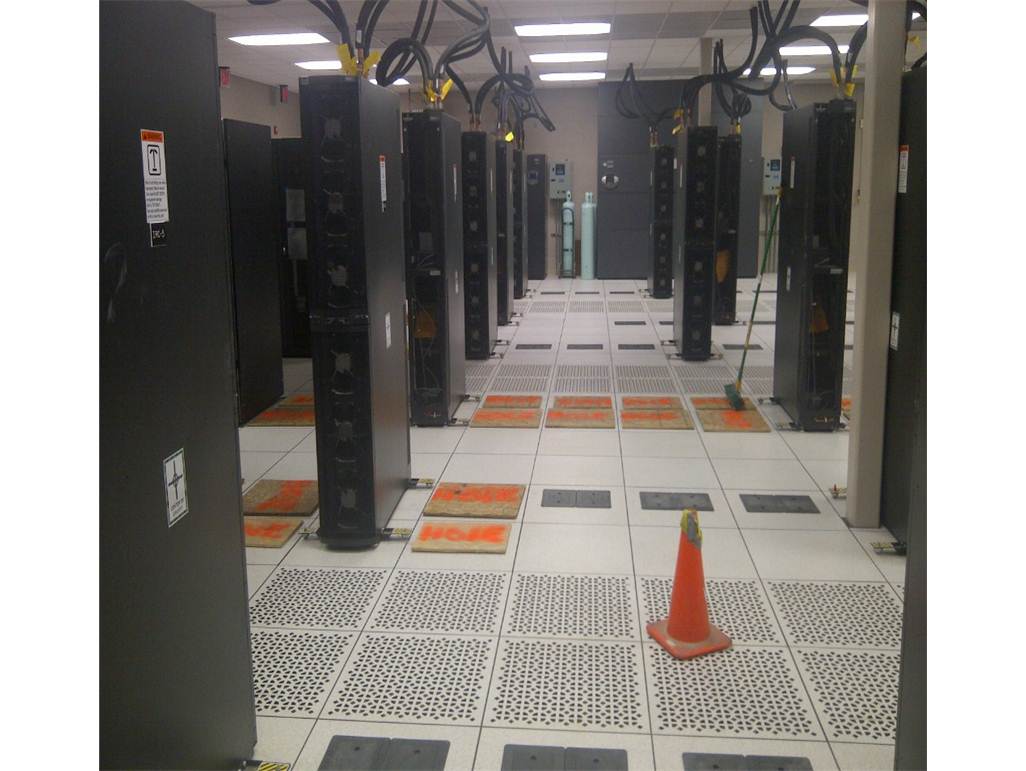
Image: WCDAS Awaits GOES-R Ground Segment Enterprise Infrastructure Equipment (14212959558).jpg | WCDAS Awaits GOES-R Ground Segment Enterprise Infrastructure Equipment | License: Public domain | Source: Wikimedia | https://commons.wikimedia.org/wiki/File:WCDAS_Awaits_GOES-R_Ground_Segment_Enterprise_Infrastructure_Equipment_(14212959558).jpg