Industrial automation is often described as a factory filled with robots. That is not wrong, but it is incomplete in the way a blueprint is incomplete without the load-bearing walls. The real subject is the system that lets machines sense what is happening, decide what to do next, and do it reliably enough to keep a production line running minute after minute, shift after shift.
In practice, industrial automation is a constraint problem. Every plant has limits: cycle time, power quality, floor space, maintenance windows, operator skill, safety rules, part variability, and the tolerance for downtime. Automation exists to work inside those limits, not to erase them. The best systems reduce human error, stabilize throughput, and make complex processes repeatable. The worst become expensive layers of software and hardware that are hard to debug and harder to keep aligned.
What industrial automation actually is
At its core, industrial automation is the use of control systems to operate machinery and processes with minimal manual intervention. That can mean a conveyor line in a packaging plant, a chemical process vessel, a robotic welding cell, a semiconductor fabrication tool, a warehouse sortation system, or a water treatment facility. The common thread is closed-loop control: the system measures a condition, compares it against a target, and adjusts equipment in response.
The basic stack usually includes sensors, controllers, actuators, industrial networking, human-machine interfaces, and software for supervision and planning. Sensors collect inputs such as temperature, pressure, position, vibration, flow, current, or vision data. Controllers process those inputs and decide what to do. Actuators carry out the action: starting a motor, opening a valve, moving a robot arm, stopping a conveyor, or altering a process parameter. Operators monitor and override the system through HMIs, dashboards, and alarms.
That sounds straightforward until you remember the environment. Industrial systems must survive electrical noise, heat, dust, vibration, long equipment lifecycles, and infrequent but costly failures. Consumer-style computing assumptions do not hold. A factory system is not successful because it is elegant on a demo bench; it is successful because it can be maintained, audited, and trusted at 3 a.m. by the person on call.
The control hierarchy that keeps plants running
Most industrial automation systems are layered. At the machine level, a programmable logic controller, or PLC, is often the workhorse. PLCs are designed for deterministic control: they read inputs, execute logic, and update outputs in a predictable loop. That predictability matters because a millisecond can be the difference between a clean pick-and-place motion and a mechanical fault.
Above that sits supervisory control, commonly handled by SCADA systems, which collect data from multiple machines or process zones and provide operators with a plant-wide view. SCADA is especially important in distributed environments such as utilities, pipelines, and large process plants where geographic distance and uptime matter as much as machine speed.
Manufacturing execution systems, or MES, live higher in the stack. MES coordinates production orders, recipe management, traceability, quality records, and work-in-progress tracking. If PLCs make the machine move and SCADA tells you what the plant is doing, MES helps connect that activity to the business question of what is being made, in what sequence, and with what documentation.
Enterprise systems such as ERP sit above that, linking production to procurement, inventory, finance, and scheduling. This is where many automation projects become messy. Industrial automation is not just about machines; it is about data alignment across systems that were often installed years apart, by different vendors, using different assumptions, in different eras of software design.
How the system makes decisions
Industrial automation works through feedback. A sensor observes a process variable, the controller compares that value to a setpoint or rule, and the controller issues an output. In a simple example, a temperature controller opens or closes a heater to keep a tank within range. In a more complex one, a robot vision system identifies the position of a part, software calculates the pick path, and the robot adjusts its motion in real time.
There are two broad kinds of logic involved. Discrete control handles events with clear on/off states: a part is present or absent, a gate is open or closed, a motor is running or stopped. Process control handles continuous variables such as pressure, temperature, speed, and flow. Many plants use both, often in the same line.
This is where industrial automation differs from ordinary software. The goal is not just correctness in a mathematical sense. It is timing, stability, and fail-safe behavior under real-world disturbance. A perfectly logical sequence that runs too slowly, cannot handle a jam, or fails unpredictably under a sensor fault is not useful on the floor.
Why robotics is only one piece of the picture
Robots get attention because they are visible, but most automation is less dramatic and more foundational. Motors, drives, sensors, vision systems, conveyors, valves, safety interlocks, and controllers often matter more to plant performance than the robot itself. A six-axis robot is only as productive as the upstream feeders, downstream fixtures, and quality checks around it.
That is why industrial automation projects often start with a process map rather than a robot purchase. The question is not “Where can we place a robot?” It is “Where is the current process slow, inconsistent, labor-intensive, or unsafe?” In some cases the answer is robotics. In others it is machine vision, better material handling, a smarter control loop, or simply replacing manual data entry with automation that removes a bottleneck.
Common applications include palletizing, welding, painting, assembly, inspection, packaging, warehousing, CNC machine tending, and high-volume sorting. In each case, the economic case depends on throughput, labor availability, scrap reduction, quality consistency, and uptime. A system that saves labor but creates maintenance headaches may not pencil out.
Industrial automation is as much IT as it is OT
One of the biggest shifts in the sector is the merging of operational technology, or OT, with information technology, or IT. Plant equipment is increasingly connected to analytics platforms, remote monitoring tools, predictive maintenance systems, and cloud dashboards. That creates value, but it also introduces new risks.
Industrial networks were historically isolated and designed for availability, not for modern cybersecurity assumptions. Once a plant connects to broader IT infrastructure, the attack surface expands. Authentication, segmentation, patch management, asset inventory, and incident response become part of the automation discussion. That is not optional. As more automation systems depend on connected software, cyber resilience becomes an operational requirement rather than a separate IT concern.
This is also where edge computing matters. Some workloads cannot wait for a cloud round trip. Machine vision inspection, safety responses, and motion control often need local compute close to the equipment. In other words, not every industrial problem can be solved by sending data to a distant server. Latency, bandwidth, and availability are part of the design envelope.
The economics: replace labor, or rewire the business?
The business case for automation is usually more nuanced than labor replacement. Yes, labor scarcity can accelerate adoption, especially in repetitive or hazardous work. But the deeper value often comes from consistency: fewer defects, better traceability, shorter cycle times, less waste, and more predictable output.
Automation can also let a plant do things that would be impractical manually. Semiconductor manufacturing is a strong example: the economics of advanced fabs depend on extremely controlled environments, precise motion, and tightly coordinated tool chains. Automotive plants use automation to maintain takt time and quality across thousands of repeated operations. Food and beverage facilities automate packaging and inspection because contamination control and speed are essential. Logistics operators use automation to handle peak demand without scaling labor linearly.
Still, the capex is real. Industrial automation involves hardware purchases, integration work, software licenses, engineering time, commissioning, training, maintenance, and future retrofits. A system that looks cheap at procurement can become expensive if it is hard to support, difficult to update, or dependent on a niche vendor. That is why lifecycle cost matters more than sticker price.
Why so many automation projects struggle
Industrial automation fails most often at the seams. The technology itself may work, but the process around it does not. Common problems include poor requirements definition, underestimating integration complexity, insufficient operator training, inadequate spare parts strategy, and weak change management. Plants also inherit legacy equipment that was never designed to talk to modern software, which forces bridging solutions that can be fragile.
Another recurring issue is over-automation. Not every task should be automated, and not every plant is ready for a full redesign. Sometimes the smartest move is incremental: automate one bottleneck, gather data, and then expand. Many successful deployments treat automation as a continuous improvement program rather than a single capital project.
Safety is another hard boundary. Industrial systems must account for emergency stops, light curtains, access control, lockout/tagout procedures, and safe motion. Standards and local regulations shape what can be deployed and how. For editorial review, specific standards such as ISO 10218, ISO 13849, IEC 61508, and related machine safety frameworks should be verified against the relevant application and jurisdiction before publication.
What to watch next
The next phase of industrial automation is less about replacing humans wholesale and more about tightening the loop between sensing, decision-making, and action. AI-enabled vision systems, digital twins, better industrial networking, and more capable edge hardware are improving what plants can observe and how quickly they can respond. But the core logic has not changed: measure accurately, decide reliably, act safely, and keep the line running.
That is why industrial automation deserves to be understood as infrastructure, not spectacle. It is the software-and-hardware discipline that makes production dependable. The most valuable systems are often the least visible ones, because their success shows up as fewer stoppages, better quality, and less chaos.
For companies investing in robotics and automation, that is the real benchmark. Not whether the system looks advanced. Whether it can survive the factory.
Sources and further reading
- International Society of Automation (ISA) materials on industrial control systems
- IEC 61131-3 programming standard for PLCs
- ISO 10218 robot safety standards
- ISO 13849 machine safety guidance
- IEC 62443 industrial cybersecurity framework
- National Institute of Standards and Technology (NIST) guidance on industrial control systems security
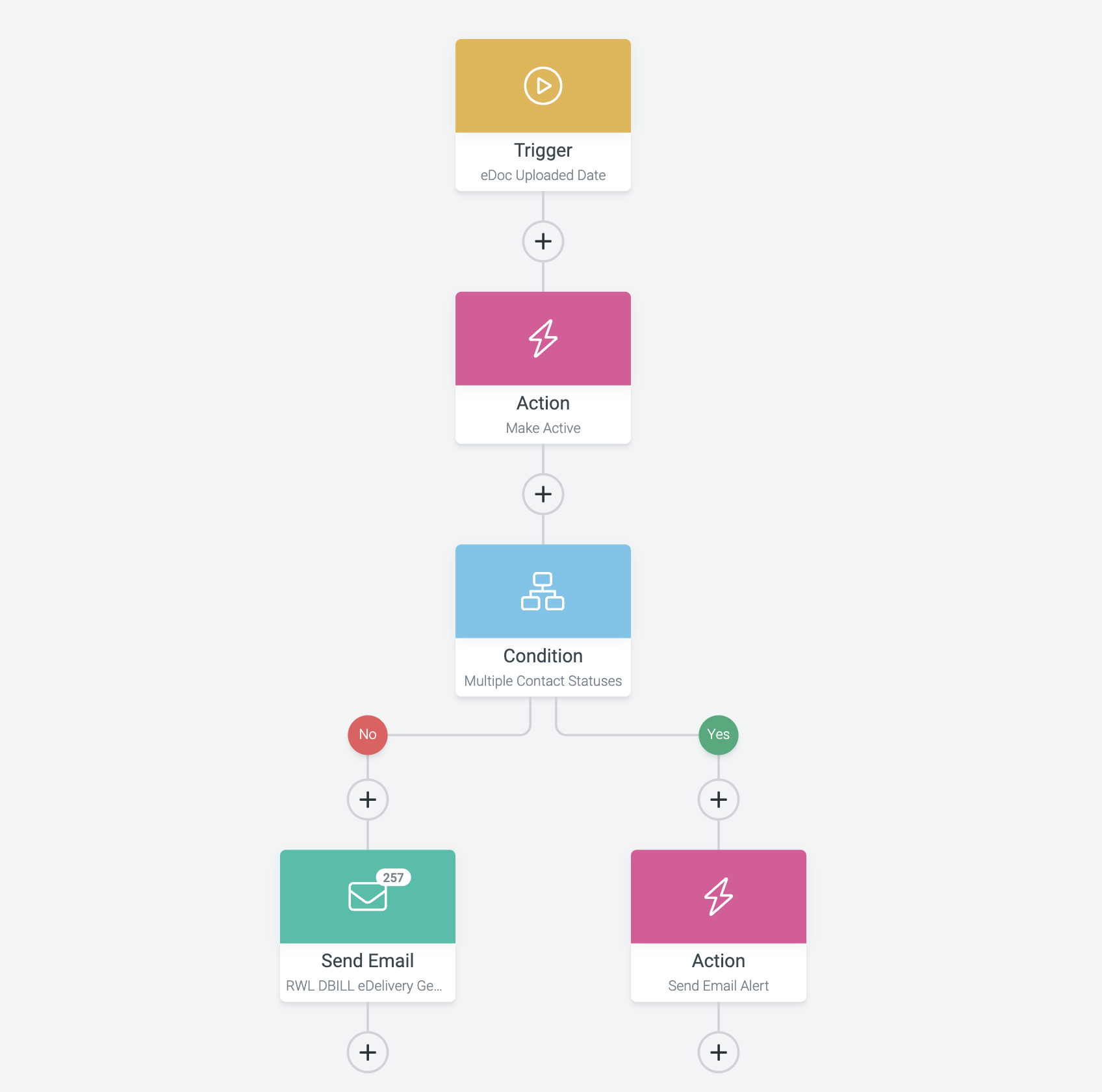
Image: Marketing Email Automation Workflow.png | Own work | License: CC0 | Source: Wikimedia | https://commons.wikimedia.org/wiki/File:Marketing_Email_Automation_Workflow.png