Google’s AI strategy is not one product — it is an operating system
Google does not compete in AI the way a startup competes in AI. It is not trying to win on a single model release, a single chatbot, or a single benchmark cycle. Its approach is broader and more structural: build frontier models, wire them into products people already use, and use custom infrastructure to keep the economics from collapsing under the weight of inference demand.
That matters because the AI race is not only a model race. It is a market-structure race. The companies that can pair model quality with distribution, data access, and compute control have more durable power than companies that can merely demo impressive software. Google understands this better than most, partly because it has spent two decades operating one of the world’s largest compute-intensive businesses.
The company’s current AI posture reflects that history. Search, YouTube, Android, Gmail, Workspace, Google Cloud, and its hardware stack all sit inside the same system. That gives Google more places to deploy AI than almost anyone else — but it also means every AI decision has to survive contact with a gigantic installed base and a business model still anchored by advertising and search traffic.
The real contest is not just model quality
It is easy to describe the AI market as a competition among models: who has the best benchmark scores, the slickest chat interface, or the most capable reasoning system. In practice, model quality is only one layer. The more durable question is whether a company can convert model capability into usage, and convert usage into revenue without blowing up infrastructure costs.
Google has a structural advantage here because it owns several of the layers simultaneously. It has consumer products with billions of users. It has cloud infrastructure sold directly to enterprises. It has a long-running advertising business that can subsidize product adoption. And it has its own semiconductor strategy through Tensor Processing Units, or TPUs, which are designed to accelerate AI workloads more efficiently than general-purpose chips for certain tasks.
That stack gives Google flexibility. It can run AI in search summaries, inside Workspace, in developer tools, in cloud APIs, and in new consumer assistants. But it also gives the company a hard constraint: if AI features increase query load, token generation, or latency-sensitive computation too quickly, the economics can deteriorate fast. In other words, Google can afford to be ambitious because it has scale — but scale also makes every inefficiency expensive.
Search is still the central battlefield
No part of Google’s AI strategy is more consequential than Search. Search remains the company’s most important product and its most important monetization engine. That is why the shift toward AI-generated summaries, conversational search, and more proactive assistance is strategically important and commercially delicate at the same time.
Traditional search is efficient. A query returns links, and the user does some of the work. Generative search changes that. The model may need to synthesize an answer, reason across multiple sources, and produce a response before the user clicks anything. That is a better experience in some cases, but it is also more computationally expensive and potentially less predictable for advertising inventory.
This is where Google’s AI strategy becomes a market-structure story rather than a product story. If Google can make AI-enhanced search feel indispensable while preserving ad performance and query growth, it protects the core business while modernizing it. If it cannot, then it risks spending more compute per query without fully preserving the economics that made search such a formidable business in the first place.
The company is therefore not just adding AI to search; it is trying to redefine search in a way that keeps the economic engine intact. That is a much harder task than launching a chatbot.
Gemini is the model layer, but the product layer is where the fight happens
Google’s Gemini family gives the company a branded foundation for its AI products, but the model itself is only the middle of the stack. The strategic challenge is to embed Gemini into products where users already have recurring workflows. That is why Google has pushed AI across Workspace, Android, Search, and its developer and cloud offerings.
This matters because users do not pay for models in the abstract. They pay — directly or indirectly — for outcomes. In a workplace setting, that could mean drafting documents, summarizing meetings, searching internal data, or automating repetitive analysis. In a consumer setting, it could mean answering questions, generating images, or helping with device interactions. Google’s advantage is that it can place AI inside products with natural frequency and clear utility.
That said, distribution is not the same as conversion. Google may be able to expose billions of users to AI features, but if the experience feels incremental rather than essential, users will treat it as a useful add-on rather than a platform shift. Microsoft’s partnership with OpenAI showed how fast AI could become a product narrative. Google’s challenge is to make that narrative feel native to its ecosystem rather than bolted on after the fact.
The company has generally responded by emphasizing integration over novelty. That is consistent with Google’s style, but it comes with a tradeoff: integrated products are often harder to market dramatically, even when they are strategically stronger over time.
TPUs are Google’s most underrated strategic asset
The semiconductor piece is easy to overlook because most of the public AI conversation focuses on Nvidia. But Google’s TPUs are central to its competitiveness. They are custom accelerators built for machine learning workloads, and they give Google a way to reduce dependence on the most expensive and heavily contested supply chain in the industry.
This is not about replacing GPUs across the market. Nvidia’s CUDA ecosystem, software stack, and developer mindshare still define much of the AI hardware landscape. But Google does not need to win the whole market to improve its own position. It needs to lower the cost of serving AI, train models more efficiently, and gain enough internal leverage to support products at scale.
That internal leverage is important because AI is becoming a data-center business as much as a software business. Training frontier models and serving them at consumer scale both require enormous power, networking, cooling, and chip capacity. Every company in the race is discovering that model quality is inseparable from infrastructure design. Google’s control over chips, data centers, and cloud operations gives it more room to optimize than most competitors.
Still, custom silicon is not a free lunch. It requires years of investment, deep systems engineering, and enough workload concentration to justify the effort. Google has those ingredients. Many rivals do not. That is one reason the company remains relevant in a market that increasingly rewards vertical integration.
Google Cloud turns AI into an enterprise sales problem
Google’s cloud business is another crucial part of the strategy. AI infrastructure is now a major purchasing category for enterprises, and cloud providers are competing not just on raw compute but on managed model access, networking, storage, and deployment tooling.
For Google, this creates a two-way opportunity. It can sell infrastructure to customers building their own AI applications, and it can also make its own models available through cloud products. That creates a channel for monetization beyond consumer advertising and gives Google a stronger position in the enterprise AI stack.
But the cloud layer also exposes Google to fierce competition from Microsoft Azure and Amazon Web Services. Enterprise buyers care about security, control, performance, and integration with existing systems. They also care about vendor lock-in, especially when AI workloads are expensive to move once they are deployed. Google must therefore compete not just on model capability, but on reliability, procurement friction, and total cost of ownership.
This is where the economics of AI become visible. The best cloud strategy is not simply offering the most powerful model. It is making it easy for customers to adopt AI in ways that fit their budgets, latency constraints, and compliance requirements. In this sense, Google Cloud is less a side business than a test of whether the company can translate AI capability into enterprise infrastructure sales.
The biggest risk is cannibalization — and Google knows it
Any honest account of Google’s AI strategy has to deal with cannibalization. If AI answers satisfy users without requiring a click, what happens to the ad-driven search model? If AI assistants complete tasks more directly than traditional software interfaces, what happens to the web traffic that historically fed Google’s ecosystem? If developers and enterprises shift from classic search behavior to AI-native workflows, what becomes of the old discovery layer?
These are not theoretical questions. They are the central tension in the company’s AI transition. Google cannot avoid cannibalization; it can only manage it. That means steering users toward richer search experiences, embedding AI where it adds utility without destroying revenue, and building new monetization paths in cloud and subscriptions where appropriate.
This is a familiar pattern in technology markets. Incumbents often know the future before they are willing to fully embrace it, because embracing it can damage the present. Google’s position is especially difficult because it is both the incumbent and the infrastructure operator. It has to decide how much of the old model to sacrifice in order to preserve long-term relevance.
That makes execution more important than slogans. If Google overprices AI access, it risks slowing adoption. If it underprices it, it may amplify compute costs faster than revenue grows. If it moves too slowly, competitors define the user expectation. If it moves too aggressively, it can weaken the business that funds the entire effort.
Why Google remains one of the few true AI platform companies
Despite the pressure from OpenAI, Microsoft, Anthropic, and a growing field of open-source model builders, Google still occupies a rare position. It is one of the few companies that can simultaneously shape model research, consumer distribution, cloud infrastructure, and silicon strategy. That combination is what makes it a platform company rather than just an AI vendor.
The practical implication is that Google can absorb more of the stack than most rivals. It can experiment in product surfaces, tune its infrastructure for efficiency, and use its scale to distribute new AI behaviors into daily workflows. That does not guarantee victory, but it does mean Google is not playing the same game as smaller model companies.
The broader lesson is that the AI race is increasingly being decided by systems, not slogans. The winners will not simply have the smartest model. They will have the best alignment between compute economics, product design, distribution, and business model. Google’s strategy is built around that reality. Its challenge is to execute it without undermining the businesses that made the company powerful in the first place.
That is why Google’s position in AI is so important to watch. It is not just competing for share in a new market. It is trying to reshape one of the most profitable market structures in technology while the infrastructure costs of the new era are still coming into focus.
Sources and further reading
- Google parent company annual reports and earnings materials
- Alphabet investor presentations and shareholder letters
- Google Cloud product documentation on AI and model hosting
- Google DeepMind and Google Research publications on Gemini and TPUs
- U.S. court filings and public reporting related to search distribution and advertising markets for contextual review
- NVIDIA, Microsoft, and Amazon public materials for comparative infrastructure and AI product positioning
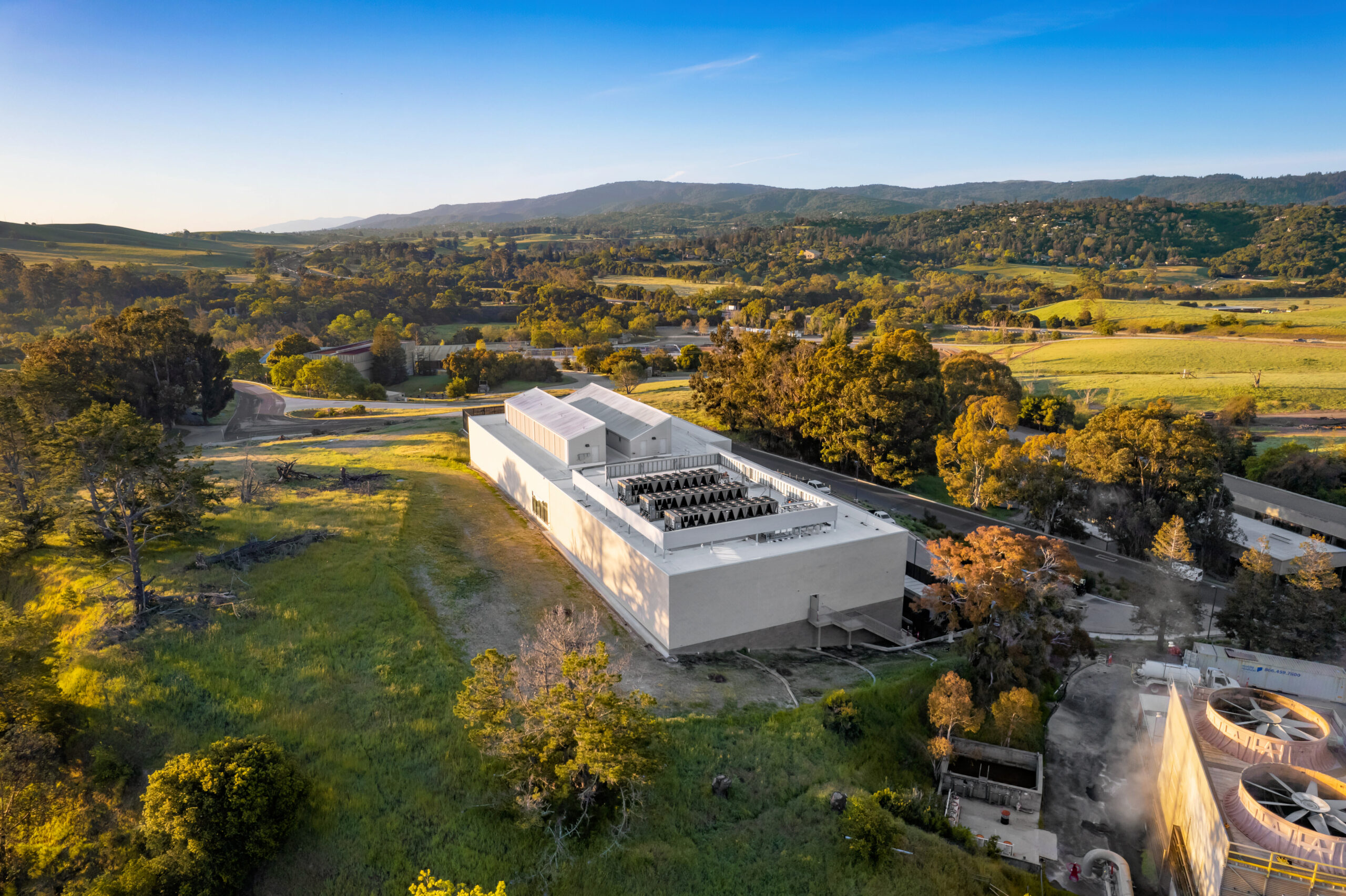
Image: Stanford Research Computing Facility (SRCF) at sunrise on SLAC campus (SRCF-data-center-CC).jpg | Stanford Research Computing Facility (SRCF) at sunrise on SLAC campus | License: CC BY 4.0 | Source: Wikimedia | https://commons.wikimedia.org/wiki/File:Stanford_Research_Computing_Facility_(SRCF)_at_sunrise_on_SLAC_campus_(SRCF-data-center-CC).jpg