Semiconductors Are Not Made in One Place
People often talk about chips as if they are a single product made in a single factory. In reality, the global chip supply chain is a distributed industrial network spanning continents, with each stage depending on highly specialized inputs, tools, and expertise. That fragmentation is not accidental. It is the result of decades of optimization for cost, scale, and technical specialization.
The consequence is simple: no country, and no company, controls the entire chain. A modern chip can be designed in the United States, fabricated in Taiwan, packaged in Southeast Asia, and assembled into a server in Mexico or Texas using equipment built in the Netherlands, Japan, and the U.S. That makes semiconductors a uniquely globalized product, but also a uniquely fragile one.
The supply chain is best understood not as a line, but as a system of constraints. Every stage can become the limiting factor, and when one stage tightens, the entire chain feels it.
The Chain Starts Long Before the Fab
A chip begins as an idea: an architecture, a target performance level, a cost ceiling, and a manufacturing process that can actually support the design. For leading-edge GPUs, AI accelerators, and advanced server CPUs, design choices are tightly bound to fabrication capabilities. A chip designed for an advanced node like 3 nanometers or 5 nanometers is not simply a more refined version of an older chip. It is an engineering bet that assumes access to a specific process technology, specific lithography tools, and a fabrication partner with enough yield to make production economical.
Before any silicon is etched, the design ecosystem already narrows the field. Electronic design automation software, IP blocks, mask preparation, and verification all shape what can be built. This is one reason the semiconductor industry is so concentrated: the tooling and know-how required to design and tape out a modern chip are difficult to replicate quickly.
Materials, Equipment, and the Hidden Dependencies
The most visible part of chip manufacturing is the fab, but the less visible parts are just as important. Semiconductor production depends on ultra-pure silicon wafers, specialty gases, photoresists, chemicals, and deposition materials. Small supply disruptions in any of these inputs can affect output, especially for leading-edge or memory production where tolerances are extreme.
Equally important is the equipment stack. A fab is only as capable as the tools inside it, and the most advanced manufacturing tools are built by a small number of firms. Lithography is the clearest example. Extreme ultraviolet, or EUV, tools are effectively indispensable for the most advanced nodes, and those machines are extraordinarily complex to manufacture and deploy. The result is an industry in which fabrication capacity depends on upstream equipment lead times that can stretch for years.
That dependence creates a structural comparison between chip supply and more conventional manufacturing. In a typical factory, more labor or more shifts can often raise output relatively quickly. In semiconductors, the bottleneck is usually not labor but tool availability, process maturity, and yield. More money does not instantly create more chips.
Foundries, IDMs, and the Economics of Specialization
The semiconductor industry is split across different business models, and those models create distinct tradeoffs. Integrated device manufacturers, or IDMs, design and manufacture chips in-house. Foundries manufacture chips for outside customers. Fabless companies design chips but outsource production. Each model has strengths, and the current global structure reflects a balance between flexibility, capital intensity, and control.
Fabless companies such as major chip designers can move faster on architecture and product planning without carrying the full burden of building fabs. That has helped fuel innovation in GPUs, mobile chips, networking silicon, and AI accelerators. But it also means they are exposed to foundry capacity and process-node availability. A fabless company can have a brilliant chip design and still miss demand if its manufacturing partner is sold out or delayed.
IDMs have tighter control over manufacturing, which can be an advantage for specialized products and supply assurance. But they also carry the full cost of maintaining highly expensive fabs and continuously upgrading them. The tradeoff is clear: outsourcing buys agility, while vertical integration buys control. Neither is free.
Why Taiwan, South Korea, Japan, the U.S., and Europe Each Matter
The global chip supply chain is geographically distributed for a reason. Taiwan dominates advanced logic manufacturing because companies like TSMC turned process leadership into an industrial system that is hard to copy. South Korea is central to memory and also advanced logic through Samsung. Japan remains critical in materials, chemicals, and equipment components. The United States leads in chip design, semiconductor software, and parts of the equipment and intellectual property stack. Europe is indispensable in lithography, especially through ASML, without which advanced chip production would be dramatically constrained.
These regions are not interchangeable. A country might host chip design talent but still depend on foreign fabrication. Another might have fabs but rely on imported equipment, chemicals, or masks. This interdependence is why the chip supply chain is so hard to regionalize. Building one segment locally does not mean controlling the whole pipeline.
That comparison matters because industrial policy often gets framed as a simple question of sovereignty. In practice, the issue is more nuanced. Building a fab in the U.S. can improve resilience, but it does not erase reliance on overseas tools, process expertise, and raw materials. Supply-chain security is incremental, not binary.
Advanced Packaging Has Become a New Battleground
As transistor scaling gets harder and more expensive, packaging has become a major competitive frontier. Advanced packaging techniques such as chiplets, 2.5D integration, and high-bandwidth memory stacks are changing how performance is delivered. Instead of putting everything on one monolithic die, companies increasingly combine multiple dies into a system package.
This shift has practical consequences. It can improve yields, reduce design risk, and let companies mix process nodes more efficiently. For example, a compute-heavy die might be built on the newest node, while I/O or control logic uses a more mature, cheaper node. That tradeoff is increasingly attractive for AI accelerators and high-end CPUs, where the cost of a giant monolithic die can be prohibitive.
But advanced packaging also creates new bottlenecks. Packaging capacity, substrate availability, and memory integration are now strategic constraints, especially in AI infrastructure. In some cases, the supply chain is no longer limited by wafer starts alone but by the ability to assemble and test finished packages fast enough to meet demand.
Why GPUs, AI Chips, and Data Centers Feel the Pinch First
Not all chips stress the supply chain equally. Commodity chips such as mature-node microcontrollers, analog devices, and some power-management components are important, but they usually do not require the same scarce leading-edge capacity as GPUs and AI accelerators. The chips that power data centers, AI training clusters, and high-performance networking are often designed for the most advanced manufacturing nodes and require complex packaging and memory integration.
That makes compute infrastructure especially sensitive to supply constraints. A data center operator may need not just the accelerator itself, but the surrounding ecosystem: HBM memory, substrate capacity, network switches, power delivery components, and enough cooling and energy infrastructure to support the deployment. The chip is only one part of the bill.
This is where the supply chain becomes a systems problem. If AI demand spikes, the constraint is not just whether a chip designer has a hot product. It is whether foundry capacity, packaging lines, memory production, and server integration can all expand in sync.
Geopolitics Is No Longer a Side Story
For years, the semiconductor industry treated geopolitics as background noise. That is no longer possible. Export controls, industrial subsidies, national security reviews, and trade restrictions now shape where chips can be designed, manufactured, and sold. Governments have recognized that chip supply is not just a commercial issue but a strategic one, because semiconductors underpin defense systems, cloud infrastructure, telecom networks, automotive production, and advanced manufacturing.
The downside is that policy can reduce efficiency even when it increases resilience. Companies may duplicate capacity across regions, hold more inventory, or redesign products to satisfy export rules. Those moves improve supply assurance but add cost. Again, the tradeoff is the point: a more secure supply chain is usually a more expensive one.
What Actually Matters for the Next Cycle
For readers trying to understand where the chip industry is headed, three variables matter most. First, leading-edge fab capacity will remain concentrated, even as new plants are built outside Asia. Second, advanced packaging will become as strategically important as wafer fabrication in high-performance compute. Third, energy and water infrastructure will increasingly shape where fabs and data centers can realistically expand.
The best way to think about the global chip supply chain is not as a market that simply balances supply and demand. It is an industrial hierarchy of chokepoints. Whoever controls the scarcest tools, the most advanced process technology, or the highest-value packaging capacity has leverage over the entire system.
That is why semiconductors matter far beyond the chip itself. They are the throughput layer for modern computing, and throughput is a function of constraints. In other words: the supply chain is the product.
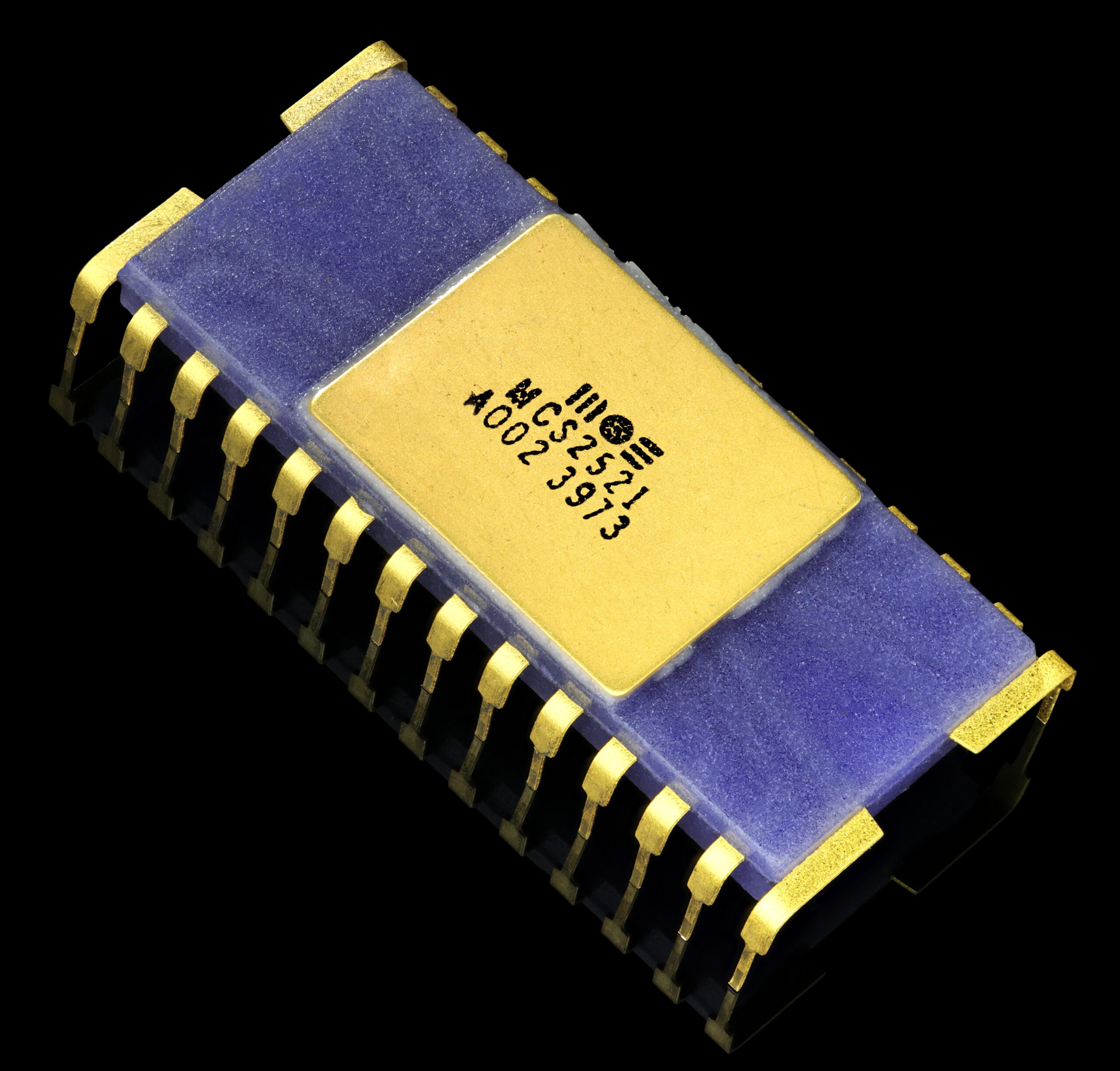
Image: MCS2521A.jpg | Own work | License: CC BY-SA 4.0 | Source: Wikimedia | https://commons.wikimedia.org/wiki/File:MCS2521A.jpg