Why TSMC matters more than almost any chip company
If you want to understand the semiconductor industry’s center of gravity, start with TSMC. The company does not sell the most famous consumer chip, and it does not build the most visible end products. But it manufactures the silicon that powers much of modern computing—from smartphones and servers to GPUs and custom accelerators. That gives TSMC a position that is at once technical, economic, and geopolitical: it is the world’s leading pure-play foundry, and the place where many of the most advanced chip designs in the world actually become physical devices.
TSMC’s dominance is often described as a simple matter of being first or being bigger. That misses the real story. The company’s advantage comes from stacking several hard things at once: advanced process technology, high-yield manufacturing at massive scale, sophisticated packaging, and a customer model that gives designers confidence their chips will actually reach volume production. In semiconductors, any one of those strengths is difficult. TSMC has built a system that makes them reinforce one another.
The foundry model changed who holds power
To understand why TSMC dominates, it helps to understand the foundry model itself. In the old vertically integrated model, companies such as Intel or Texas Instruments designed and manufactured many of their own chips. TSMC helped popularize a different structure: one company focuses on design, while the foundry specializes in manufacturing for many customers.
That separation sounds administrative, but it reshaped the industry. Once manufacturing became a standalone business, the economics changed. A foundry could spread the cost of giant fabs, toolsets, process development, and yield engineering across a broad customer base. Designers, meanwhile, could focus on architecture, software, and product differentiation without having to own the full burden of fab operations.
TSMC became the best company in the world at that model because it treated manufacturing not as a back-office function, but as the core product. Its customers are not buying wafers alone. They are buying access to process technology, predictable ramp-up, stable yields, packaging options, and a supply chain that can turn a design into millions of working chips.
Process leadership is necessary, but not sufficient
The most visible measure of semiconductor leadership is process node advancement: moving from one generation of transistor technology to the next. TSMC has repeatedly stayed near the front of that race, including major transitions to FinFET-era nodes and, more recently, its work on 3-nanometer-class production and the roadmap toward gate-all-around architectures. Exact node naming is not perfectly comparable across companies, so the labels are less important than the underlying point: TSMC has repeatedly proven that it can industrialize cutting-edge transistor designs at scale.
That matters because leading-edge chips are not just smaller versions of old chips. Every generation introduces new design rules, tighter lithography constraints, new power and thermal tradeoffs, and more complicated qualification requirements. The technical challenge is not merely drawing smaller features. It is making billions of transistors behave consistently across wafers, across batches, and across fab sites.
TSMC’s advantage is that it is very good at the unglamorous part of this problem: manufacturing consistency. A leading-edge node is only valuable if customers can obtain enough yield to make the economics work. Better yields lower cost per usable die, accelerate product launches, and reduce the risk of delays. In practice, that is where TSMC’s reputation has been built—less on a single headline process, and more on the ability to get complex nodes from lab readiness to high-volume reality.
Advanced packaging turned into a second battleground
In the current generation of chips, process node leadership alone is no longer the whole game. As transistor scaling becomes harder and more expensive, packaging has become a major source of performance gains. TSMC has invested heavily in advanced packaging technologies such as CoWoS and other heterogeneous integration methods that let designers combine different types of dies in one system package.
This is especially important for AI accelerators and GPUs, where large compute dies need to sit close to high-bandwidth memory. The package is no longer just a protective shell; it is part of the performance architecture. The closer you can place logic and memory, the better the bandwidth and power efficiency. For data center chips, that can determine whether a design is competitive at all.
TSMC’s packaging capability matters because it allows customers to mix and match functions. A company might combine a leading-edge logic die with memory, I/O dies, chiplets, or analog components rather than forcing everything onto a single monolithic piece of silicon. That gives designers more flexibility and can improve yield by letting them manufacture different parts of the system in the most appropriate process technology. In a world where system-level integration is increasingly important, the foundry that can package those pieces reliably has a major advantage.
Scale is not just volume; it is learning speed
TSMC’s fabs are enormous capital projects, but scale in semiconductors is not simply about producing more wafers. It is about learning faster than everyone else. Every wafer lot generates data about defects, process drift, tool performance, materials behavior, and yield loss. A company running enormous volumes across many customers sees more of this feedback than a smaller competitor, and that accelerates process tuning.
That learning loop is one reason why semiconductor leadership tends to compound. Once a company has the process know-how, the customer base, the tool relationships, and the operational discipline, each new node gets somewhat easier to ramp than the last. Not easy—just easier relative to the first time.
TSMC also benefits from the fact that its customer mix includes many of the industry’s most demanding designers. Apple, AMD, NVIDIA, Qualcomm, Broadcom, and others have all relied on TSMC for leading-edge manufacturing at different times and for different products. Those relationships are strategically important because they create a feedback loop: the hardest chips to build are often the chips that push the foundry’s capabilities forward. The more frontier designs a foundry handles, the better it gets at frontier manufacturing.
The customer trust that keeps rivals at bay
Manufacturing chips is not just a technical challenge; it is a trust business. A chip design team can spend years and hundreds of millions of dollars developing a product. If the foundry misses timing, mishandles yields, or cannot support the package and test flow, the entire launch can suffer. That is why switching foundries is painful even when another company appears technically competitive.
TSMC has built a reputation for being a reliable partner rather than a vendor that can be swapped in and out. Its customers know that the company is likely to support them through design enablement, process development, tape-out, volume ramp, and lifecycle production. For large system companies, that reliability is often worth more than a small theoretical advantage elsewhere.
This trust becomes even more valuable in an era of supply-chain fragility. After pandemic-era disruptions, geopolitical tensions, and repeated warnings about semiconductor concentration, customers have become more sensitive to manufacturing resilience. Yet the response has not been to abandon TSMC in large numbers. Instead, many firms have hedged—diversifying some production while still keeping the most advanced designs at TSMC because there is no easy substitute.
Why competitors still struggle to catch up
TSMC’s main rivals are formidable. Samsung Foundry has deep semiconductor experience and major manufacturing capabilities. Intel is trying to reestablish itself as both a product company and a leading foundry. Other players are investing too. But catching TSMC requires more than matching a roadmap slide.
The challenge is that foundry leadership is a systems problem. Process technology, lithography access, EUV tool integration, design ecosystem support, packaging, production planning, defect control, and customer management all have to work together. A gap in any one of those areas can erase progress elsewhere.
There is also a financial reality. Leading-edge fabs cost staggering amounts to build and equip, and the economics depend on very high utilization. A foundry needs enough customers to fill capacity, but the most advanced customers are often the most demanding and the hardest to serve profitably. TSMC’s long-standing market position makes that balancing act easier. A challenger has to prove not only that it can fabricate advanced chips, but that it can do so in a way that customers trust with their most important products.
Intel’s foundry ambitions are important to watch, particularly as governments in the U.S. and Europe want more domestic manufacturing capacity. But those efforts should be understood as a long-term industrial policy project, not a quick substitute for TSMC’s accumulated operating advantage. If editorial review needs a single sentence summary: fabs can be built faster than manufacturing culture can be replicated.
Why TSMC’s dominance matters right now
TSMC is not just winning a corporate competition. It sits at the center of the computing stack at a time when demand for advanced silicon is being pulled by AI servers, high-end GPUs, cloud infrastructure, networking equipment, smartphones, automotive electronics, and industrial systems. The result is that TSMC’s capacity decisions can ripple through entire markets. When advanced packaging capacity is tight, for example, it affects AI accelerator availability. When leading-edge node supply is constrained, it influences product launch timing for some of the world’s biggest tech companies.
That makes TSMC a crucial company to watch not because it is flashy, but because it is infrastructural. It is one of the few firms whose operational performance can shape the competitive position of dozens of others.
It is also a reminder that the semiconductor industry is not governed only by design brilliance. The best architecture in the world still has to be manufactured, tested, packaged, and shipped. TSMC dominates because it has learned how to execute all of those steps better than anyone else at the frontier. In a field where small process differences can decide billion-dollar product cycles, that is not just an advantage. It is the business.
Sources and further reading
- TSMC Annual Report and investor materials
- TSMC Technology Symposium presentations
- U.S. CHIPS and Science Act background materials
- Intel Foundry and Samsung Foundry public roadmap disclosures
- Semiconductor Industry Association (SIA) reports and industry briefings
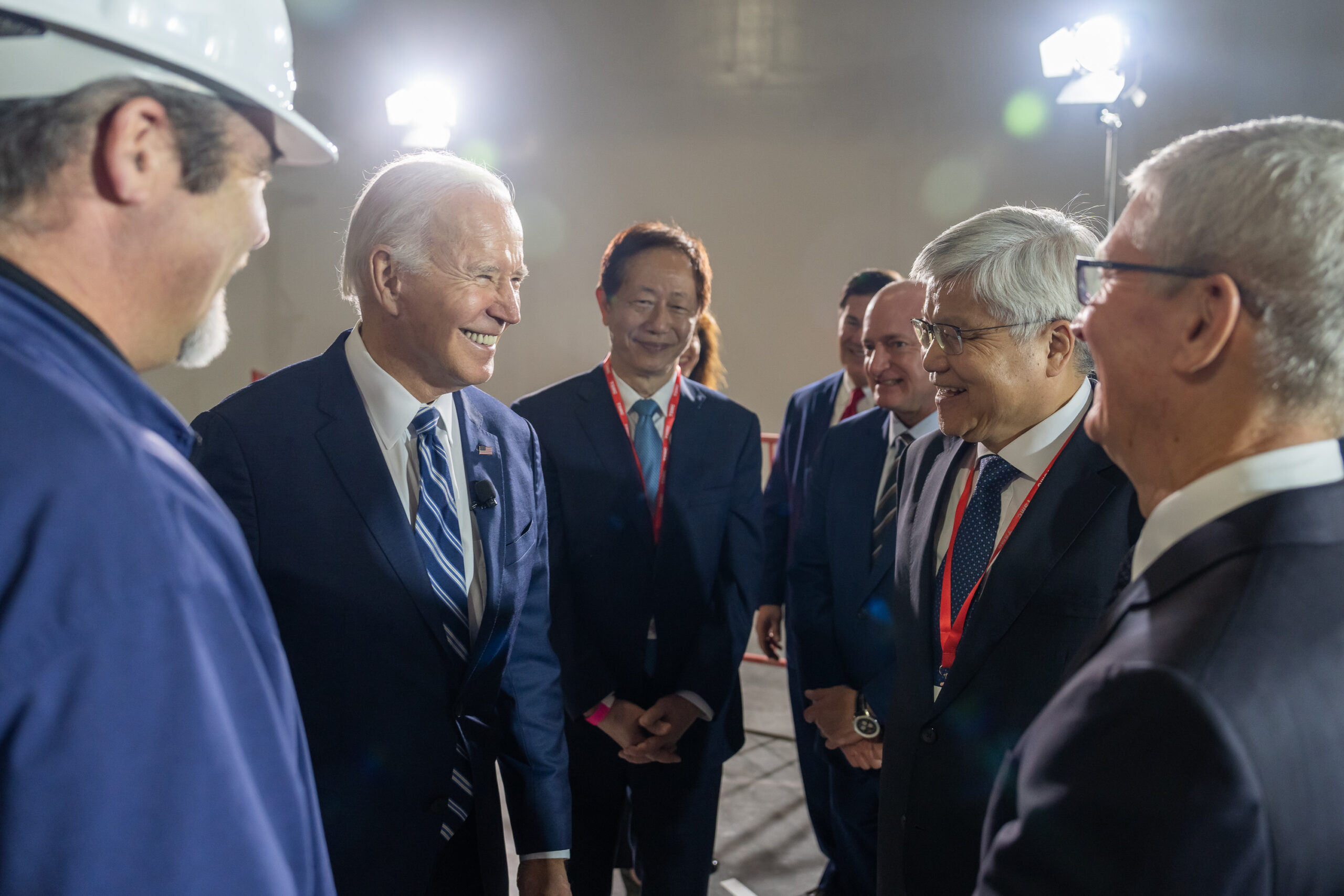
Image: Joe Biden at the TSMC Semiconductor Plant in Phoenix (P20221206AS-0794).jpg | P20221206AS-0794 | License: Public domain | Source: Wikimedia | https://commons.wikimedia.org/wiki/File:Joe_Biden_at_the_TSMC_Semiconductor_Plant_in_Phoenix_(P20221206AS-0794).jpg