What a cobot actually is
“Cobot” is short for collaborative robot: a machine designed to share workspace with a human operator. That definition sounds simple, but it marks a major shift in industrial automation. Traditional industrial robots are usually installed inside fenced cells because they move fast, carry heavy loads, and can cause injury if a person gets too close. Cobots are built to reduce that risk through a combination of force limiting, speed control, sensing, and software safeguards.
The key idea is not that cobots are harmless. It is that they are designed to operate under a different set of constraints. In practice, that means lower payloads, slower motion, more careful path planning, and tighter attention to the application. A cobot can be a good fit for repetitive tasks that require human judgment nearby. It is often a poor fit for high-speed, high-payload production where throughput matters more than flexibility.
Why cobots became attractive in the first place
Manufacturing automation has always been a tradeoff between capability and complexity. Traditional robots can be incredibly productive, but they usually require more floor space, more safety infrastructure, more specialized integration, and more process discipline. That can be a hard sell for small and mid-sized manufacturers, contract manufacturers, labs, and warehouses that do not want to redesign an entire line around automation.
Cobots lowered the barrier to entry. By shrinking the footprint and simplifying safety architecture, vendors made robotics more approachable for deployments that were previously too expensive or too rigid. Instead of building a dedicated cage, guard system, and custom workflow around a robot, an operator can often deploy a cobot closer to existing processes and have a person handle the parts of the job that still require judgment, dexterity, or exception handling.
That matters because many real factory tasks are not purely mechanical. They are a mix of repeatable steps and messy edge cases: aligning parts that arrive slightly off position, checking labels, loading fixtures, tending a machine that needs occasional intervention, or packaging products with variation. In those environments, a cobot can do the repetitive motion while a human handles variability.
The technical architecture that makes collaboration possible
Cobots are not defined by one piece of hardware. They are a system-level design approach. The arm itself matters, but so do the controls, sensors, end effector, software stack, and application context.
One common safety approach is power and force limiting, where the robot is engineered to stop or slow when it encounters resistance. Another is speed and separation monitoring, in which the robot’s behavior changes depending on how close a person is. Some systems rely on hand-guiding or reduced-power modes during setup, while others use vision and proximity sensing to maintain a safer operating envelope.
In practical terms, collaboration depends on more than the robot’s marketing label. A cobot still needs a well-designed gripper, stable fixtures, accurate part presentation, and software that can tolerate the reality of a shop floor. If the parts are inconsistent, the environment is cluttered, or the task requires fine-tuned force control, the deployment can become much harder than the pitch suggests.
This is where many first-time buyers underestimate the system. The robot arm may be the smallest part of the budget. Integrating conveyors, tooling, part feeders, machine vision, and safety validation can drive the real cost and determine whether the cell actually works reliably.
Cobots versus industrial robots: a comparison of tradeoffs
The most useful way to understand cobots is not as “better robots,” but as robots optimized for a different deployment model.
Industrial robots are the right tool when the task is stable, fast, and high-volume. They can move heavier payloads, cover larger work envelopes, and deliver higher throughput. They usually demand more guarding and more engineering, but that investment pays off when the process is mature and the economics justify dedicated automation.
Cobots are the right tool when flexibility and quick deployment matter more than raw speed. They are easier to place near people, easier to redeploy, and often easier to justify in environments where production changes frequently or the labor pool is tight. They can also be useful as a bridge technology: a manufacturer can automate one step without rethinking the entire line.
But that convenience comes with limits. A cobot’s collaborative design typically means slower cycle times, lower payload capacity, and tighter restrictions on tooling and reach. Once a process becomes high-volume enough, those limits can erode the economic advantage. In other words, a cobot can help a business start automation sooner, but it does not eliminate the logic of industrial robotics. It simply moves the threshold where each architecture makes sense.
Where cobots are strongest
Cobots tend to shine in applications where the work is repetitive but not perfectly uniform. Examples include machine tending, screwdriving, pick-and-place, light assembly, dispensing, inspection support, and packaging. They are also useful in laboratory and logistics settings where a human still needs to supervise exceptions or handle delicate objects.
Machine tending is a good example. A cobot can load and unload a CNC machine, injection molding press, or test station while a human operator manages multiple machines, checks quality, and handles interruptions. That kind of labor reallocation is often where cobots create value: not by replacing a person entirely, but by taking over the most repetitive part of the job.
Another advantage is deployment speed. Because cobots are frequently marketed with user-friendly programming interfaces, teach pendant workflows, and no-code or low-code setup tools, they can be easier for smaller teams to learn. That said, the gap between “easy to demo” and “easy to run in production” is real. A smooth demo cell can still fail on the factory floor if the upstream and downstream processes are not controlled.
Where they break down
Cobots run into trouble when the task demands high force, high speed, or a highly controlled environment. Heavy lifting is an obvious boundary, but so are subtler problems like poor part presentation, inconsistent tolerances, reflective surfaces that confuse vision systems, or workflows that require fine tactile feedback.
Another limitation is safety itself. The word “collaborative” can imply that the robot is safe by default. It is not. The entire cell has to be analyzed for risk: tool choice, pinch points, payload, speed, potential impact zones, and the behavior of nearby workers. A sharp gripper or a fast-moving arm can still be hazardous, even if the robot is technically a cobot.
Ergonomics can also become a hidden issue. If a cobot is placed too low, too far, or in a position that forces workers to bend, reach, or twist, the system may reduce some forms of strain while increasing others. Good deployment is about workflow design, not just arm selection.
Economically, cobots can disappoint when buyers expect a plug-and-play labor substitute. If the process is unstable, if the part mix changes too often, or if the required cycle time is too aggressive, the return on investment may never materialize. The robot may work technically while failing financially.
The infrastructure cobots enable
The most important contribution of cobots may be less visible than the robot itself. They encourage a different kind of automation infrastructure: smaller cells, more modular workflows, and distributed deployment across a facility instead of one large, fully fenced robot island.
That matters for manufacturers trying to modernize incrementally. Instead of betting on a single large automation project, they can build a portfolio of smaller automation points around existing staff. A cobot can sit beside a manual station, a CNC machine, or a packing bench and absorb repetitive motions without forcing a complete plant redesign. In that sense, cobots function as infrastructure for partial automation.
This model fits an industrial reality that is often overlooked in glossy robotics marketing: many plants are not greenfield factories. They are older facilities with mixed equipment, legacy processes, and a workforce that cannot be retrained overnight. Cobots are attractive precisely because they can be inserted into that messier environment. The catch is that integration quality matters more, not less, when the process is fragmented.
What buyers should evaluate before buying
For decision-makers, the right question is rarely “Should we buy a cobot?” It is “Which process step is constrained, and what would automation need to do better than the current method?”
Before buying, teams should pressure-test the following:
- Part consistency: Are the parts presented in a predictable position and orientation?
- Cycle time: Can a slower collaborative system still meet throughput targets?
- Safety case: What is the actual risk assessment for the end effector, speed, payload, and workspace?
- Integration burden: How much vision, tooling, fixturing, and upstream/downstream change is required?
- Maintenance and uptime: Who will troubleshoot the cell when the process drifts?
- Labor model: Is the goal to reduce headcount, improve ergonomics, or redeploy workers to higher-value tasks?
That list sounds operational, because it is. Cobots reward buyers who think in process terms rather than product terms. The robot brand matters less than the repeatability of the task, the quality of the integration, and the maturity of the workflow around it.
Why cobots matter now
Cobots matter because they make automation more incremental. That is a genuinely important shift in an era when manufacturers, labs, and logistics operators face labor scarcity, rising quality expectations, and pressure to adapt faster. They are not a universal answer, and they are not a shortcut around engineering discipline. But they do give companies a practical way to automate work that previously sat in the awkward middle ground between fully manual labor and full industrial automation.
That middle ground is where a lot of real value lives. If a cobot can handle the repetitive portion of a task, improve ergonomics, and free a skilled worker for inspection, setup, or exception handling, it can change the economics of a line without demanding a complete rebuild. If the application is too fast, too heavy, or too variable, the same machine can become an expensive lesson in mismatched expectations.
That is the real takeaway: cobots are not a category defined by friendliness. They are a category defined by constraints. The businesses that understand those constraints will use collaborative robotics to extend what their existing infrastructure can do. The ones that ignore them will find out quickly where collaboration stops and physics begins.
Sources and further reading
- ISO 10218 series on industrial robot safety
- ISO/TS 15066 on collaborative robot operation and safety guidance
- OSHA guidance on robot safety and machine guarding
- Vendors’ application notes from Universal Robots, FANUC, ABB, and KUKA for deployment examples
- National Institute of Standards and Technology (NIST) materials on robotics and manufacturing automation
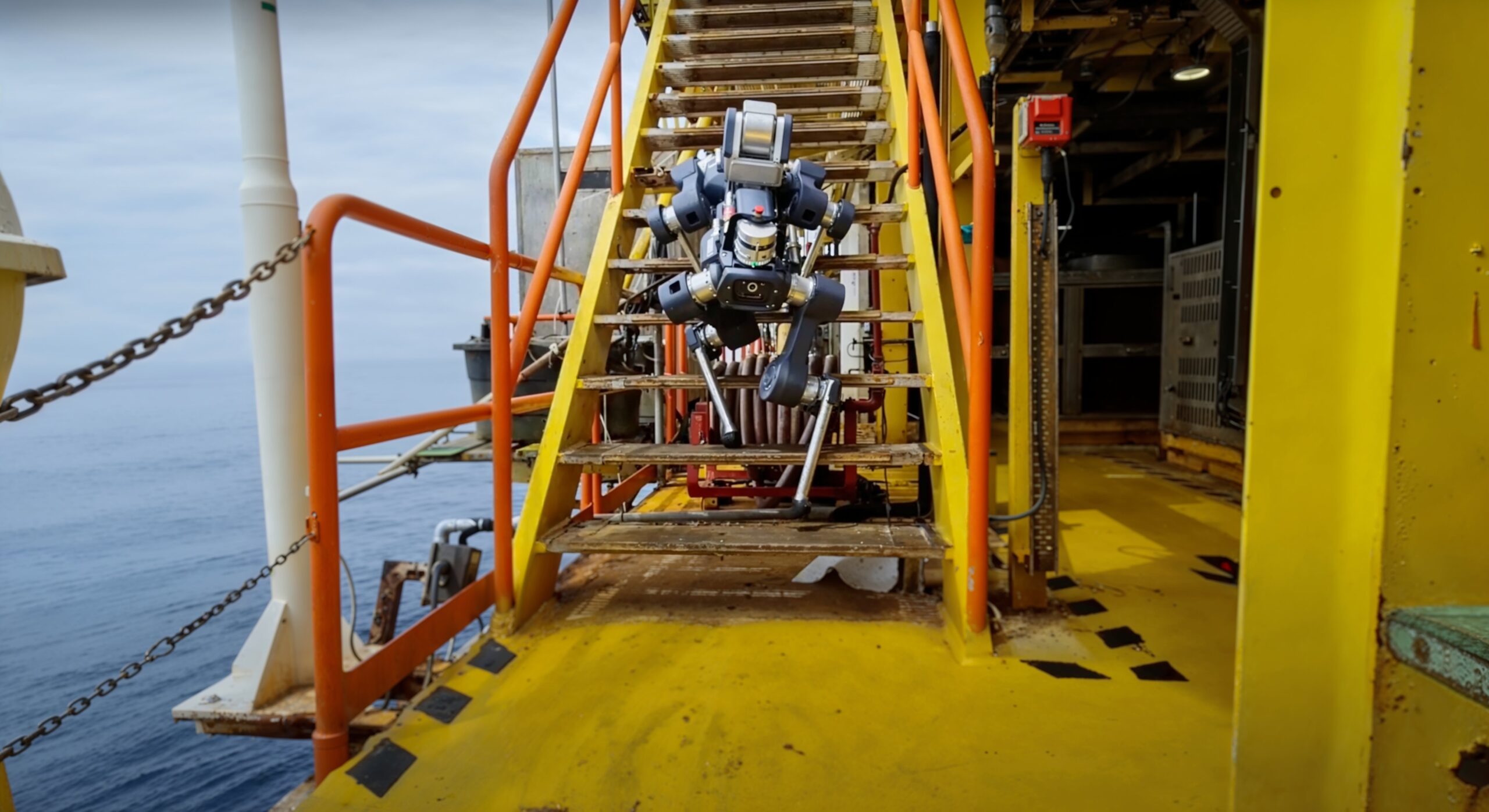
Image: AnymalX-robot-inspection-offshore.jpg | Own work | License: CC BY-SA 4.0 | Source: Wikimedia | https://commons.wikimedia.org/wiki/File:AnymalX-robot-inspection-offshore.jpg