The company behind the chips everyone else depends on
TSMC is one of the most important companies in the global economy, and also one of the least visible. Most people will never buy a TSMC product directly because TSMC does not make consumer devices, sell cloud services, or design branded processors for retail shelves. Instead, it manufactures chips for other companies—Apple, Nvidia, AMD, Qualcomm, Broadcom, and a long list of others that shape modern computing.
That business model sounds narrow until you understand what it actually means. In semiconductors, manufacturing excellence is not a back-office function. It is the product. The company that can print smaller, faster, more power-efficient transistors at high volume effectively sets the pace for the rest of the industry. That is why TSMC matters so much: it is not simply a factory. It is the industrial engine behind the most advanced computing systems on earth.
Why the foundry model won
TSMC did not become dominant by trying to do everything. It focused on one job: manufacturing chips for customers that design their own silicon. That is the foundry model, and TSMC helped turn it from a niche concept into the standard architecture of the modern chip industry.
The logic is straightforward. Chip design is expensive and specialized. Chip manufacturing is even more expensive, capital intensive, and operationally unforgiving. A company like Apple or Nvidia can create differentiated products by controlling architecture, software integration, and system design, while outsourcing the physical production to a manufacturer with world-class process expertise. That division of labor lets designers move faster and lets TSMC concentrate capital and talent on a single mission: making fabs more advanced, more efficient, and more reliable.
This specialization created a flywheel. As more top-tier customers sent work to TSMC, the company gained scale. As it gained scale, it could justify enormous investments in lithography tools, process development, packaging, and factory capacity. As its process technology improved, more customers came aboard. Over time, TSMC became not just a supplier but the default manufacturing platform for the leading edge of computing.
Advanced nodes are the real moat
TSMC’s power comes from its ability to manufacture at advanced process nodes—terms like 7nm, 5nm, 3nm, and beyond. These numbers are no longer literal measurements of transistor size, but they still signal progress in density, performance, and energy efficiency. In practical terms, advanced nodes help chips do more work while using less power, which is critical for smartphones, AI accelerators, and data center hardware.
At the high end, the difference between a strong process node and a lagging one is strategic, not cosmetic. A better node can mean a faster smartphone battery life, a cooler laptop, a more efficient server, or a GPU that can fit more compute into the same power envelope. It can also determine who gets access to the most advanced AI hardware in the first place. When the world is racing to build bigger AI systems, manufacturing throughput becomes a bottleneck as important as chip design itself.
This is where TSMC’s lead becomes difficult to challenge. Advanced semiconductors require extraordinary process control, defect management, materials science, and equipment orchestration. It is not enough to own the latest machines from ASML or other suppliers. The company must integrate thousands of steps into a repeatable industrial system, with yields high enough to make production economically viable. That combination of scale, precision, and consistency is what competitors struggle to match.
TSMC, Nvidia, Apple, and the new hierarchy of tech power
TSMC sits at the center of several of the most consequential relationships in technology. Apple relies on TSMC to manufacture the chips that power its iPhones, Macs, and other devices. Nvidia relies on TSMC for the advanced AI accelerators that drive the current data center buildout. AMD, Broadcom, and many other chip designers also depend on it for leading-edge fabrication.
These are not ordinary vendor relationships. TSMC’s customers are often among the most valuable companies in the world, but they cannot build their most important products without access to TSMC’s capacity and process technology. That creates a subtle but profound shift in power. Design brands may own the customer relationship, the software stack, and the product experience, but the manufacturing roadmap still runs through a single company in Taiwan.
That concentration matters more now than it did a decade ago. AI demand has made leading-edge chips a strategic asset. Cloud providers need them for training and inference. Consumer electronics companies need them for premium devices. Automotive and industrial companies increasingly need them for advanced compute, sensor fusion, and power management. In that environment, TSMC is not just one supplier among many. It is the gatekeeper to the most valuable layer of the semiconductor stack.
Why Taiwan is part of the story, not just the location
Any analysis of TSMC has to include geography. The company is based in Taiwan, and that fact has major implications for global industry and geopolitics. Taiwan’s role in semiconductors is often described as a “silicon shield,” meaning the island’s centrality to chip manufacturing may raise the costs of conflict and increase the world’s incentive to preserve stability. Whether that theory fully holds is debated, but the strategic reality is clear: the concentration of leading-edge chip manufacturing in Taiwan is now a matter of global concern.
TSMC has been expanding fabrication capacity outside Taiwan, including in the United States and elsewhere, but moving this kind of manufacturing is slow and expensive. Advanced fabs depend on a dense ecosystem of suppliers, engineers, cleanroom expertise, and local operational know-how. A chip factory is not like a generic industrial plant that can be replicated on demand. It is a highly tuned organism whose performance depends on coordination at every level.
This creates resilience challenges for customers and governments alike. Even modest disruptions—natural disasters, logistics shocks, energy constraints, export controls, or geopolitical tensions—can ripple through supply chains that depend on TSMC’s output. For industries built on just-in-time inventory and rapid product cycles, that risk is now a permanent part of strategic planning.
The hidden advantage: packaging, scale, and execution
TSMC’s story is often reduced to process nodes, but that misses an important part of the company’s edge. Modern chip performance is increasingly shaped not just by transistor scale but also by advanced packaging and chiplet integration. As chips get harder to shrink economically, the industry is moving toward systems made from multiple dies packaged together and connected with very high bandwidth. This is especially important for AI accelerators and high-performance computing products.
TSMC has invested heavily in these adjacent capabilities because the future of chip manufacturing is not just about making smaller transistors. It is about assembling heterogeneous systems efficiently, with memory, logic, and interconnect optimized together. That expands TSMC’s role from pure manufacturer to systems enabler. Customers do not just come to TSMC for wafers; they come for a platform that can turn design intent into working silicon at scale.
Execution is the real moat here. Semiconductor manufacturing is full of companies with grand roadmaps and limited production credibility. TSMC’s reputation rests on delivering on schedule, at volume, and with yields that make cutting-edge chips commercially practical. In a sector where delays can cost billions and product windows are unforgiving, reliability is a strategic asset.
What TSMC means for the next phase of computing
As AI, robotics, autonomous systems, and industrial automation demand more compute, the semiconductor industry is shifting from a device market to a full-stack infrastructure market. The limiting factors are no longer only design ingenuity or demand creation. They are power, capacity, packaging, supply chain discipline, and manufacturing precision. TSMC sits at the intersection of all of those constraints.
That means the company’s influence will likely grow, even if the industry becomes more diversified over time. Competitors will keep trying to close the gap. Governments will keep pushing for domestic manufacturing capacity. Customers will keep looking for more resilience and more bargaining power. But the underlying economics of advanced semiconductor production still reward the company that can combine scale, process leadership, and operational discipline better than anyone else.
TSMC is, in effect, a control point for the digital economy. It does not own the most famous consumer brands, but it enables them. It does not dominate public conversation, but it shapes the hardware underneath nearly every major computing platform. And in an era when advanced chips increasingly determine the winners in AI, cloud, mobile, and high-performance computing, that makes TSMC not just important, but foundational.
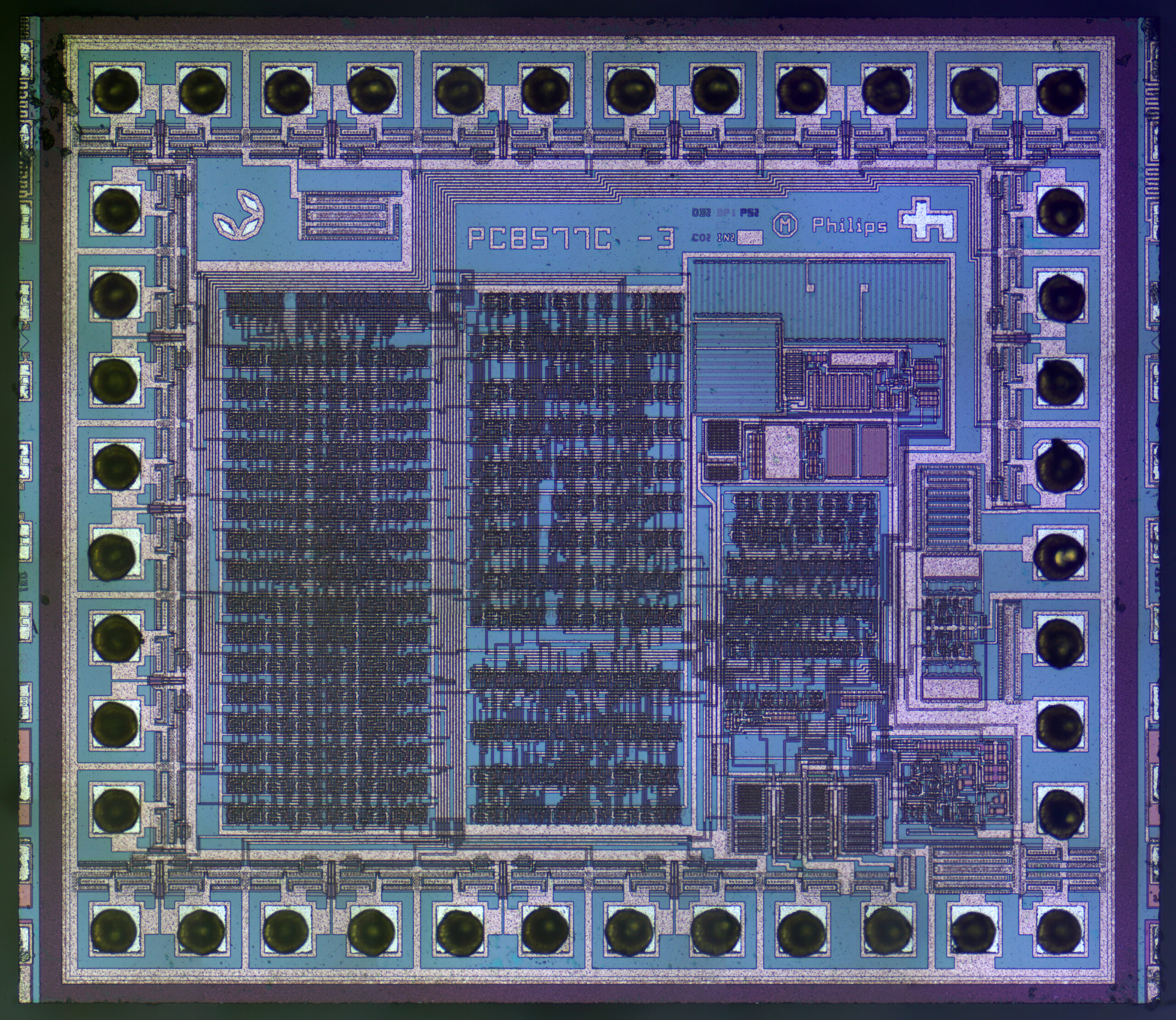
Image: NXP PCF8577C LCD driver with I²C (Colour Corrected).jpg | https://www.flickr.com/photos/187597251@N05/49899342293/ | License: CC BY-SA 2.0 | Source: Wikimedia | https://commons.wikimedia.org/wiki/File:NXP_PCF8577C_LCD_driver_with_I%C2%B2C_(Colour_Corrected).jpg