Collaborative robots, or cobots, are often introduced as the friendly face of automation: compact robot arms working safely beside people, easy to program, useful in small factories, and flexible enough to move from one task to another. That pitch is accurate as far as it goes, but it misses the more important point. Cobots matter because they solve a very specific industrial constraint: how to automate work that is too variable, too space-constrained, or too economically marginal for a traditional industrial robot cell.
In other words, cobots are not replacing the old model of automation. They are filling the gaps in it.
What a cobot actually is
A cobot is a robot designed to work in proximity to humans, often without the hard physical separation required by conventional industrial robots. That usually means built-in force limits, torque sensing, speed controls, collision detection, and software designed for simpler setup. The goal is not to make the robot “safe” in some abstract sense. The goal is to make it safe enough to operate in a shared workspace under defined conditions.
This distinction matters because a standard industrial robot can be extremely fast, strong, and precise, but it generally needs cages, light curtains, interlocks, and dedicated safety engineering around it. Cobots trade some of that raw throughput for easier integration into human-centered workflows. In many cases, that tradeoff is exactly what makes them economically viable.
Where cobots fit in the automation stack
The best way to think about cobots is as a mid-stack automation tool. They sit between purely manual labor and heavily engineered automation cells. They are not usually the answer to the highest-volume, lowest-variation task on a factory floor, where a traditional robot arm and conveyor system can run at full speed around the clock. Nor are they the answer to tasks that require highly complex dexterity and judgment. Their sweet spot is somewhere in between.
That sweet spot includes repetitive but variable tasks such as machine tending, packaging, palletizing small loads, screwdriving, inspection support, kitting, and pick-and-place operations. In these environments, a cobot can take over the most physically repetitive part of the work while a human handles exceptions, quality judgment, and changeovers. That division of labor is often the real productivity gain.
For operators, the appeal is workflow continuity. A cobot can be placed near a CNC machine, injection molding press, test station, or packaging line and handle the unglamorous but necessary material movement that otherwise forces workers into constant motion. In a labor market where retention, ergonomics, and flexibility matter more each year, that can be a decisive advantage.
Why cobots took off now
Cobots are not new, but their adoption has accelerated because manufacturing has changed around them. Factories are under pressure to produce more variants in smaller batches. Supply chains are less predictable. Product lifecycles are shorter. At the same time, plants face labor shortages, higher turnover, and rising pressure to reduce injuries tied to repetitive motion.
Traditional automation works best when the process is stable, high-volume, and worth the capital expense of custom engineering. But many modern production environments do not look like that. They need automation that can be installed faster, reconfigured more easily, and justified at a smaller scale. Cobots fit that shift.
There is also a labor economics angle. A cobot is often attractive not because it eliminates a person’s job, but because it makes one person more productive across multiple stations. Instead of dedicating staff to monotonous loading and unloading, a plant can redeploy workers to oversight, setup, and exception handling. That can improve output without requiring a full redesign of the line.
The engineering tradeoffs behind the promise
The “collaborative” label can obscure the fact that cobots are constrained machines. Their safety features limit speed, payload, reach, and sometimes precision under dynamic loads. In practice, this means a cobot may be ideal for handling light parts, tending a single machine, or assisting in low-speed packaging, but less suitable for heavy palletizing or high-throughput assembly.
That constraint is not a weakness so much as the core design choice. Once you remove the need for a full fenced-off cell, you also accept lower performance ceilings. The engineering challenge is balancing safety and productivity so the robot can work near people without becoming so slow that it loses the automation case.
Integration is another hidden cost. Even a “plug-and-play” cobot still needs end effectors, fixtures, part presentation, vision systems in many cases, and software tuned to the actual workflow. A robot arm is not the same thing as a deployed automation system. The value comes from the whole stack: arm, gripper, sensors, safety logic, and the industrial process around it.
Why vision and software matter as much as the arm
Modern cobots increasingly depend on machine vision and better control software. In simple jobs, a cobot can repeat a fixed motion from a known position. But factories rarely stay that clean for long. Parts shift, bins get messy, tolerances vary, and upstream processes drift. Vision systems help cobots locate parts and adapt to that variability. Better software helps operators teach tasks without deep robotics expertise.
This is where the market has shifted. The most important innovation in cobots is not the arm itself. It is the reduction in the friction required to deploy it. If a line supervisor or technician can program a task in hours instead of weeks, the robot becomes a practical tool rather than a special project. That reduction in integration overhead is often more valuable than a small improvement in speed or payload.
For industrial buyers, this also changes procurement logic. Instead of asking whether a line deserves a large automation project, they can ask whether one workflow bottleneck can be relieved quickly enough to justify the spend. That makes cobots easier to deploy in small and mid-sized factories, where capital budgets are tighter and engineering teams are smaller.
What cobots do not solve
Cobots are not a universal automation answer. They are not ideal for ultra-high-speed production, high-payload material handling, or tasks that require fine human-level dexterity across unpredictable environments. They also do not erase the need for good process design. If parts are poorly fixtured, if upstream variability is extreme, or if the line layout is chaotic, a cobot will not magically fix the system.
This is why the most successful cobot deployments are usually unglamorous. They are targeted. They remove one bottleneck, one repetitive motion, or one awkward transfer step. They work because they are inserted into a process that has been thought through, not because they are general-purpose labor substitutes.
Why cobots matter beyond the factory floor
As automation spreads, cobots point to a broader shift in industrial computing and robotics: the value is moving from isolated machines toward systems that can be deployed in real workflows with minimal disruption. That means easier programming, safer human-machine interaction, better sensing, and tighter integration with production software.
For manufacturers, the significance is practical. Cobots can help absorb labor shortages, improve ergonomics, and create more resilient operations. For the robotics industry, they represent a demand signal: the next phase of automation is not just about making robots stronger or faster. It is about making them easier to install, safer to share space with, and more useful in the messy middle of real production.
That is why cobots matter. They are not a showroom product. They are an answer to a workflow constraint.
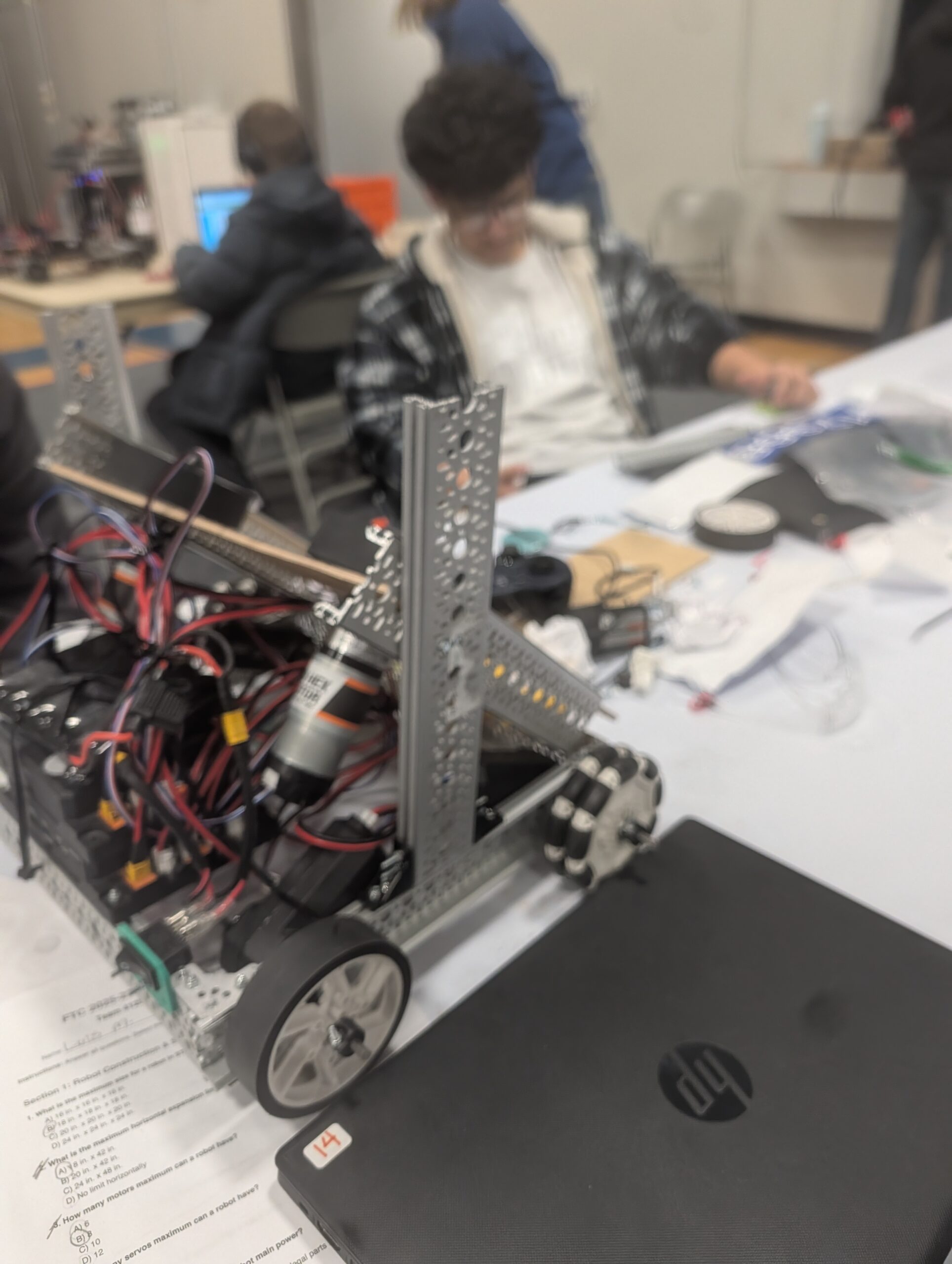
Image: A VEX model constructed by high school student robotics competition.jpg | Own work | License: CC BY 4.0 | Source: Wikimedia | https://commons.wikimedia.org/wiki/File:A_VEX_model_constructed_by_high_school_student_robotics_competition.jpg